Bristol Genetic Epidemiology Laboratory (BGEL), MRC Centre for Causal Analyses in Translational Epidemiology (MRC CAiTE), School of Social and Community Medicine, University of Bristol, Oakfield House, Oakfield Grove, Clifton BS8 2BN, UK.
Gene. 2012 May 10;499(1):8-13. doi: 10.1016/j.gene.2012.03.034. Epub 2012 Mar 11.
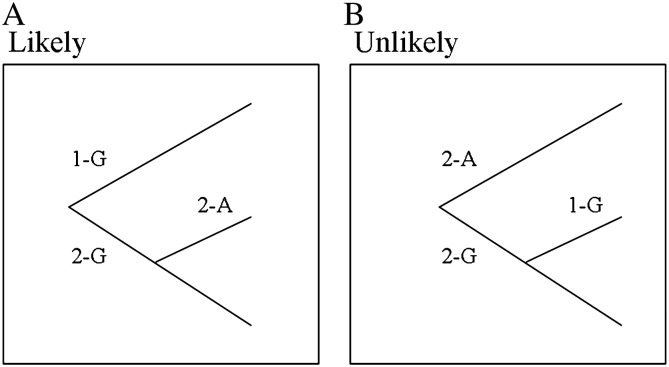
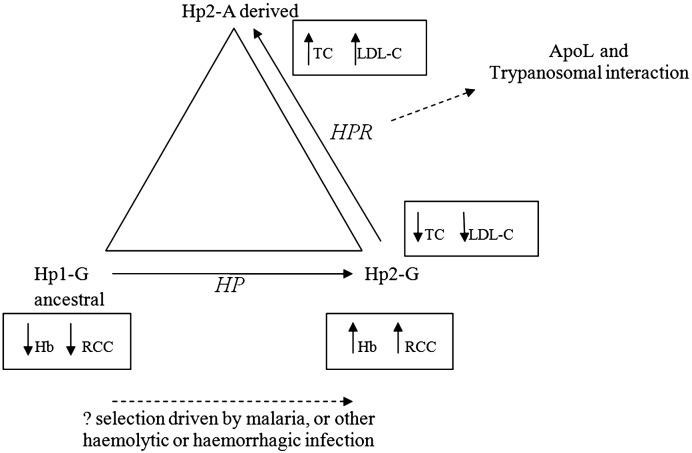
HP and HPR are related and contiguous genes in strong linkage disequilibrium (LD), encoding haptoglobin and haptoglobin-related protein. These bind and chaperone free Hb for recycling, protecting against oxidation. A copy number variation (CNV) within HP (Hp1/Hp2) results in different possible haptoglobin complexes which have differing properties. HPR rs2000999 (G/A), identified in meta-GWAS, influences total cholesterol (TC) and LDL-cholesterol (LDL-C). We examined the relationship between HP CNV, HPR rs2000999, Hb, red cell count (RCC), LDL-C and TC in the British Women's Heart and Health Study (n=2779 for samples having CNV, rs2000999, and phenotypes). Analysing single markers by linear regression, rs2000999 was associated with LDL-C (β=0.040 mmol/L, p=0.023), TC (β=-0.040 mmol/L, p=0.019), Hb (β=-0.044 g/dL, p=0.028) and borderline with RCC (β=-0.032 × 10(12)/L, p=0.066). Analysis of CNV by linear regression revealed an association with Hb (Hp1 vs Hp2, β=0.057 g/dL, p=0.004), RCC (β=0.045 × 10(12)/L, p=0.014), and showed a trend with LDL-C and TC. There were 3 principal haplotypes (Hp1-G 36%; Hp2-G 45%; Hp2-A 18%). Haplotype comparisons showed that LDL-C and TC associations were from rs2000999; Hb and RCC associations derived largely from the CNV. Distinct genotype-phenotype effects are evident at the genetic epidemiological level once LD has been analysed, perhaps reflecting HP-HPR functional biology and evolutionary history. The derived Hp2 allele of the HP gene has apparently been subject to malaria-driven positive selection. Haptoglobin-related protein binds Hb and apolipoprotein-L, i.e. linking HPR to the cholesterol system; and the HPR/apo-L complex is specifically trypanolytic. Our analysis illustrates the complex interplay between functions and haplotypes of adjacent genes, environmental context and natural selection, and offers insights into potential use of haptoglobin or haptoglobin-related protein as therapeutic agents.
HP 和 HPR 是紧密连锁的基因,存在强连锁不平衡(LD),编码触珠蛋白和触珠蛋白相关蛋白。这些蛋白结合并伴侣游离的 Hb 进行再循环,防止氧化。HP 内的拷贝数变异(CNV)(Hp1/Hp2)导致不同可能的触珠蛋白复合物具有不同的性质。在荟萃 GWAS 中鉴定的 HPR rs2000999(G/A)影响总胆固醇(TC)和 LDL-胆固醇(LDL-C)。我们在英国妇女心脏和健康研究(n=2779,用于具有 CNV、rs2000999 和表型的样本)中研究了 HP CNV、HPR rs2000999、Hb、红细胞计数(RCC)、LDL-C 和 TC 之间的关系。通过线性回归分析单个标记物,rs2000999 与 LDL-C(β=0.040mmol/L,p=0.023)、TC(β=-0.040mmol/L,p=0.019)、Hb(β=-0.044g/dL,p=0.028)相关,与 RCC 呈边缘相关(β=-0.032×10(12)/L,p=0.066)。通过线性回归分析 CNV 发现与 Hb(Hp1 与 Hp2,β=0.057g/dL,p=0.004)、RCC(β=0.045×10(12)/L,p=0.014)相关,并与 LDL-C 和 TC 呈趋势相关。有 3 个主要单倍型(Hp1-G36%;Hp2-G45%;Hp2-A18%)。单倍型比较显示 LDL-C 和 TC 关联来自 rs2000999;Hb 和 RCC 关联主要来自 CNV。一旦分析了 LD,在遗传流行病学水平上就可以明显看出不同的基因型-表型效应,这可能反映了 HP-HPR 的功能生物学和进化历史。HP 基因的衍生 Hp2 等位基因显然受到疟疾驱动的正选择。触珠蛋白相关蛋白结合 Hb 和载脂蛋白-L,即 HPR 与胆固醇系统相关;HPR/apo-L 复合物是专门的抗锥虫剂。我们的分析说明了相邻基因的功能和单倍型、环境背景和自然选择之间的复杂相互作用,并提供了关于触珠蛋白或触珠蛋白相关蛋白作为治疗剂的潜在用途的见解。