Pechlaner Raimund, Kiechl Stefan, Willeit Peter, Demetz Egon, Haun Margot, Weger Siegfried, Oberhollenzer Friedrich, Kronenberg Florian, Bonora Enzo, Weiss Günter, Willeit Johann
Department of Neurology, Medical University Innsbruck, Innsbruck, Austria (R.P., S.K., P.W., J.W.).
Department of Neurology, Medical University Innsbruck, Innsbruck, Austria (R.P., S.K., P.W., J.W.) Department of Public Health and Primary Care, University of Cambridge, Cambridge, United Kingdom (P.W.).
J Am Heart Assoc. 2014 May 16;3(3):e000732. doi: 10.1161/JAHA.113.000732.
Haptoglobin (Hp) is an abundant plasma protein with antioxidant properties. The Hp 2-2 genotype has previously been linked to coronary heart disease risk in individuals with elevated glycosylated hemoglobin (HbA1c). We investigated the association of Hp and HbA1c with cardiovascular disease (CVD) in the longitudinal, population-based Bruneck Study.
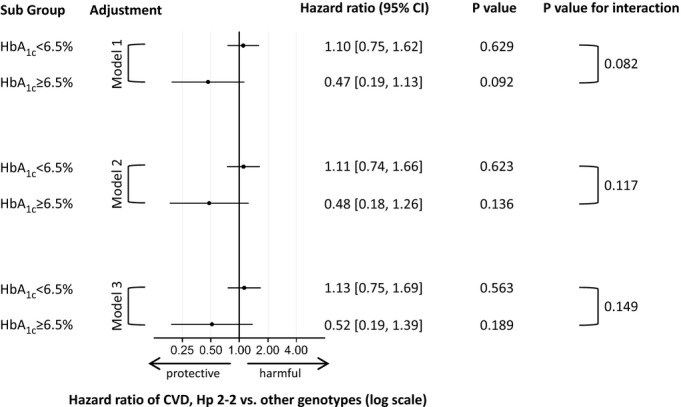
Hp genotype was determined by polymerase chain reaction according to standard procedures and HbA1c concentration by a Diabetes Control and Complications Trial-aligned assay. HbA1c was measured in 1995, 2000, and 2005. Occurrence of the combined CVD endpoint of myocardial infarction or stroke was recorded between 1995 and 2010. Outcome analyses employed the Cox proportional hazards model with HbA1c category as time-varying covariate. At baseline in 1995, 806 subjects (male sex, 49.3%; age, mean ± standard deviation, 62.70 ± 11.08 years) were included. During follow-up, 123 subjects experienced at least 1 CVD event (48 suffered myocardial infarction, 68 stroke, and 7 both). Among subjects with HbA1c ≥ 6.5% (≥ 48 mmol/mol), those with the Hp 2-2 genotype did not show an elevated risk of incident CVD compared with those with other genotypes (age- and sex-adjusted hazard ratio [95% CI], 0.47 [0.19, 1.13], P=0.092) and a null association was also observed in subjects with HbA1c<6.5% (1.10 [0.75, 1.62], P=0.629) (P for interaction=0.082).
Subjects with the Hp 2-2 genotype and elevated HbA1c compared with subjects with other Hp genotypes and elevated HbA1c did not show increased CVD risk.
触珠蛋白(Hp)是一种具有抗氧化特性的丰富血浆蛋白。此前,Hp 2-2基因型与糖化血红蛋白(HbA1c)升高的个体患冠心病的风险有关。我们在基于人群的纵向布伦内克研究中调查了Hp和HbA1c与心血管疾病(CVD)的关联。
根据标准程序通过聚合酶链反应确定Hp基因型,并通过与糖尿病控制与并发症试验一致的检测方法测定HbA1c浓度。分别于1995年、2000年和2005年测量HbA1c。记录1995年至2010年间心肌梗死或中风这一联合CVD终点事件的发生情况。结局分析采用Cox比例风险模型,将HbA1c类别作为随时间变化的协变量。1995年基线时纳入了806名受试者(男性占49.3%;年龄,均值±标准差,62.70±11.08岁)。随访期间,123名受试者经历了至少1次CVD事件(48例发生心肌梗死,68例中风,7例两者皆有)。在HbA1c≥6.5%(≥48 mmol/mol)的受试者中,与其他基因型受试者相比,Hp 2-2基因型受试者发生CVD的风险并未升高(年龄和性别调整后的风险比[95%CI],0.47[0.19,1.13],P=0.092),在HbA1c<6.5%的受试者中也观察到无关联(1.10[0.75,1.62],P=0.629)(交互作用P=0.082)。
与其他Hp基因型且HbA1c升高的受试者相比,Hp 2-2基因型且HbA1c升高的受试者并未表现出CVD风险增加。