School of Health and Social Care, University of Greenwich, London, UK.
BMC Health Serv Res. 2012 Mar 21;12:71. doi: 10.1186/1472-6963-12-71.
When it was initiated in 2001, England's national patient survey programme was one of the first in the world and has now been widely emulated in other healthcare systems. The aim of the survey programme was to make the National Health Service (NHS) more "patient centred" and more responsive to patient feedback. The national inpatient survey has now been running in England annually since 2002 gathering data from over 600,000 patients. The aim of this study is to investigate how the data have been used and to summarise what has been learned about patients' evaluation of care as a result.
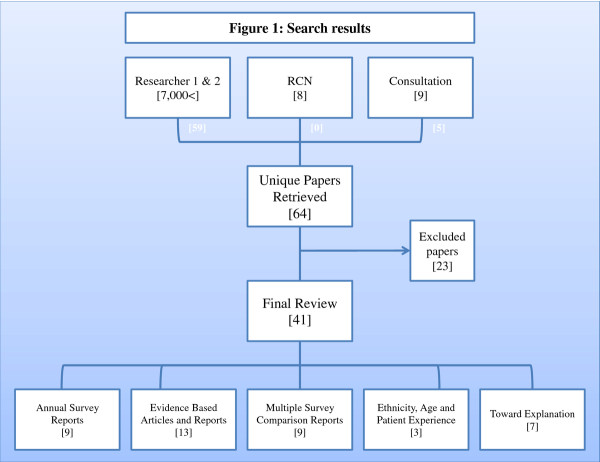
Two independent researchers systematically gathered all research that included analyses of the English national adult inpatient survey data. Journals, databases and relevant websites were searched. Publications prior to 2002 were excluded. Articles were also identified following consultation with experts. All documents were then critically appraised by two co-authors both of whom have a background in statistical analysis.
We found that the majority of the studies identified were reports produced by organisations contracted to gather the data or co-ordinate the data collection and used mainly descriptive statistics. A few articles used the survey data for evidence based reporting or linked the survey to other healthcare data. The patient's socio-demographic characteristics appeared to influence their evaluation of their care but characteristics of the workforce and the. At a national level, the results of the survey have been remarkably stable over time. Only in those areas where there have been co-ordinated government-led campaigns, targets and incentives, have improvements been shown. The main findings of the review are that while the survey data have been used for different purposes they seem to have incited little academic interest.
The national inpatient survey has been a useful resource for many authors and organisations but the full potential inherent in this large, longitudinal publicly available dataset about patients' experiences has not as yet been fully exploited.This review suggests that the presence of survey results alone is not enough to improve patients' experiences and further research is required to understand whether and how the survey can be best used to improve standards of care in the NHS.
2001 年启动时,英格兰国家患者调查项目是世界上最早的项目之一,现已在其他医疗保健系统中广泛效仿。该调查项目的目的是使国民保健制度(NHS)更加“以患者为中心”,并对患者反馈做出更积极的响应。自 2002 年以来,英国全国住院患者调查每年都在进行,从超过 60 万名患者那里收集数据。本研究旨在调查数据的使用情况,并总结从患者对护理的评估中学到的内容。
两名独立的研究人员系统地收集了所有分析英格兰成年住院患者全国调查数据的研究。检索了期刊、数据库和相关网站。排除了 2002 年之前发表的文章。还与专家协商确定了文章。然后,两位合著者(均具有统计学分析背景)对所有文件进行了批判性评估。
我们发现,确定的大多数研究都是受委托收集数据或协调数据收集的组织编写的报告,主要使用描述性统计数据。少数文章使用调查数据进行循证报告,或将调查与其他医疗保健数据相关联。患者的社会人口统计学特征似乎影响他们对护理的评价,但劳动力和的特征也有影响。在国家一级,调查结果在时间上非常稳定。只有在政府主导的协调一致的运动、目标和激励措施的领域,才显示出改善。审查的主要发现是,尽管调查数据已用于不同目的,但似乎并没有引起学术界的太多兴趣。
全国住院患者调查对许多作者和组织来说是一个有用的资源,但尚未充分利用关于患者体验的这一大规模、纵向、公开可用数据集所固有的全部潜力。本审查表明,仅调查结果的存在不足以改善患者的体验,需要进一步研究以了解调查是否以及如何能够最好地用于提高国民保健制度的护理标准。