Department of Psychological Sciences, University of Missouri, Columbia, MO 65211, USA.
Personal Disord. 2013 Jan;4(1):33-42. doi: 10.1037/a0027361. Epub 2012 Mar 5.
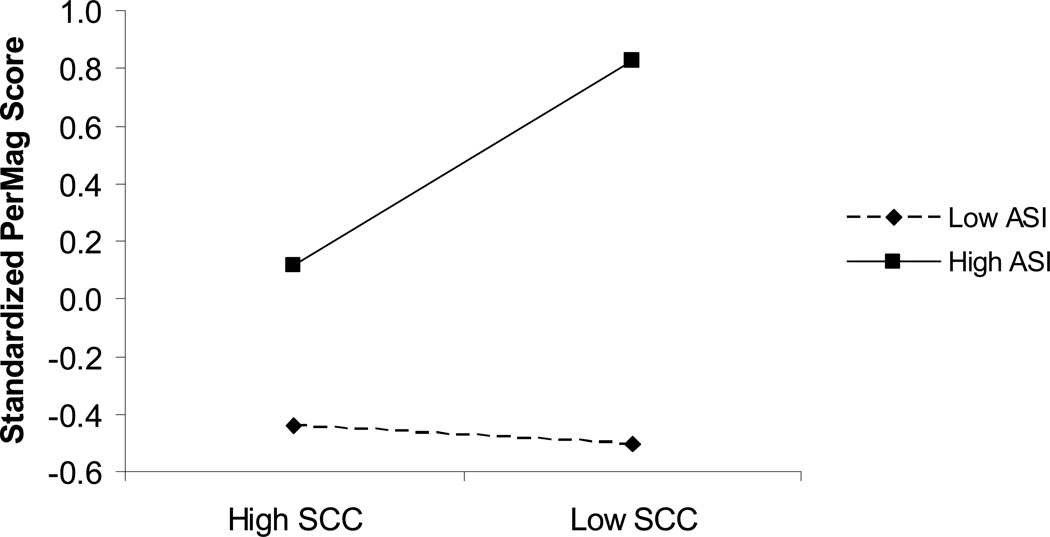
Most theories of psychotic-like experiences posit the involvement of cognitive mechanisms. The current research examined the relations between psychotic-like experiences and two cognitive mechanisms, high aberrant salience and low self-concept clarity. In particular, we examined whether aberrant salience, or the incorrect assignment of importance to neutral stimuli, and low self-concept clarity interacted to predict psychotic-like experiences. The current research included three large samples (n = 667, 724, 744) of participants and oversampled for increased schizotypal personality traits. In all three studies, an interaction between aberrant salience and self-concept clarity was found such that participants with high aberrant salience and low self-concept clarity had the highest levels of psychotic-like experiences. In addition, aberrant salience and self-concept clarity interacted to predict a supplemental measure of delusions in Study 2. In Study 3, in contrast to low self-concept clarity, neuroticism did not interact with aberrant salience to predict psychotic-like experiences, suggesting that the relation between low self-concept clarity and psychosis may not be a result of neuroticism. Additionally, aberrant salience and self-concept clarity did not interact to predict two other SPD criteria, social anhedonia or trait paranoia, which suggests the interaction is specific to psychotic-like experiences. Overall, our results are consistent with several cognitive models of psychosis suggesting that aberrant salience and self-concept clarity might be important mechanisms in the occurrence of psychotic-like symptoms.
大多数关于类精神病体验的理论都假设认知机制的参与。本研究考察了类精神病体验与两种认知机制(异常突显和自我概念清晰度低)之间的关系。特别是,我们检验了异常突显(即对中性刺激赋予错误的重要性)和自我概念清晰度低是否相互作用,从而预测类精神病体验。本研究包括三个大型样本(n=667、724、744)的参与者,并对具有较高精神分裂型人格特质的参与者进行了过度抽样。在所有三项研究中,都发现异常突显和自我概念清晰度之间存在交互作用,即具有高异常突显和低自我概念清晰度的参与者具有最高水平的类精神病体验。此外,异常突显和自我概念清晰度相互作用,预测了研究 2 中妄想的补充测量。在研究 3 中,与自我概念清晰度低相反,神经质与异常突显之间没有相互作用来预测类精神病体验,这表明自我概念清晰度低与精神病之间的关系可能不是神经质的结果。此外,异常突显和自我概念清晰度也没有相互作用来预测其他两个 SPD 标准,即社交快感缺失或特质妄想,这表明这种相互作用是特定于类精神病体验的。总体而言,我们的结果与几种精神病的认知模型一致,表明异常突显和自我概念清晰度可能是类精神病症状发生的重要机制。