CSIRO Petroleum, P.O. Box 1130, Bentley, WA, 6102, Australia; E-Mails:
Sensors (Basel). 2009;9(8):6232-53. doi: 10.3390/s90806232. Epub 2009 Aug 6.
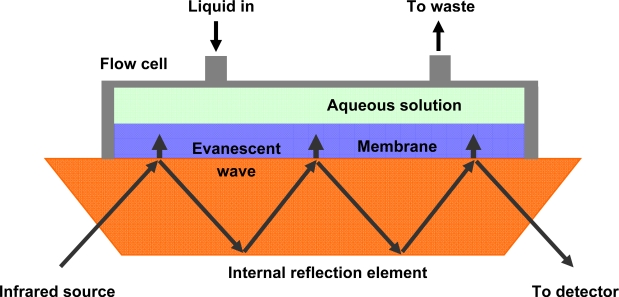
The development of chemical sensors for monitoring the levels of organic pollutants in the aquatic environment has received a great deal of attention in recent decades. In particular, the mid-infrared (MIR) sensor based on attenuated total reflectance (ATR) is a promising analytical tool that has been used to detect a variety of hydrocarbon compounds (i.e., aromatics, alkyl halides, phenols, etc.) dissolved in water. It has been shown that under certain conditions the MIR-ATR sensor is capable of achieving detection limits in the 10-100 ppb concentration range. Since the infrared spectral features of every single organic molecule are unique, the sensor is highly selective, making it possible to distinguish between many different analytes simultaneously. This review paper discusses some of the parameters (i.e., membrane type, film thickness, conditioning) that dictate MIR-ATR sensor response. The performance of various chemoselective membranes which are used in the fabrication of the sensor will be evaluated. Some of the challenges associated with long-term environmental monitoring are also discussed.
近年来,用于监测水环境污染中有机污染物水平的化学传感器的发展受到了极大关注。特别是基于衰减全反射(ATR)的中红外(MIR)传感器是一种很有前途的分析工具,已被用于检测溶解在水中的各种碳氢化合物(即芳烃、卤代烷基、酚类等)。已经表明,在某些条件下,MIR-ATR 传感器能够达到 10-100 ppb 浓度范围内的检测限。由于每个有机分子的红外光谱特征都是独特的,因此传感器具有高度选择性,能够同时区分许多不同的分析物。本文综述了一些决定 MIR-ATR 传感器响应的参数(即膜类型、膜厚度、调节)。将评估用于制造传感器的各种化学选择性膜的性能。还讨论了与长期环境监测相关的一些挑战。