Programa de Nanomedicinas, Departamento de Ciencia y Tecnología, Universidad Nacional de Quilmes, Roque Saenz Peña 352, Bernal, Buenos Aires, Argentina.
Int J Nanomedicine. 2012;7:1373-85. doi: 10.2147/IJN.S28261. Epub 2012 Mar 12.
Molecules taken up by olfactory and trigeminal nerve neurons directly access the brain by the nose-to-brain pathway. In situ-forming mucoadhesive gels would increase the residence time of intranasal material, favoring the nose-to-brain delivery. In this first approach, brain radioactivity after intranasal administration of (32)P-small interference RNA (siRNA) complexed with poly(amidoamine) G7 dendrimers (siRNA dendriplexes) within in situ-forming mucoadhesive gels, was determined.
(32)P-siRNA dendriplexes were incorporated into in situ-forming mucoadhesive gels prepared by blending thermosensitive poloxamer (23% w/w) with mucoadhesive chitosan (1% w/w, PxChi) or carbopol (0.25% w/w, PxBCP). Rheological properties, radiolabel release profile, and local toxicity in rat nasal mucosa were determined. The best-suited formulation was intranasally administered to rats, and blood absorption and brain distribution of radioactivity were measured.
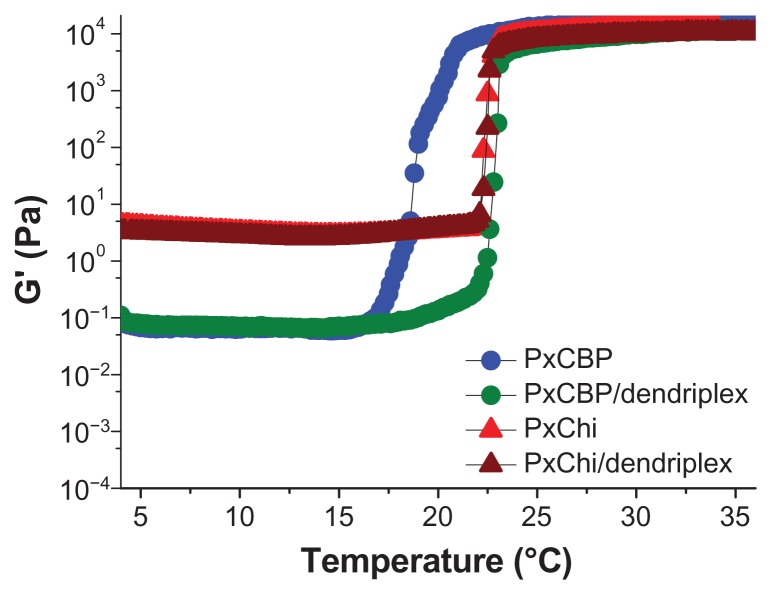
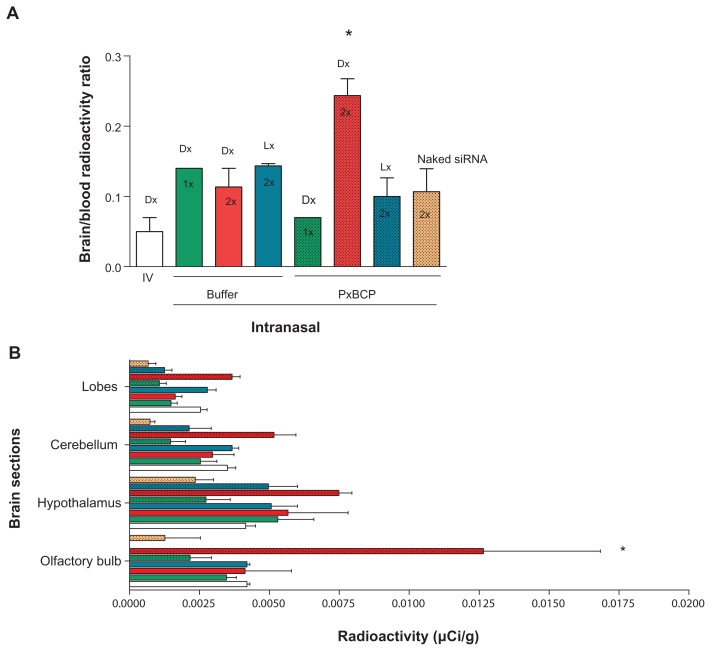
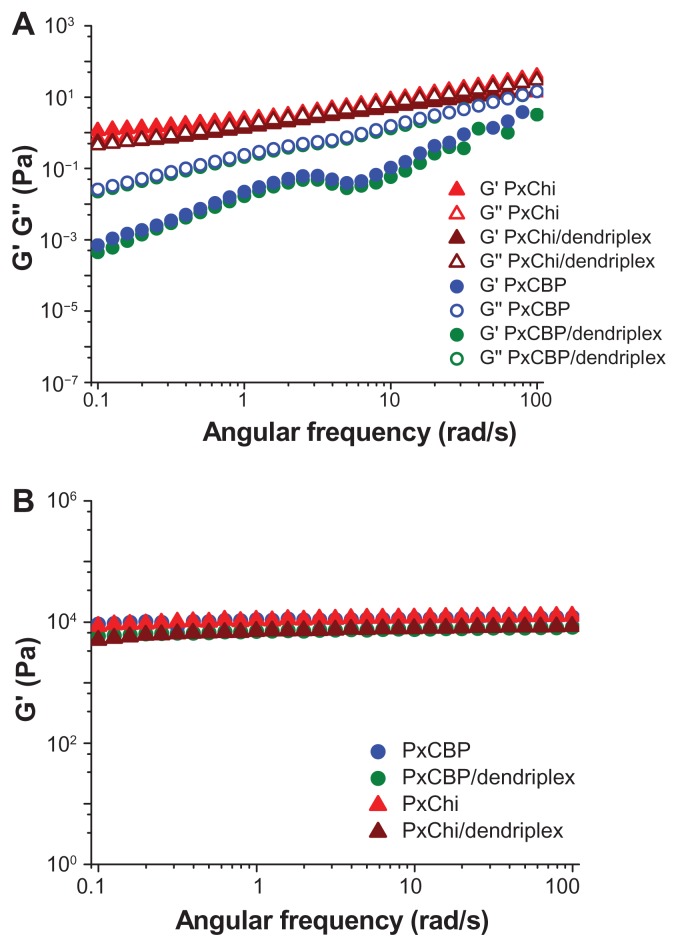
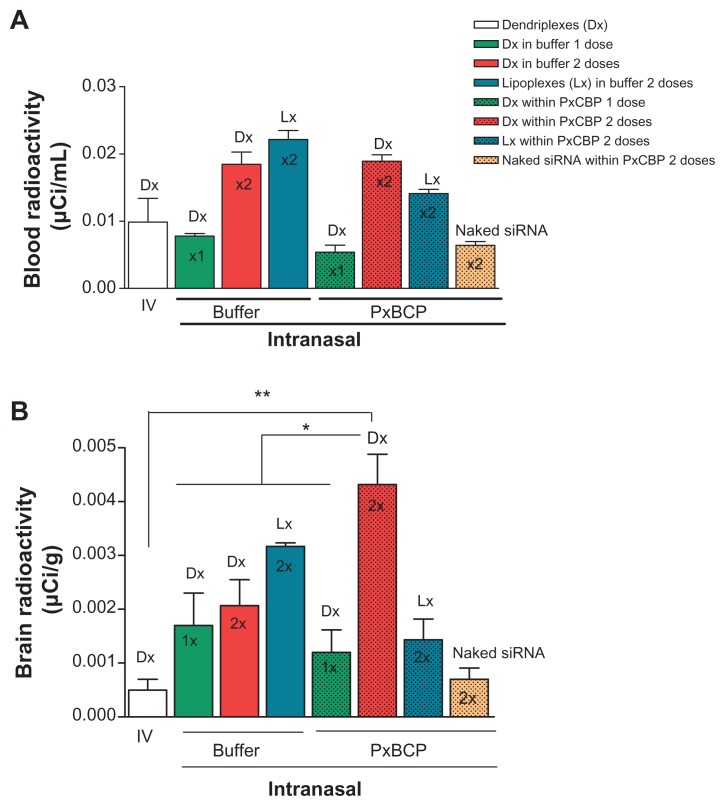
The gelation temperature of both formulations was 23°C. The PxChi liquid showed non-Newtonian pseudoplastic behavior of high consistency and difficult manipulation, and the gel retained 100% of radiolabel after 150 minutes. The PxCBP liquid showed a Newtonian behavior of low viscosity and easy manipulation, while in the gel phase showed apparent viscosity similar to that of the mucus but higher than that of aqueous solution. The gel released 35% of radiolabel and the released material showed silencing activity in vitro. Three intranasal doses of dendriplexes in PxCBP gel did not damage the rat nasal mucosa. A combination of (32)P-siRNA complexation with dendrimers, incorporation of the dendriplexes into PxCBP gel, and administration of two intranasal doses was necessary to achieve higher brain radioactivity than that achieved by intravenous dendriplexes or intranasal naked siRNA.
The increased radioactivity within the olfactory bulb suggested that the combination above mentioned favored the mediation of a direct brain delivery.
通过鼻腔-脑途径,嗅神经和三叉神经神经元摄取的分子可直接进入大脑。原位形成的黏膜黏附凝胶会增加鼻腔内物质的停留时间,有利于鼻腔-脑递药。在这一初步研究中,我们测定了(32)P-小干扰 RNA(siRNA)与聚(酰胺-胺) G7 树枝状聚合物(siRNA 树突状聚合物)形成复合物后,经鼻腔内给予原位形成的黏膜黏附凝胶中的放射性脑内分布。
(32)P-siRNA 树突状聚合物被掺入由热敏泊洛沙姆(23%w/w)与黏膜黏附性壳聚糖(1%w/w,PxChi)或卡波姆(0.25%w/w,PxBCP)混合而成的原位形成的黏膜黏附凝胶中。测定了流变学特性、放射性标记释放曲线和大鼠鼻腔黏膜的局部毒性。选择最合适的配方进行大鼠鼻腔内给药,并测定放射性脑内分布和血吸收情况。
两种配方的凝胶化温度均为 23°C。PxChi 液表现出高稠度的非牛顿假塑性伪塑性行为,操作困难,凝胶在 150 分钟后保留 100%的放射性标记物。PxCBP 液表现出低粘度的牛顿行为,易于操作,而在凝胶相中表现出与黏液相似的表观粘度,但高于水溶液。凝胶释放了 35%的放射性标记物,释放的物质在体外具有沉默活性。PxCBP 凝胶中的两剂三剂量树突聚合物不会损害大鼠鼻黏膜。siRNA 与树枝状聚合物的(32)P-siRNA 复合物的复合、将该复合物掺入 PxCBP 凝胶中以及两次鼻腔内给药的联合应用是实现比静脉内树突聚合物或鼻腔内裸 siRNA 更高的脑放射性所必需的。
嗅球内放射性增加提示上述联合应用有利于介导直接脑内递药。