Institute for Hygiene and National Consulting Laboratory on Hemolytic Uremic Syndrome, Münster, Germany.
Emerg Infect Dis. 2012 Apr;18(4):582-8. doi: 10.3201/eid1804.111414.
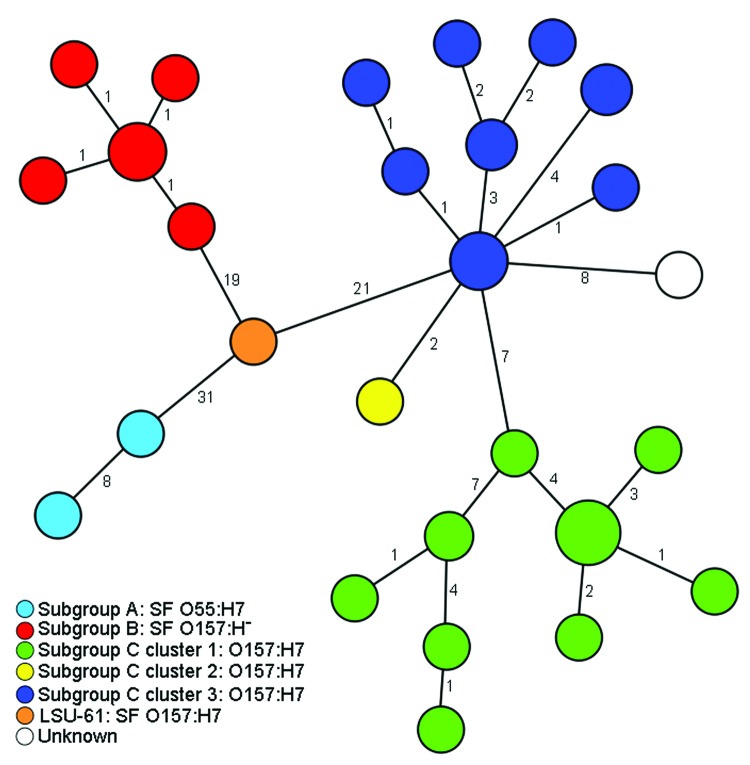
Highly pathogenic enterohemorrhagic Escherichia coli (EHEC) O157 cause a spectrum of clinical signs that include diarrhea, bloody diarrhea, and hemolytic uremic syndrome. The current evolutionary model of EHEC O157:H7/H(-) consists of a stepwise evolution scenario proceeding from O55:H7 to a node (hypothetical intermediate) that then branches into sorbitol-fermenting (SF) O157:H(-) and non-SF (NSF) O157:H7. To identify this hypothetical intermediate, we performed single nucleotide polymorphism analysis by sequencing of 92 randomly distributed backbone genomic regions of 40 O157:H7/H(-) isolates. Overall, 111 single nucleotide polymorphisms were identified in 75/92 partial open reading frames after sequencing 51,041 nt/strain. The EHEC O157:H7 strain LSU-61 from deer occupied an intermediate position between O55:H7 and both O157 branches (SF and NSF O157), complementing the stepwise evolutionary model of EHEC O157:H7/H(-). The animal origin of this intermediate emphasizes the value of nonhuman reservoirs in the clarification of the evolution of human pathogens.
高致病性肠出血性大肠杆菌(EHEC)O157 可引起一系列临床症状,包括腹泻、血便和溶血性尿毒综合征。EHEC O157:H7/H(-)的当前进化模型由一个逐步进化的情景组成,从 O55:H7 到一个节点(假设的中间),然后分支为山梨醇发酵(SF)O157:H(-)和非 SF(NSF)O157:H7。为了鉴定这个假设的中间物,我们对 40 株 O157:H7/H(-)分离株的 92 个随机分布的基因组主干区进行了单核苷酸多态性分析,通过测序 92 个随机分布的基因组主干区。在对 51041nt/株进行测序后,在 75/92 个部分开放阅读框中发现了 111 个单核苷酸多态性。鹿来源的 EHEC O157:H7 菌株 LSU-61 位于 O55:H7 和 O157 两个分支(SF 和 NSF O157)之间,补充了 EHEC O157:H7/H(-)的逐步进化模型。这种中间物的动物来源强调了非人类宿主在阐明人类病原体进化中的价值。