Mellmann Alexander, Andersen Paal Skytt, Bletz Stefan, Friedrich Alexander W, Kohl Thomas A, Lilje Berit, Niemann Stefan, Prior Karola, Rossen John W, Harmsen Dag
Institute of Hygiene, University Hospital Münster, Münster, Germany
Department of Microbiology and Infection Control, Statens Serum Institut (SSI), Copenhagen, Denmark.
J Clin Microbiol. 2017 Mar;55(3):908-913. doi: 10.1128/JCM.02242-16. Epub 2017 Jan 4.
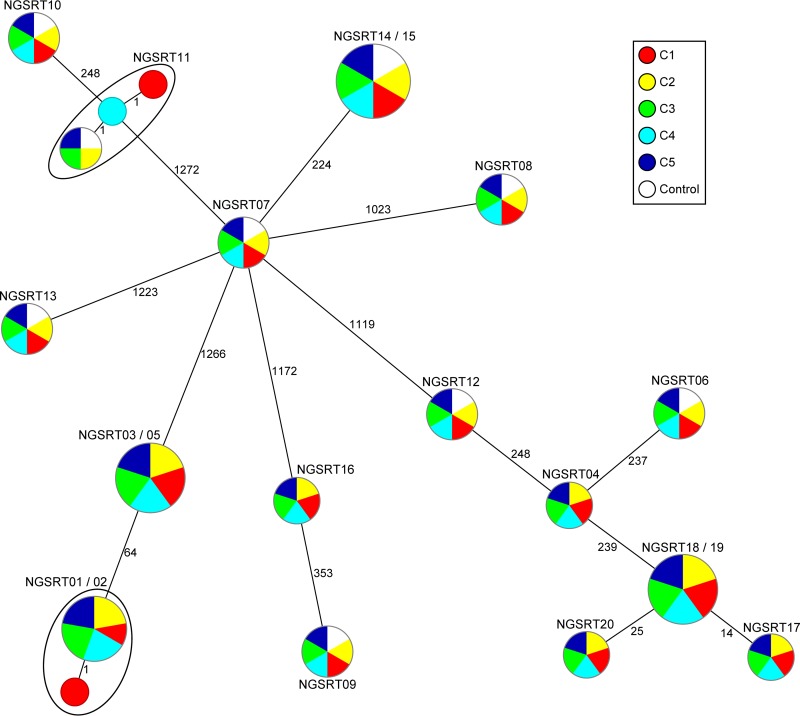
Today, next-generation whole-genome sequencing (WGS) is increasingly used to determine the genetic relationships of bacteria on a nearly whole-genome level for infection control purposes and molecular surveillance. Here, we conducted a multicenter ring trial comprising five laboratories to determine the reproducibility and accuracy of WGS-based typing. The participating laboratories sequenced 20 blind-coded DNA samples using 250-bp paired-end chemistry for library preparation in a single sequencing run on an Illumina MiSeq sequencer. The run acceptance criteria were sequencing outputs >5.6 Gb and Q30 read quality scores of >75%. Subsequently, spa typing, multilocus sequence typing (MLST), ribosomal MLST, and core genome MLST (cgMLST) were performed by the participants. Moreover, discrepancies in cgMLST target sequences in comparisons with the included and also published sequence of the quality control strain ATCC 25923 were resolved using Sanger sequencing. All five laboratories fulfilled the run acceptance criteria in a single sequencing run without any repetition. Of the 400 total possible typing results, 394 of the reported spa types, sequence types (STs), ribosomal STs (rSTs), and cgMLST cluster types were correct and identical among all laboratories; only six typing results were missing. An analysis of cgMLST allelic profiles corroborated this high reproducibility; only 3 of 183,927 (0.0016%) cgMLST allele calls were wrong. Sanger sequencing confirmed all 12 discrepancies of the ring trial results in comparison with the published sequence of ATCC 25923. In summary, this ring trial demonstrated the high reproducibility and accuracy of current next-generation sequencing-based bacterial typing for molecular surveillance when done with nearly completely locked-down methods.
如今,为了感染控制和分子监测目的,下一代全基因组测序(WGS)越来越多地用于在几乎全基因组水平上确定细菌的遗传关系。在此,我们开展了一项由五个实验室参与的多中心环形试验,以确定基于WGS分型的可重复性和准确性。参与实验室使用250bp双端化学法制备文库,在Illumina MiSeq测序仪上进行单次测序运行,对20个盲编码的DNA样本进行测序。运行验收标准为测序产量>5.6 Gb且Q30读段质量得分>75%。随后,参与者进行了spa分型、多位点序列分型(MLST)、核糖体MLST和核心基因组MLST(cgMLST)。此外,使用桑格测序法解决了与质控菌株ATCC 25923的已收录且已发表序列相比cgMLST靶序列中的差异。所有五个实验室在单次测序运行中均满足运行验收标准,无需任何重复。在总共400个可能的分型结果中,所有实验室报告的394个spa型、序列型(STs)、核糖体STs(rSTs)和cgMLST聚类类型是正确且一致的;仅6个分型结果缺失。对cgMLST等位基因谱的分析证实了这种高可重复性;在183,927个cgMLST等位基因调用中,只有3个(0.0016%)是错误的。桑格测序证实了环形试验结果与ATCC 25923已发表序列相比的所有12个差异。总之,这项环形试验表明,当采用几乎完全封闭的方法时,当前基于下一代测序的细菌分型用于分子监测具有高可重复性和准确性。