Vigneault Francois, Ter-Ovanesyan Dmitry, Alon Shahar, Eminaga Seda, C Christodoulou Danos, Seidman J G, Eisenberg Eli, M Church George
Department of Genetics, Harvard Medical School, Boston, Massachusetts.
Wyss Institute for Biologically Inspired Engineering, Boston, Massachusetts.
Curr Protoc Hum Genet. 2012 Apr;Chapter 11:11.12.1-11.12.10. doi: 10.1002/0471142905.hg1112s73.
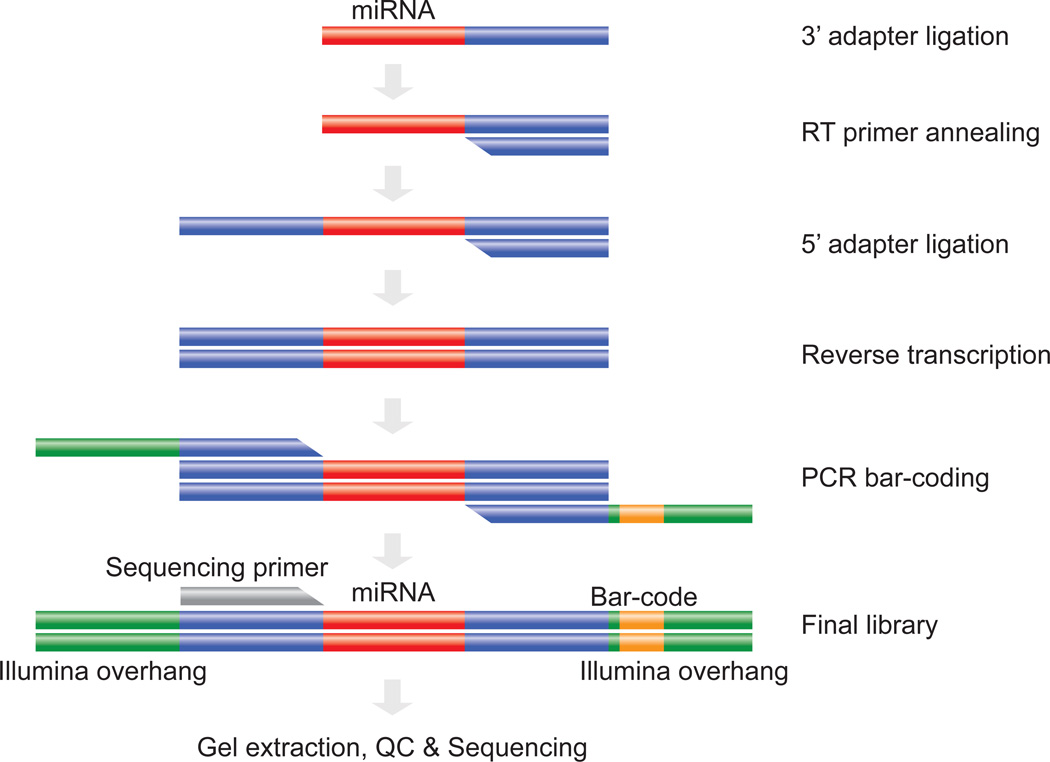
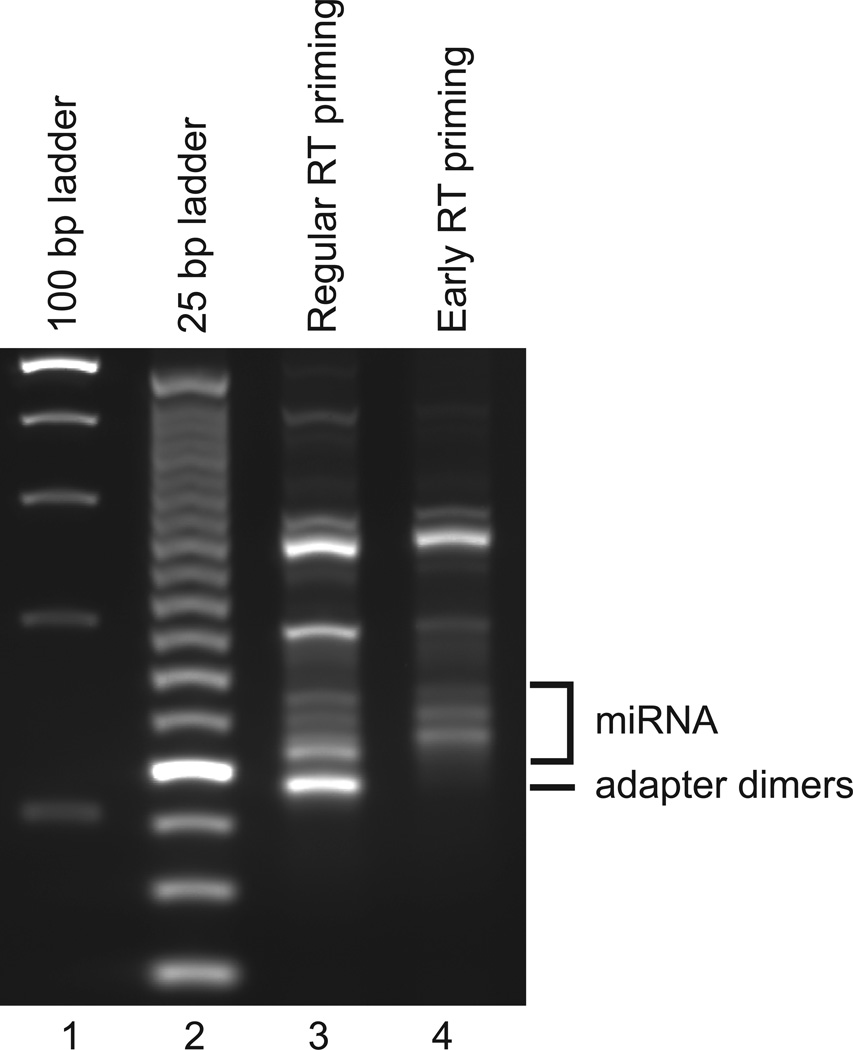
Next-generation sequencing offers many advantages over other methods of microRNA (miRNA) expression profiling, such as sample throughput and the capability to discover novel miRNAs. As the sequencing depth of current sequencing platforms exceeds what is necessary to quantify miRNAs, multiplexing several samples in one sequencing run offers a significant cost advantage. Although previous studies have achieved this goal by adding bar codes to miRNA libraries at the ligation step, this was recently shown to introduce significant bias into the miRNA expression data. This bias can be avoided, however, by bar coding the miRNA libraries at the PCR step instead. Here, we describe a user-friendly PCR bar-coding method of preparing multiplexed microRNA libraries for Illumina-based sequencing. The method also prevents the production of adapter dimers and can be completed in one day.
与其他微小RNA(miRNA)表达谱分析方法相比,新一代测序具有许多优势,例如样本通量以及发现新型miRNA的能力。由于当前测序平台的测序深度超过了定量miRNA所需的深度,因此在一次测序运行中对多个样本进行多重分析具有显著的成本优势。尽管先前的研究通过在连接步骤向miRNA文库添加条形码实现了这一目标,但最近发现这会给miRNA表达数据引入显著偏差。然而,通过在PCR步骤对miRNA文库进行条形码标记可以避免这种偏差。在此,我们描述了一种用于制备基于Illumina测序的多重微小RNA文库的用户友好型PCR条形码标记方法。该方法还可防止接头二聚体的产生,并且可以在一天内完成。