Department for Innovation in Biological, Agro-food and Forest systems, University of Tuscia, Via S, Camillo de Lellis, Viterbo 01100, Italy.
BMC Plant Biol. 2012 Apr 3;12:47. doi: 10.1186/1471-2229-12-47.
The genetic control of important adaptive traits, such as bud set, is still poorly understood in most forest trees species. Poplar is an ideal model tree to study bud set because of its indeterminate shoot growth. Thus, a full-sib family derived from an intraspecific cross of P. nigra with 162 clonally replicated progeny was used to assess the phenotypic plasticity and genetic variation of bud set in two sites of contrasting environmental conditions.
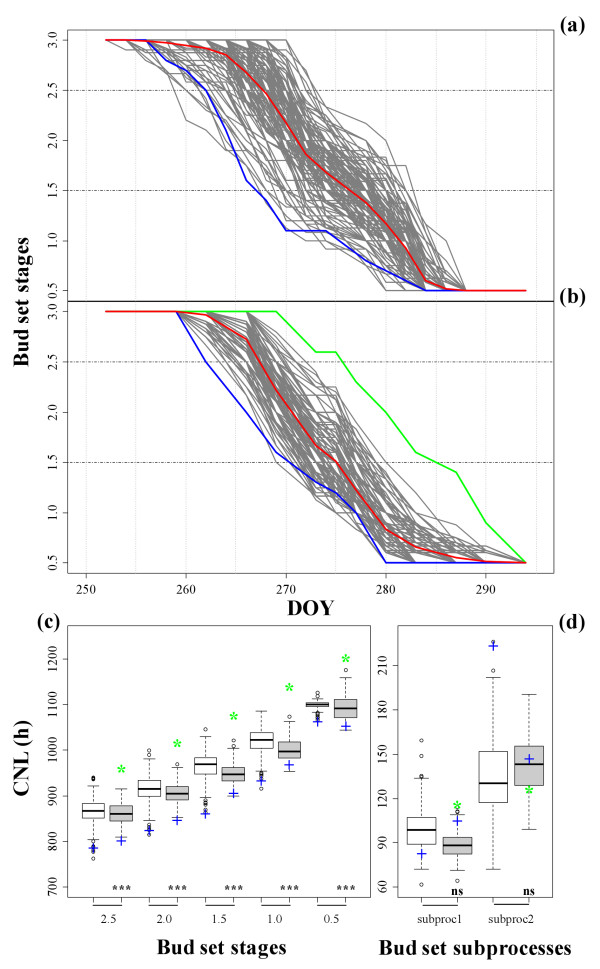
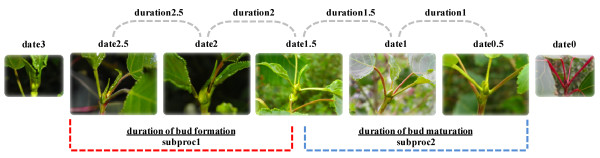
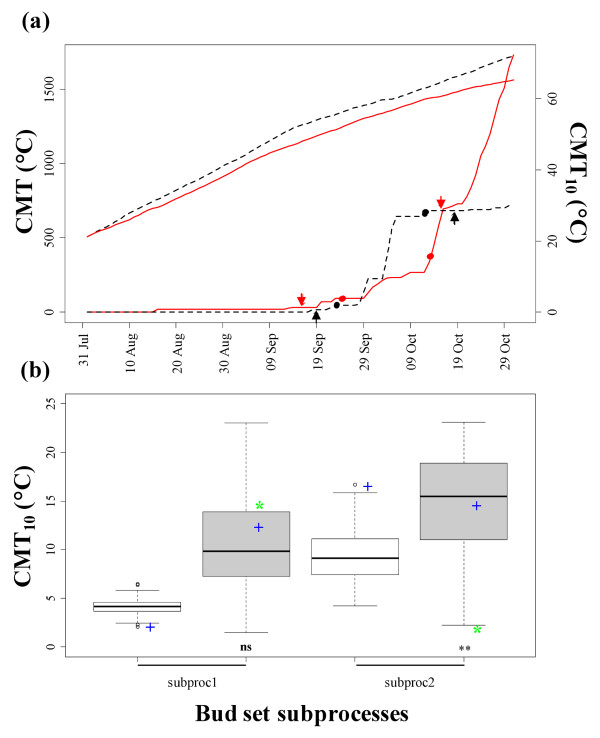
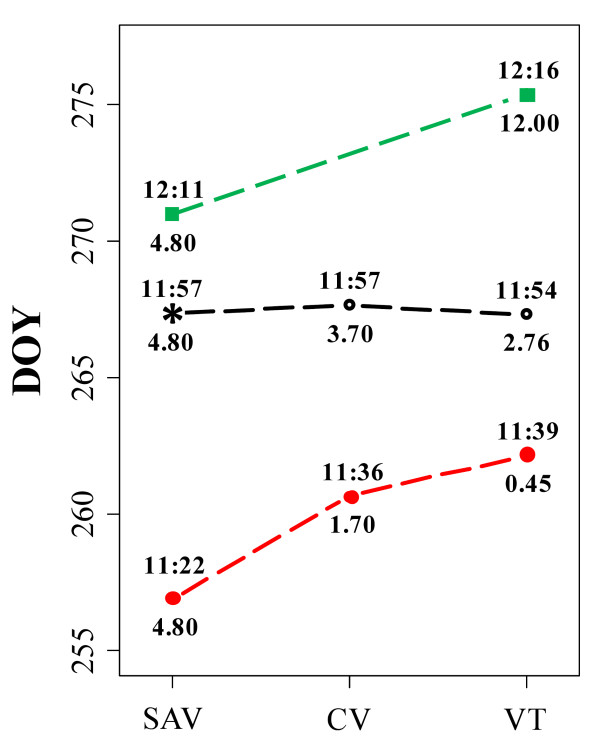
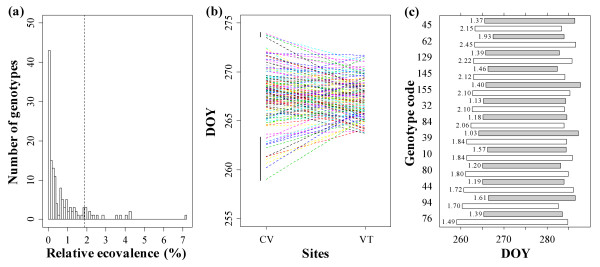
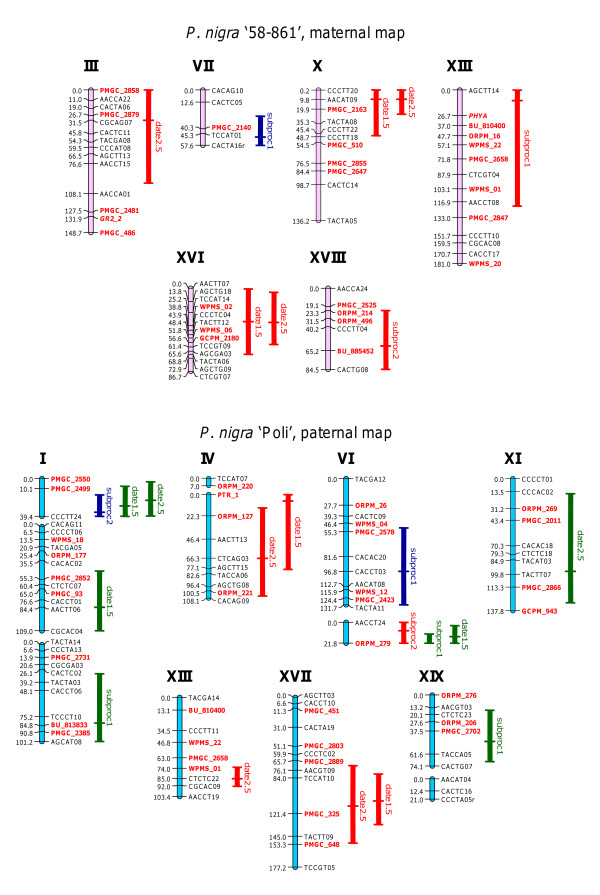
Six crucial phenological stages of bud set were scored. Night length appeared to be the most important signal triggering the onset of growth cessation. Nevertheless, the effect of other environmental factors, such as temperature, increased during the process. Moreover, a considerable role of genotype × environment (G × E) interaction was found in all phenological stages with the lowest temperature appearing to influence the sensitivity of the most plastic genotypes.Descriptors of growth cessation and bud onset explained the largest part of phenotypic variation of the entire process. Quantitative trait loci (QTL) for these traits were detected. For the four selected traits (the onset of growth cessation (date2.5), the transition from shoot to bud (date1.5), the duration of bud formation (subproc1) and bud maturation (subproc2)) eight and sixteen QTL were mapped on the maternal and paternal map, respectively. The identified QTL, each one characterized by small or modest effect, highlighted the complex nature of traits involved in bud set process. Comparison between map location of QTL and P. trichocarpa genome sequence allowed the identification of 13 gene models, 67 bud set-related expressional and six functional candidate genes (CGs). These CGs are functionally related to relevant biological processes, environmental sensing, signaling, and cell growth and development. Some strong QTL had no obvious CGs, and hold great promise to identify unknown genes that affect bud set.
This study provides a better understanding of the physiological and genetic dissection of bud set in poplar. The putative QTL identified will be tested for associations in P. nigra natural populations. The identified QTL and CGs will also serve as useful targets for poplar breeding.
在大多数林木物种中,对芽休眠等重要适应性性状的遗传控制仍知之甚少。杨树是研究芽休眠的理想模式树种,因为其具有不定芽生长的特性。因此,利用源自黑杨种内杂交的一个全同胞家系,该家系具有 162 个无性系复制后代,在两个具有不同环境条件的地点评估芽休眠的表型可塑性和遗传变异。
共记录了芽休眠的六个关键物候阶段。夜间长度似乎是触发生长停止的最重要信号。然而,其他环境因素(如温度)的影响在这个过程中增加了。此外,还发现基因型与环境(G×E)互作在所有物候阶段都起着相当大的作用,而最低温度似乎影响了最具可塑性基因型的敏感性。生长停止和芽萌发的描述符解释了整个过程中表型变异的最大部分。检测到了这些性状的数量性状基因座(QTL)。对于四个选定的性状(生长停止的开始(日期 2.5)、从芽到芽的转变(日期 1.5)、芽形成的持续时间(子进程 1)和芽成熟(子进程 2)),在母本和父本图谱上分别定位了 8 个和 16 个 QTL。鉴定的 QTL ,每个 QTL 都具有小或中等的效应,突出了涉及芽休眠过程的性状的复杂性。QTL 图谱位置与 P. trichocarpa 基因组序列的比较,确定了 13 个基因模型、67 个芽休眠相关表达和 6 个功能候选基因(CGs)。这些 CGs 与相关的生物学过程、环境感应、信号转导以及细胞生长和发育功能相关。一些强 QTL 没有明显的 CGs,这为鉴定影响芽休眠的未知基因提供了很大的希望。
本研究提供了对杨树芽休眠生理和遗传解析的更好理解。鉴定的拟定位 QTL 将在黑杨天然种群中进行关联测试。鉴定的 QTL 和 CGs 也将作为杨树育种的有用目标。