
春迁蚜揭示了瓜蚜的性别和寄主选择
What do spring migrants reveal about sex and host selection in the melon aphid?
机构信息
INRA, UMR1062 CBGP, F-34988 Montferrier-sur-Lez, France.
出版信息
BMC Evol Biol. 2012 Apr 3;12:47. doi: 10.1186/1471-2148-12-47.
BACKGROUND
Host plants exert considerable selective pressure on aphids because the plants constitute their feeding, mating and oviposition sites. Therefore, host specialisation in aphids evolves through selection of the behavioural and chemical mechanisms of host-plant location and recognition, and through metabolic adaptation to the phloem content of the host plant. How these adaptive traits evolve in an aphid species depends on the complexity of the annual life cycle of that species. The purpose of this field study was to determine how winged spring-migrant populations contribute to the evolution and maintenance of host specialisation in Aphis gossypii through host-plant choice and acceptance. We also assessed whether host-specialised genotypes corresponded exclusively to anholocyclic lineages regardless of the environmental conditions.
RESULTS
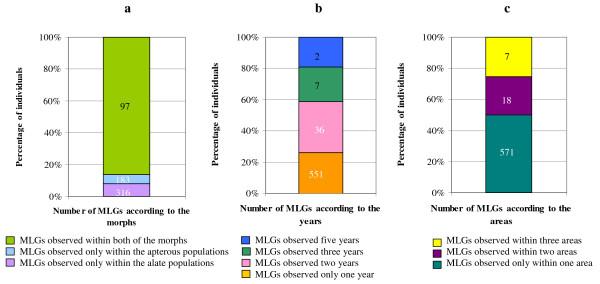
The spring populations of cotton-melon aphids visiting newly planted melon crops exhibited an unexpectedly high level of genetic diversity that contrasted with the very low diversity characterising the host-specialised populations of this aphid species. This study illustrated in natura host-plant-selection pressure by showing the great differences in genetic diversity between the spring-migrant populations (alate aphids) and the melon-infesting populations (the apterous offspring of the alate aphids). Moreover, an analysis of the genetic composition of these alate and apterous populations in four geographic regions suggested differences in life-history strategies, such as host choice and reproductive mode, and questioned the common assertion that A. gossypii is an anholocyclic species throughout its distribution area, including Europe.
CONCLUSIONS
Our results clearly demonstrate that the melon plant acts as a selective filter against the reproduction of non-specialised individuals. We showed that olfactory cues are unlikely to be decisive in natura for host recognition by spring-migrant aphid populations that are not specialised on Cucurbitaceae. The agroecosystem structure and history of the four studied regions may have partially shaped the genetic structure of the spring-migrant populations of A. gossypii. Cucurbitaceae-specialised genotypes corresponded exclusively to anholocyclic lineages, regardless of the environmental conditions. However, some genotypes that were genetically close to the host-specialised genotypes and some genotypes that probably originated from wild plants had never been previously sampled; both were holocylic.
背景
寄主植物对蚜虫施加了相当大的选择压力,因为植物构成了它们的取食、交配和产卵场所。因此,蚜虫的寄主专化性是通过对寄主植物定位和识别的行为和化学机制的选择,以及对寄主植物韧皮部内容物的代谢适应而进化的。这些适应性特征在蚜虫物种中的进化方式取决于该物种年度生命周期的复杂性。本野外研究的目的是通过寄主植物选择和接受来确定有翅春季迁徙种群如何促进棉蚜 Aphis gossypii 的进化和维持寄主专化性。我们还评估了专化基因型是否仅对应于无论环境条件如何的环生谱系。
结果
访问新种植的甜瓜作物的棉瓜蚜春季种群表现出出人意料的高水平遗传多样性,与这种蚜虫物种的专化种群的非常低多样性形成鲜明对比。本研究通过展示春季迁徙种群(有翅蚜虫)和瓜类侵染种群(有翅蚜虫的无翅后代)之间遗传多样性的巨大差异,说明了自然选择压力下的寄主植物选择。此外,对四个地理区域的这些有翅和无翅种群的遗传组成进行分析表明,在生活史策略(如寄主选择和繁殖模式)方面存在差异,并对 A. gossypii 在其分布区域包括欧洲都是环生种的普遍说法提出了质疑。
结论
我们的结果清楚地表明,甜瓜植物是对非专化个体繁殖的选择性过滤器。我们表明,嗅觉线索不太可能在自然条件下对春季迁徙蚜虫种群的寄主识别起决定性作用,这些蚜虫种群对葫芦科植物没有专化性。四个研究区域的农业生态系统结构和历史可能部分塑造了棉蚜春季迁徙种群的遗传结构。葫芦科专化基因型仅对应于环生谱系,无论环境条件如何。然而,一些与寄主专化基因型遗传上接近的基因型和一些可能来自野生植物的基因型以前从未被采样过;两者都是全生的。




 Zotero 插件