Department of Dermatology, University of Freiburg, Hauptstr, 7, Freiburg 79104, Germany.
BMC Immunol. 2012 Apr 4;13:16. doi: 10.1186/1471-2172-13-16.
Autoimmunity to collagen VII is typically associated with the skin blistering disease epidermolysis bullosa acquisita (EBA), but also occurs occasionally in patients with systemic lupus erythematosus or inflammatory bowel disease. The aim of our present study was to develop an accurate immunoassay for assessing the presence of autoantibodies against collagen VII in large cohorts of patients and healthy donors.
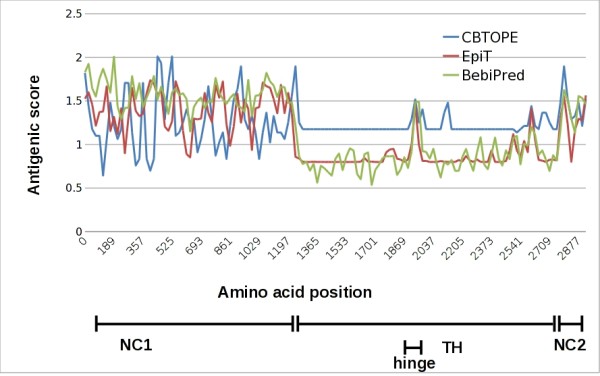
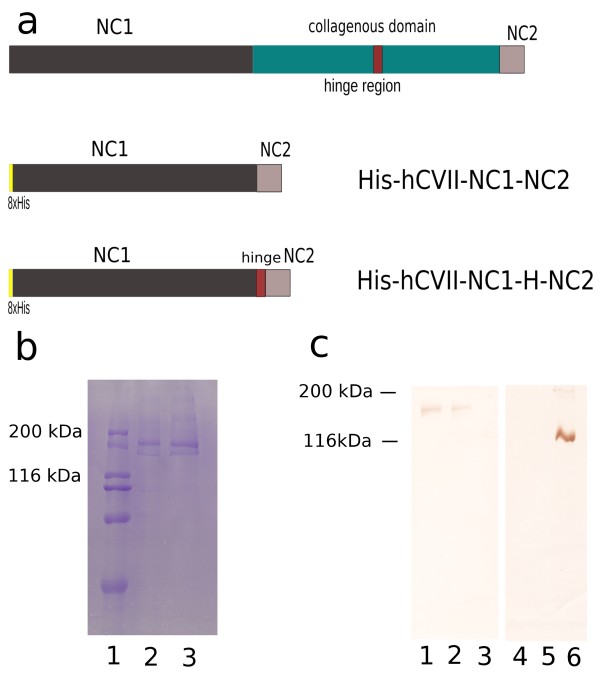
Based on in silico antigenic analysis and previous wetlab epitope mapping data, we designed a chimeric collagen VII construct containing all collagen VII epitopes with higher antigenicity. ELISA was performed with sera from patients with EBA (n = 50), Crohn's disease (CD, n = 50), ulcerative colitis (UC, n = 50), bullous pemphigoid (BP, n = 76), and pemphigus vulgaris (PV, n = 42) and healthy donors (n = 245).
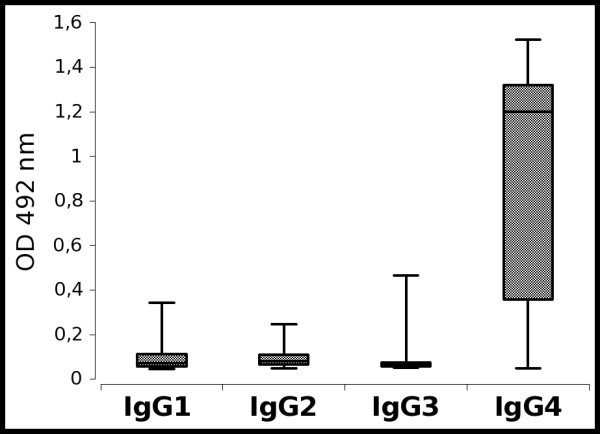
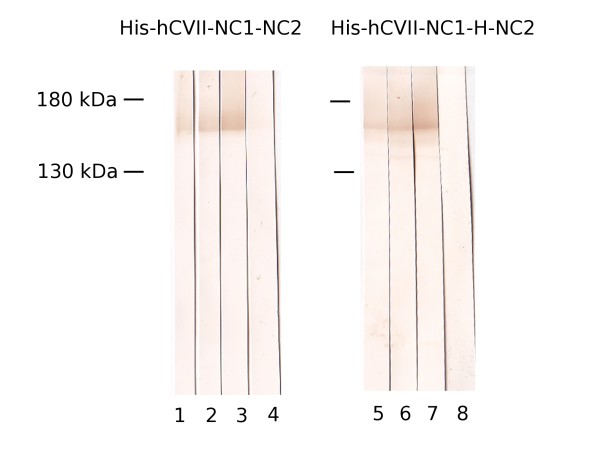
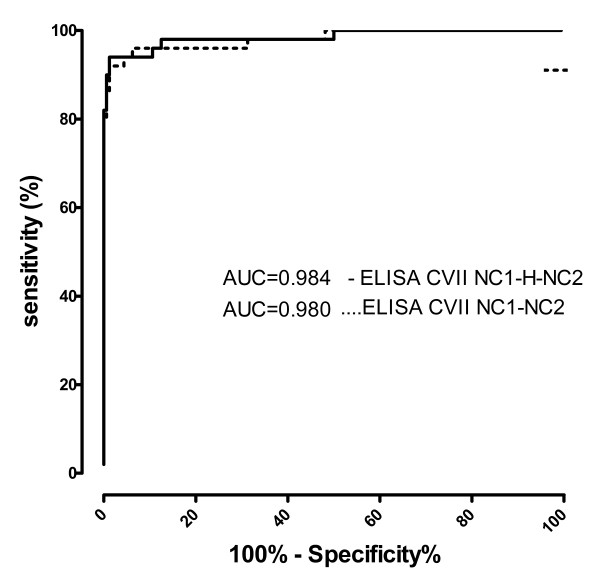
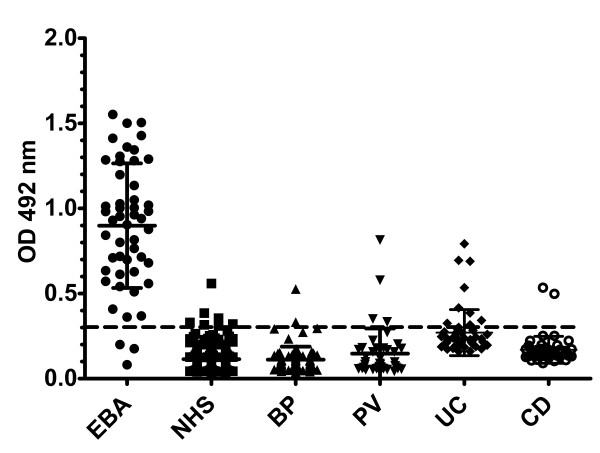
By ELISA, the receiver operating characteristics analysis yielded an area under the curve of 0.98 (95% CI: 0.9638-1.005), allowing to set the cut-off at 0.32 OD at a calculated specificity of 98% and a sensitivity of 94%. Running the optimized test showed that serum IgG autoantibodies from 47 EBA (94%; 95% CI: 87.41%-100%), 2 CD (4%; 95% CI: 0%-9.43%), 8 UC (16%; 95% CI: 5.8%-26%), 2 BP (2.63%; 95% CI: 0%-6.23%), and 4 PV (9.52%; 95% CI: 0%-18.4%) patients as well as from 4 (1.63%; 95% CI: 0%-3.21%) healthy donors reacted with the chimeric protein. Further analysis revealed that in 34%, 37%, 16% and 100% of sera autoantibodies of IgG1, IgG2, IgG3, and IgG4 isotype, respectively, recognized the recombinant autoantigen.
Using a chimeric protein, we developed a new sensitive and specific ELISA to detect collagen specific antibodies. Our results show a low prevalence of collagen VII-specific autoantibodies in inflammatory bowel disease, pemphigus and bullous pemphigoid. Furthermore, we show that the autoimmune response against collagen VII is dominated by IgG4 autoantibodies. The new immunoassay should prove a useful tool for clinical and translational research and should improve the routine diagnosis and disease monitoring in diseases associated with collagen VII-specific autoimmunity.
胶原 VII 自身抗体通常与皮肤大疱性疾病获得性大疱性表皮松解症(EBA)相关,但也偶尔发生在系统性红斑狼疮或炎症性肠病患者中。我们目前研究的目的是开发一种准确的免疫测定法,用于评估大样本量患者和健康供体中针对胶原 VII 的自身抗体的存在。
基于计算机抗原分析和以前的湿实验室表位作图数据,我们设计了一种包含所有胶原 VII 表位的嵌合胶原 VII 构建体,这些表位具有更高的抗原性。使用来自获得性大疱性表皮松解症(EBA,n = 50)、克罗恩病(CD,n = 50)、溃疡性结肠炎(UC,n = 50)、大疱性类天疱疮(BP,n = 76)和寻常性天疱疮(PV,n = 42)患者以及健康供体(n = 245)的血清进行 ELISA 检测。
通过 ELISA,接收者操作特性分析的曲线下面积为 0.98(95%CI:0.9638-1.005),可以将截断值设置为 0.32 OD,计算特异性为 98%,灵敏度为 94%。运行优化后的测试表明,来自 47 名 EBA(94%;95%CI:87.41%-100%)、2 名 CD(4%;95%CI:0%-9.43%)、8 名 UC(16%;95%CI:5.8%-26%)、2 名 BP(2.63%;95%CI:0%-6.23%)和 4 名 PV(9.52%;95%CI:0%-18.4%)患者的血清 IgG 自身抗体以及 4 名(1.63%;95%CI:0%-3.21%)健康供体的血清与嵌合蛋白发生反应。进一步分析表明,在 34%、37%、16%和 100%的血清 IgG1、IgG2、IgG3 和 IgG4 同种型中,自身抗体分别识别重组自身抗原。
我们使用嵌合蛋白开发了一种新的敏感和特异性 ELISA 来检测胶原特异性抗体。我们的结果表明,在炎症性肠病、天疱疮和大疱性类天疱疮中,胶原 VII 特异性自身抗体的患病率较低。此外,我们表明针对胶原 VII 的自身免疫反应主要由 IgG4 自身抗体主导。新的免疫测定法应该成为临床和转化研究的有用工具,并应改善与胶原 VII 特异性自身免疫相关的疾病的常规诊断和疾病监测。