Mariotti Feliciana, Pira Anna, De Luca Naomi, Giampetruzzi Anna Rita, Russo Filomena, Cerri Amilcare, Gasparini Giulia, Cozzani Emanuele, Marzano Angelo V, Antiga Emiliano, Caproni Marzia, Quaglino Pietro, Carrozzo Marco, Didona Biagio, Di Zenzo Giovanni
Molecular and Cell Biology Laboratory, Istituto Dermopatico dell'Immacolata (IDI)-IRCCS, Rome, Italy.
Dermatology Unit, Istituto Dermopatico dell'Immacolata (IDI)-IRCCS, Rome, Italy.
Front Immunol. 2024 Nov 29;15:1494294. doi: 10.3389/fimmu.2024.1494294. eCollection 2024.
Bullous pemphigoid (BP) and mucous membrane pemphigoid (MMP) are rare autoimmune blistering disorders characterized by autoantibodies (autoAbs) targeting dermo-epidermal junction components such as BP180 and BP230. The differential diagnosis, based on both the time of appearance and the extension of cutaneous and/or mucosal lesions, is crucial to distinguish these diseases for improving therapy outcomes and delineating the correct prognosis; however, in some cases, it can be challenging. In addition, negative results obtained by commercially available enzyme-linked immunosorbent assays (ELISAs) with BP and MMP sera, especially from patients with ocular involvement, often delay diagnosis and treatment, leading to a greater risk of poor outcomes.
Our aim was to find potentially different reactivity profiles in BP and MMP and improve available approaches for diagnosis with focus on ocular MMP.
Two cohorts of 90 BP and 90 MMP, recruited from different Italian clinical centers, were characterized also employing a novel ELISA based on the BP180 extracellular domain (ECD-BP180).
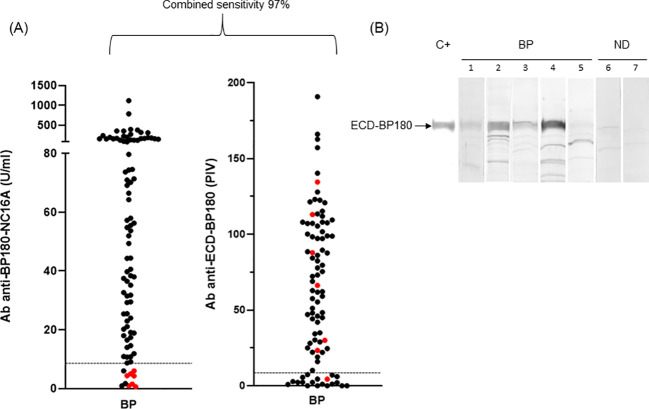
Immunoglobulin G (IgG) reactivity to BP180 and BP230 in MMP sera was significantly reduced in comparison with BP, mostly affecting BP230 and E-1080 (53% and 36% in BP vs. 11% and 3% in MMP, respectively, < 0.0001). The combined sensitivity of BP180-NC16A and ECD-BP180 ELISAs was greater compared to BP180-NC16A and BP230 ELISAs both in BP (97% and 92%, respectively) and in MMP (42% and 31%, respectively). The present study shows that MMP patients with ocular involvement rarely reacted to BP180 by IgG in contrast with patients with oral and/or cutaneous involvement ( = 0.0245 and = 0.0377, respectively), suggesting that an oral and/or cutaneous MMP positive to BP180 hardly evolves to ocular MMP. Of note, one-third of ocular MMP showed immunoglobulin A (IgA) reactivity to ECD-BP180 by immunoblotting.
The present study provides several hints to perform a correct and timely diagnosis in BP and MMP, which is crucial for improving therapy outcomes and delineating the correct prognosis.
大疱性类天疱疮(BP)和黏膜类天疱疮(MMP)是罕见的自身免疫性水疱病,其特征是自身抗体(autoAbs)靶向真皮 - 表皮连接成分,如BP180和BP230。基于皮肤和/或黏膜病变出现的时间以及范围进行鉴别诊断,对于区分这些疾病以改善治疗效果和明确正确的预后至关重要;然而,在某些情况下,这可能具有挑战性。此外,使用针对BP和MMP血清的市售酶联免疫吸附测定(ELISA)获得的阴性结果,尤其是来自眼部受累患者的结果,常常会延迟诊断和治疗,导致出现不良结局的风险更高。
我们的目的是发现BP和MMP中潜在的不同反应模式,并改进现有的诊断方法,重点关注眼部MMP。
从意大利不同临床中心招募了两个队列,分别为90例BP患者和90例MMP患者,并采用基于BP180细胞外结构域(ECD - BP180)的新型ELISA对其进行特征分析。
与BP相比,MMP血清中免疫球蛋白G(IgG)对BP180和BP230的反应性显著降低,主要影响BP230和E - 1080(BP中分别为53%和36%,MMP中分别为11%和3%,P < 0.0001)。在BP和MMP中,BP180 - NC16A和ECD - BP180 ELISA的联合敏感性均高于BP180 - NC16A和BP230 ELISA(BP中分别为97%和92%,MMP中分别为42%和31%)。本研究表明,与口腔和/或皮肤受累患者相比,眼部受累的MMP患者很少有IgG对BP180产生反应(分别为P = 0.0245和P = 0.0377),这表明对BP180呈阳性的口腔和/或皮肤MMP很少发展为眼部MMP。值得注意的是,三分之一的眼部MMP通过免疫印迹显示免疫球蛋白A(IgA)对ECD - BP180有反应。
本研究为BP和MMP的正确及时诊断提供了几条线索,这对于改善治疗效果和明确正确的预后至关重要。