Division of Cell and Molecular Biology, Department of Biology, Boston University, Boston, MA 02215, USA.
Biol Sex Differ. 2012 Apr 4;3:9. doi: 10.1186/2042-6410-3-9.
Early liver development and the transcriptional transitions during hepatogenesis are well characterized. However, gene expression changes during the late postnatal/pre-pubertal to young adulthood period are less well understood, especially with regards to sex-specific gene expression.
Microarray analysis of male and female mouse liver was carried out at 3, 4, and 8 wk of age to elucidate developmental changes in gene expression from the late postnatal/pre-pubertal period to young adulthood.
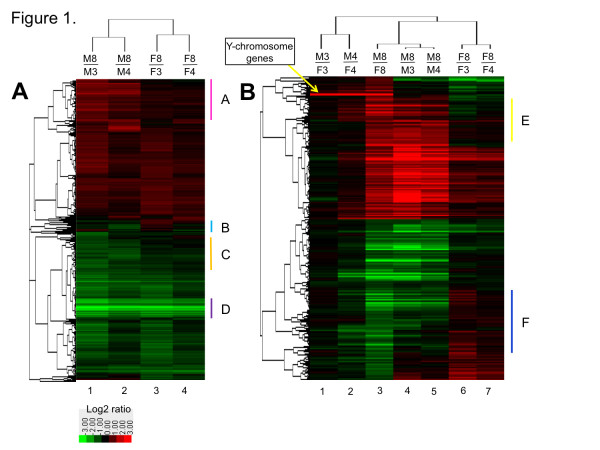
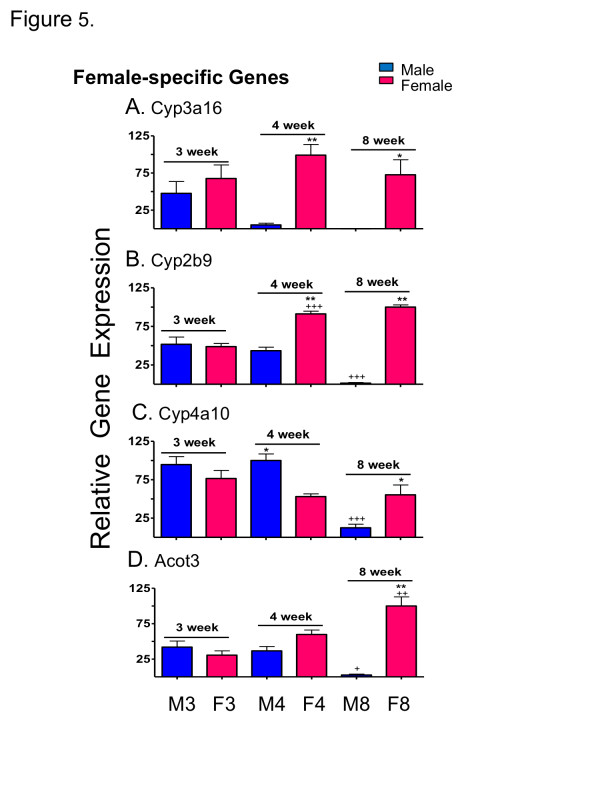
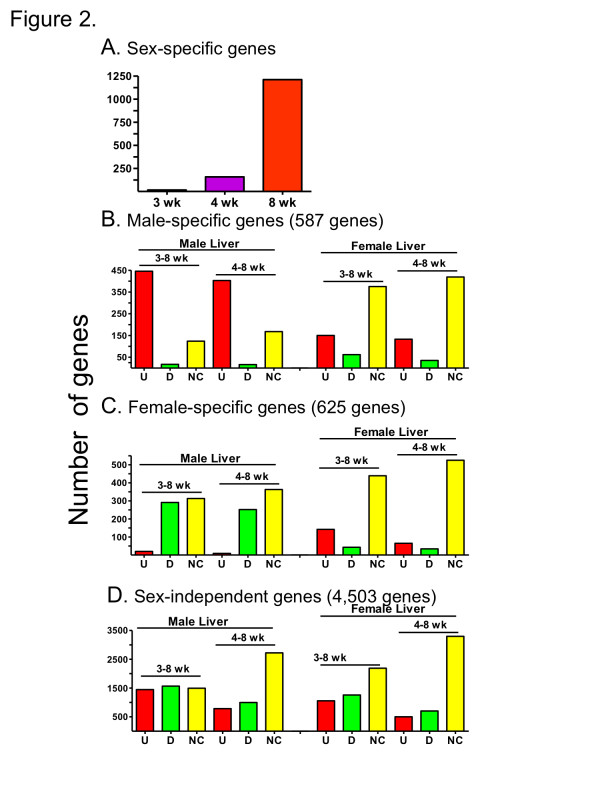
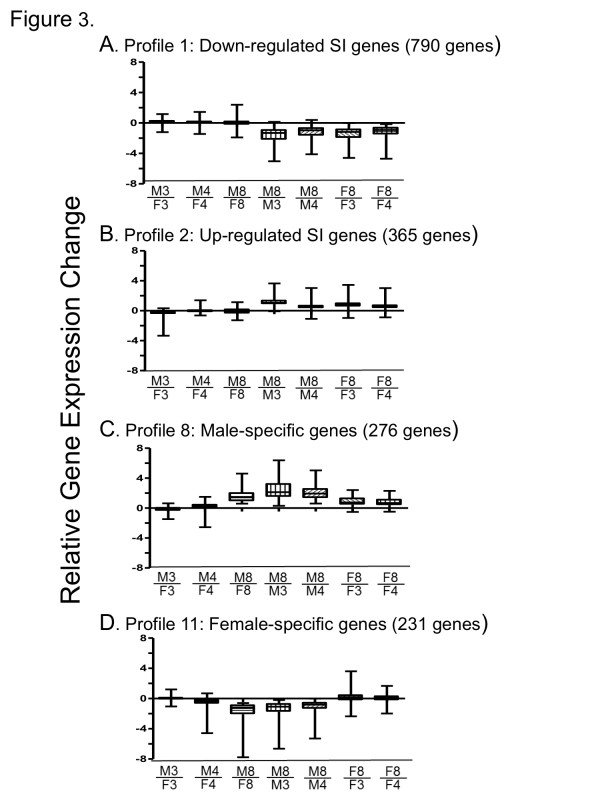
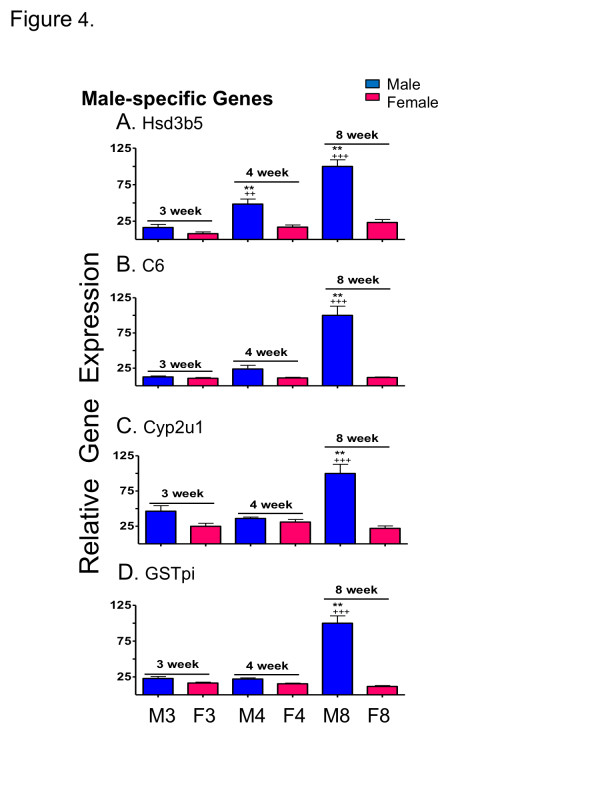
A large number of sex-biased and sex-independent genes showed significant changes during this developmental period. Notably, sex-independent genes involved in cell cycle, chromosome condensation, and DNA replication were down regulated from 3 wk to 8 wk, while genes associated with metal ion binding, ion transport and kinase activity were up regulated. A majority of genes showing sex differential expression in adult liver did not display sex differences prior to puberty, at which time extensive changes in sex-specific gene expression were seen, primarily in males. Thus, in male liver, 76% of male-specific genes were up regulated and 47% of female-specific genes were down regulated from 3 to 8 wk of age, whereas in female liver 67% of sex-specific genes showed no significant change in expression. In both sexes, genes up regulated from 3 to 8 wk were significantly enriched (p < E-76) in the set of genes positively regulated by the liver transcription factor HNF4α, as determined in a liver-specific HNF4α knockout mouse model, while genes down regulated during this developmental period showed significant enrichment (p < E-65) for negative regulation by HNF4α. Significant enrichment of the developmentally regulated genes in the set of genes subject to positive and negative regulation by pituitary hormone was also observed. Five sex-specific transcriptional regulators showed sex-specific expression at 4 wk (male-specific Ihh; female-specific Cdx4, Cux2, Tox, and Trim24) and may contribute to the developmental changes that lead to global acquisition of liver sex-specificity by 8 wk of age.
Overall, the observed changes in gene expression during postnatal liver development reflect the deceleration of liver growth and the induction of specialized liver functions, with widespread changes in sex-specific gene expression primarily occurring in male liver.
早期肝脏发育和肝发生过程中的转录转换已经得到很好的描述。然而,对于出生后/青春期前到成年早期的后期,基因表达的变化了解较少,特别是关于性别特异性基因表达。
对雄性和雌性小鼠肝脏进行微阵列分析,以阐明从出生后/青春期前到成年早期的基因表达在发育过程中的变化。
大量的性别偏倚和非性别依赖基因在这个发育阶段发生了显著变化。值得注意的是,参与细胞周期、染色体浓缩和 DNA 复制的非性别依赖基因从 3 周到 8 周下调,而与金属离子结合、离子转运和激酶活性相关的基因上调。在成年肝脏中表现出性别差异表达的大多数基因在青春期前没有表现出性别差异,此时观察到广泛的性别特异性基因表达变化,主要发生在雄性中。因此,在雄性肝脏中,76%的雄性特异性基因上调,47%的雌性特异性基因下调,从 3 周到 8 周龄,而在雌性肝脏中,67%的性别特异性基因表达没有显著变化。在两性中,从 3 周到 8 周上调的基因在由肝转录因子 HNF4α正向调节的基因集中显著富集(p < E-76),如在肝特异性 HNF4α敲除小鼠模型中确定的那样,而在此发育期间下调的基因在 HNF4α负调节中显著富集(p < E-65)。发育调节基因在受垂体激素正向和负向调节的基因集中也有显著富集。五个性别特异性转录调节因子在 4 周时表现出性别特异性表达(雄性特异性 Ihh;雌性特异性 Cdx4、Cux2、Tox 和 Trim24),可能有助于导致 8 周龄时肝脏获得性别特异性的全局变化。
总的来说,出生后肝脏发育过程中基因表达的变化反映了肝脏生长的减速和专门化肝脏功能的诱导,性别特异性基因表达的广泛变化主要发生在雄性肝脏中。