Biocentre Klein Flottbek and Botanical Garden , University of Hamburg , Department of Biology, Biodiversity of Plants, Ohnhorststrasse 18, 22609 Hamburg , Germany.
AoB Plants. 2010;2010:plq003. doi: 10.1093/aobpla/plq003. Epub 2010 Feb 22.
In the context of the 200th anniversary of Charles Darwin's birth in 1809, this study discusses the variation in structure and adaptation associated with survival and reproductive success in the face of environmental stresses in the trees of tropical floodplains.
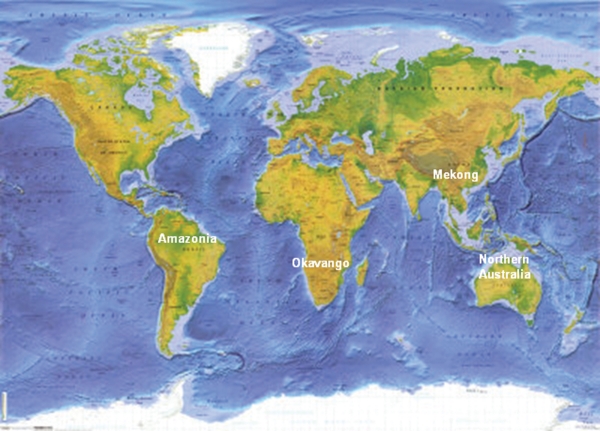
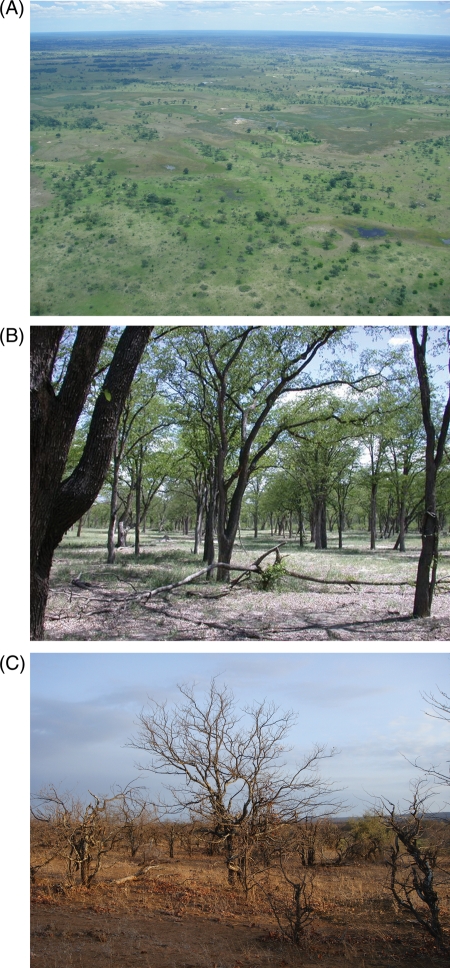
We provide a comparative review on the responses to flooding stress in the trees of freshwater wetlands in tropical environments. The four large wetlands we evaluate are: (i) Central Amazonian floodplains in South America, (ii) the Okavango Delta in Africa, (iii) the Mekong floodplains of Asia and (iv) the floodplains of Northern Australia. They each have a predictable 'flood pulse'. Although flooding height varies between the ecosystems, the annual pulse is a major driving force influencing all living organisms and a source of stress for which specialized adaptations for survival are required.
The need for trees to survive an annual flood pulse has given rise to a large variety of adaptations. However, phenological responses to the flood are similar in the four ecosystems. Deciduous and evergreen species respond with leaf shedding, although sap flow remains active for most of the year. Growth depends on adequate carbohydrate supply. Physiological adaptations (anaerobic metabolism, starch accumulation) are also required.
Data concerning the ecophysiology and adaptations of trees in floodplain forests worldwide are extremely scarce. For successful floodplain conservation, more information is needed, ideally through a globally co-ordinated study using reproducible comparative methods. In the light of climatic change, with increasing drought, decreased groundwater availability and flooding periodicities, this knowledge is needed ever more urgently to facilitate fast and appropriate management responses to large-scale environmental change.
在 1809 年查尔斯·达尔文诞辰 200 周年之际,本研究探讨了在面临热带洪泛平原树木环境压力时,与生存和繁殖成功相关的结构和适应性变化。
我们提供了一个关于热带淡水湿地树木对洪水胁迫反应的比较综述。我们评估的四个大型湿地是:(i)南美洲的中央亚马逊河洪泛平原,(ii)非洲的奥卡万戈三角洲,(iii)亚洲的湄公河洪泛平原,(iv)澳大利亚北部的洪泛平原。它们都有一个可预测的“洪水脉冲”。尽管各生态系统的洪水高度不同,但每年的脉冲是影响所有生物的主要驱动力,也是需要专门适应才能生存的压力源。
树木需要在每年的洪水脉冲中生存,这导致了大量的适应性。然而,四个生态系统中对洪水的物候反应是相似的。落叶和常绿物种都会落叶,但在大多数年份,液流仍然活跃。生长取决于足够的碳水化合物供应。还需要生理适应(无氧代谢、淀粉积累)。
有关世界范围内洪泛平原森林树木生态生理学和适应性的数据极其匮乏。为了成功保护洪泛平原,需要更多的信息,理想情况下是通过使用可重复比较方法进行全球协调研究。鉴于气候变化,干旱加剧、地下水供应减少和洪水周期性变化,为了促进对大规模环境变化的快速和适当的管理反应,这种知识越来越迫切需要。