Department of Earth and Planetary Sciences, Rutgers University, New Brunswick, NJ 08854.
Department of Physics, Federal University of Santa Catarina, Florianópolis 88040-900, Brazil.
Proc Natl Acad Sci U S A. 2023 Aug 15;120(33):e2301255120. doi: 10.1073/pnas.2301255120. Epub 2023 Aug 7.
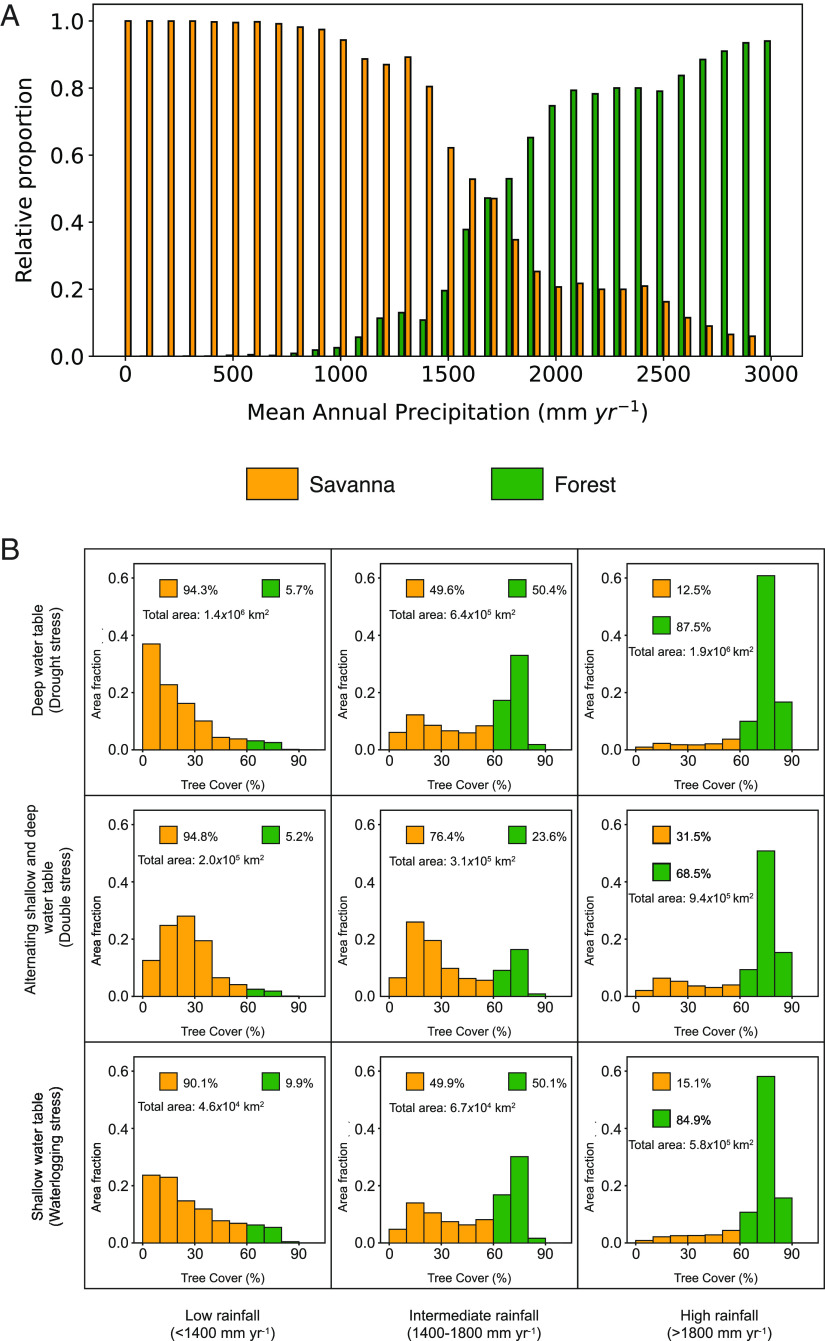
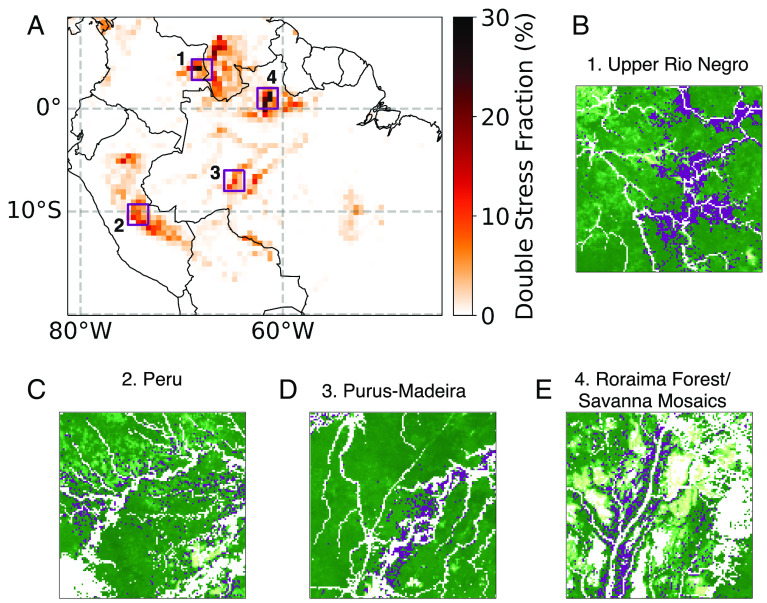
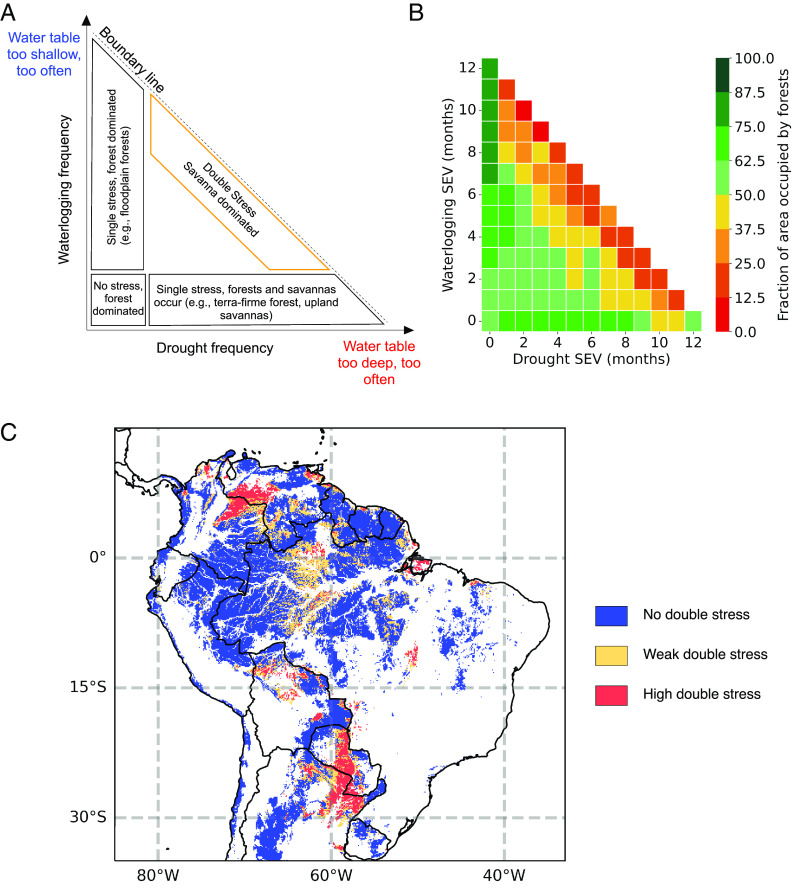
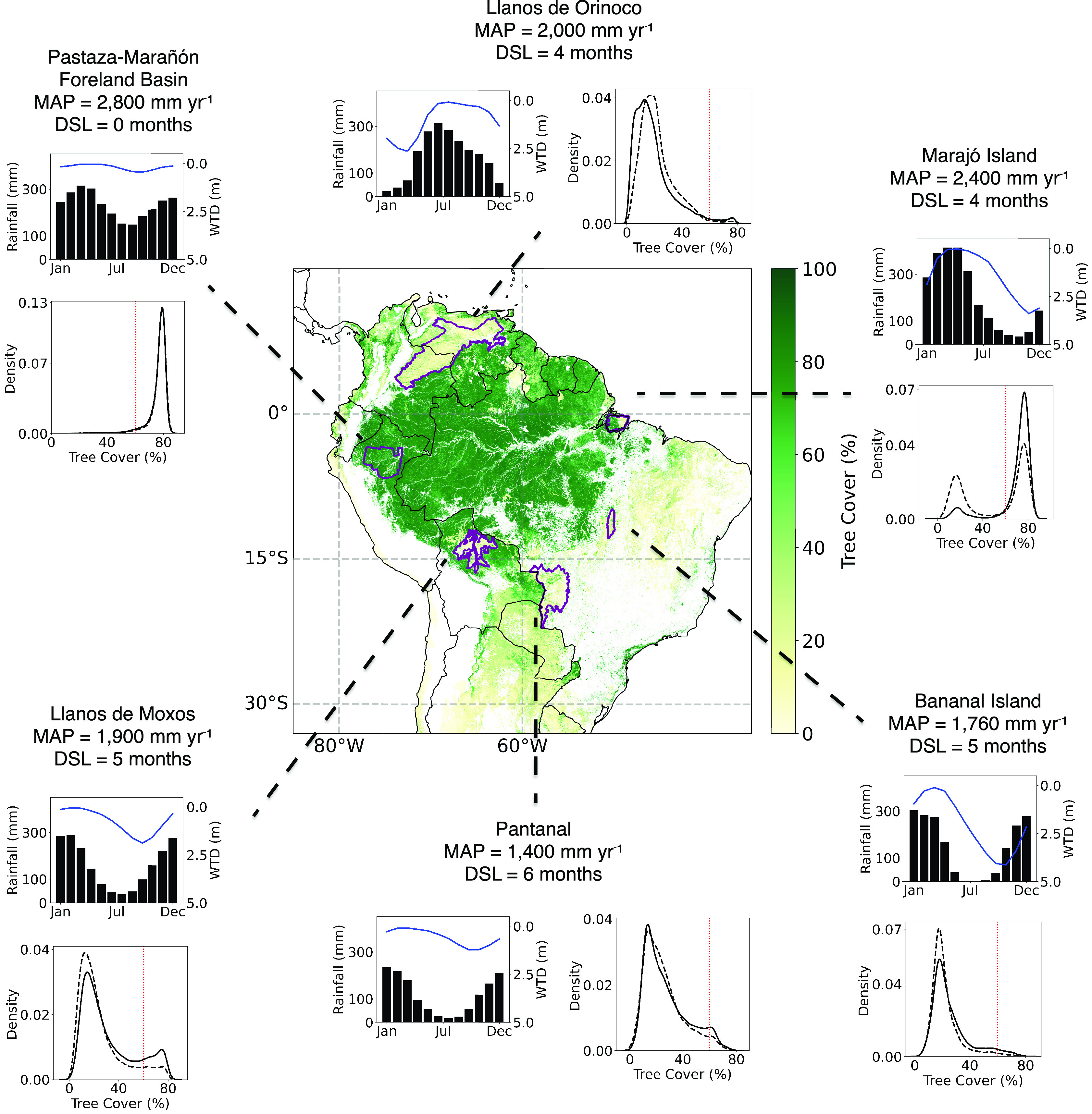
Forest-savanna boundaries are ecotones that support complex ecosystem functions and are sensitive to biotic/abiotic perturbations. What drives their distribution today and how it may shift in the future are open questions. Feedbacks among climate, fire, herbivory, and land use are known drivers. Here, we show that alternating seasonal drought and waterlogging stress favors the dominance of savanna-like ecosystems over forests. We track the seasonal water-table depth as an indicator of water stress when too deep and oxygen stress when too shallow and map forest/savanna occurrence within this double-stress space in the neotropics. We find that under a given annual precipitation, savannas are favored in landscape positions experiencing double stress, which is more common as the dry season strengthens (climate driver) but only found in waterlogged lowlands (terrain driver). We further show that hydrological changes at the end of the century may expose some flooded forests to savanna expansion, affecting biodiversity and soil carbon storage. Our results highlight the importance of land hydrology in understanding/predicting forest-savanna transitions in a changing world.
森林-稀树草原边界是支持复杂生态系统功能的生态过渡带,对生物/非生物干扰很敏感。是什么驱动了它们今天的分布,以及未来可能会如何变化,这些都是悬而未决的问题。气候、火灾、食草和土地利用之间的反馈是已知的驱动因素。在这里,我们表明,季节性干湿交替压力有利于类似于稀树草原的生态系统对森林的优势。我们跟踪季节性地下水位深度,作为当水位过深时出现水压力和当水位过浅时出现氧气压力的指标,并在新热带地区的这个双重压力空间内绘制森林/稀树草原的出现情况。我们发现,在给定的年降水量下,在经历双重压力的景观位置上,稀树草原更受欢迎,这种情况在旱季增强时(气候驱动因素)更为常见,但只在水涝的低地(地形驱动因素)中发现。我们进一步表明,本世纪末的水文变化可能会使一些被洪水淹没的森林面临稀树草原扩张的风险,从而影响生物多样性和土壤碳储存。我们的研究结果强调了土地水文学在理解/预测变化世界中的森林-稀树草原转变中的重要性。