Centre for Population Health Sciences, University of Edinburgh, Edinburgh, United Kingdom.
PLoS One. 2012;7(3):e34222. doi: 10.1371/journal.pone.0034222. Epub 2012 Mar 27.
Systematic reviews of complex interventions commonly find heterogeneity of effect sizes among similar interventions which cannot be explained. Commentators have suggested that complex interventions should be viewed as interventions in complex systems. We hypothesised that if this is the case, the distribution of effect sizes from complex interventions should be heavy tailed, as in other complex systems. Thus, apparent heterogeneity may be a feature of the complex systems in which such interventions operate.
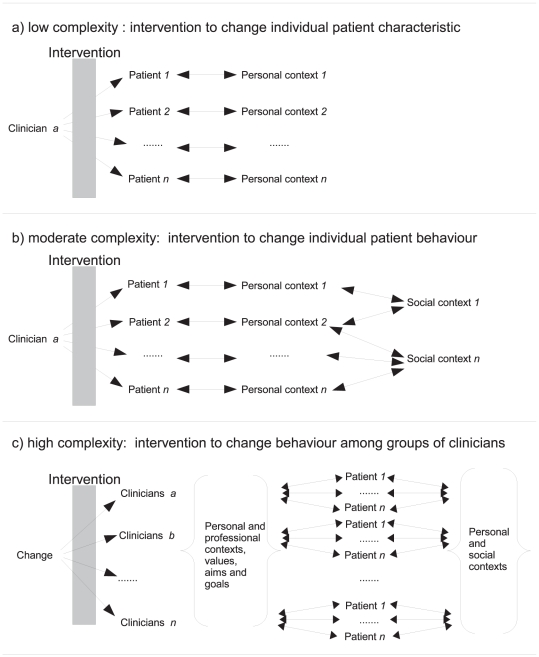
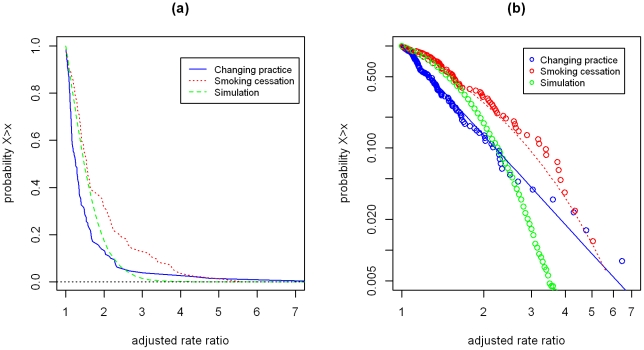
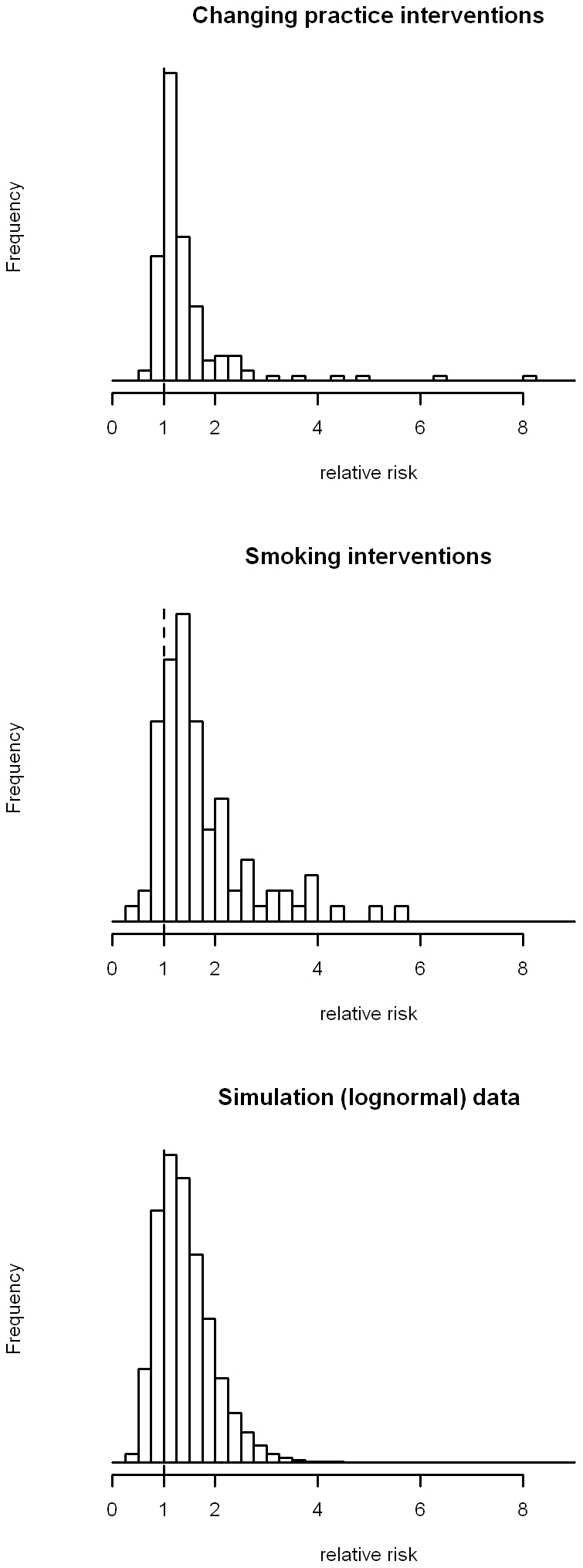
METHODOLOGY/PRINCIPAL FINDINGS: We specified three levels of complexity and identified systematic reviews which reported effect sizes of healthcare interventions at two of these levels (interventions to change professional practice and personal interventions to help smoking cessation). These were compared with each other and with simulated data representing the lowest level of complexity. Effect size data were rescaled across reviews at each level using log-normal parameters and pooled. Distributions were plotted and fitted against the inverse power law (Pareto) and stretched exponential (Weibull) distributions, heavy tailed distributions which are commonly reported in the literature, using maximum likelihood fitting. The dataset included 155 studies of interventions to change practice and 98 studies of helping smoking cessation. Both distributions showed a heavy tailed distribution which fitted best to the inverse power law for practice interventions (exponent = 3.9, loglikelihood = -35.3) and to the stretched exponential for smoking cessation (loglikelihood = -75.2). Bootstrap sensitivity analysis to adjust for possible publication bias against weak results did not diminish the goodness of fit.
CONCLUSIONS/SIGNIFICANCE: The distribution of effect sizes from complex interventions includes heavy tails as typically seen in both theoretical and empirical complex systems. This is in keeping with the idea of complex interventions as interventions in complex systems.
系统评价复杂干预措施时,通常会发现类似干预措施的效应大小存在无法解释的异质性。评论员建议将复杂干预措施视为复杂系统中的干预措施。我们假设如果是这样,那么来自复杂干预措施的效应大小分布应该是长尾的,就像其他复杂系统一样。因此,明显的异质性可能是这些干预措施所运作的复杂系统的一个特征。
方法/主要发现:我们指定了三个复杂程度级别,并确定了报告了其中两个级别(改变专业实践的干预措施和帮助戒烟的个人干预措施)的医疗保健干预措施效应大小的系统评价。这些系统评价相互比较,并与代表最低复杂程度的模拟数据进行比较。在每个级别上,使用对数正态参数对效应大小数据进行跨综述重新缩放,并进行汇总。绘制分布并拟合逆幂律(Pareto)和拉伸指数(Weibull)分布,这是文献中常见的重尾分布,使用最大似然拟合。该数据集包括 155 项关于改变实践的干预措施研究和 98 项帮助戒烟的研究。两种分布均显示出长尾分布,最适合实践干预措施的逆幂律(指数=3.9,对数似然=-35.3)和戒烟的拉伸指数(对数似然=-75.2)。为了调整可能存在的对弱结果的发表偏倚而进行的引导敏感性分析并没有降低拟合优度。
结论/意义:来自复杂干预措施的效应大小分布包括长尾,这在理论和实证复杂系统中都很常见。这符合将复杂干预措施视为复杂系统中的干预措施的观点。