Biomedical Informatics Group, Facultad de Informática, Departamento de Inteligencia Artificial, Universidad Politécnica de Madrid, Campus de Montegancedo, s/n, 28660 Madrid, Spain.
BMC Med Inform Decis Mak. 2012 Apr 5;12:29. doi: 10.1186/1472-6947-12-29.
Over the last few decades, the ever-increasing output of scientific publications has led to new challenges to keep up to date with the literature. In the biomedical area, this growth has introduced new requirements for professionals, e.g., physicians, who have to locate the exact papers that they need for their clinical and research work amongst a huge number of publications. Against this backdrop, novel information retrieval methods are even more necessary. While web search engines are widespread in many areas, facilitating access to all kinds of information, additional tools are required to automatically link information retrieved from these engines to specific biomedical applications. In the case of clinical environments, this also means considering aspects such as patient data security and confidentiality or structured contents, e.g., electronic health records (EHRs). In this scenario, we have developed a new tool to facilitate query building to retrieve scientific literature related to EHRs.
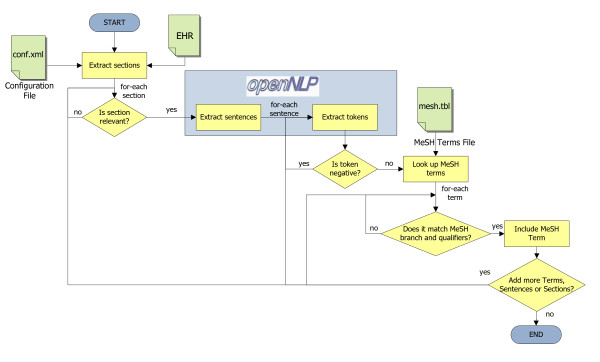
We have developed CDAPubMed, an open-source web browser extension to integrate EHR features in biomedical literature retrieval approaches. Clinical users can use CDAPubMed to: (i) load patient clinical documents, i.e., EHRs based on the Health Level 7-Clinical Document Architecture Standard (HL7-CDA), (ii) identify relevant terms for scientific literature search in these documents, i.e., Medical Subject Headings (MeSH), automatically driven by the CDAPubMed configuration, which advanced users can optimize to adapt to each specific situation, and (iii) generate and launch literature search queries to a major search engine, i.e., PubMed, to retrieve citations related to the EHR under examination.
CDAPubMed is a platform-independent tool designed to facilitate literature searching using keywords contained in specific EHRs. CDAPubMed is visually integrated, as an extension of a widespread web browser, within the standard PubMed interface. It has been tested on a public dataset of HL7-CDA documents, returning significantly fewer citations since queries are focused on characteristics identified within the EHR. For instance, compared with more than 200,000 citations retrieved by breast neoplasm, fewer than ten citations were retrieved when ten patient features were added using CDAPubMed. This is an open source tool that can be freely used for non-profit purposes and integrated with other existing systems.
在过去的几十年中,科学出版物的产量不断增加,给人们跟上文献的步伐带来了新的挑战。在生物医学领域,这种增长对专业人员提出了新的要求,例如医生,他们必须在大量出版物中找到他们在临床和研究工作中所需的确切论文。在此背景下,新型信息检索方法变得更加必要。虽然网络搜索引擎在许多领域都得到了广泛应用,方便了各种信息的获取,但还需要额外的工具来自动将从这些引擎中检索到的信息与特定的生物医学应用联系起来。在临床环境中,这还意味着要考虑患者数据的安全性和保密性或结构化内容,例如电子健康记录 (EHR)。在这种情况下,我们开发了一种新工具,以方便构建查询来检索与 EHR 相关的科学文献。
我们开发了 CDAPubMed,这是一种开源的 Web 浏览器扩展,可将 EHR 功能集成到生物医学文献检索方法中。临床用户可以使用 CDAPubMed:(i) 加载患者临床文档,即基于健康水平 7-临床文档架构标准 (HL7-CDA) 的 EHR,(ii) 在这些文档中为科学文献搜索识别相关术语,即医学主题词 (MeSH),这是由 CDAPubMed 配置自动驱动的,高级用户可以优化配置以适应每个特定情况,以及 (iii) 生成并向主要搜索引擎,即 PubMed,发起文献搜索查询,以检索与正在检查的 EHR 相关的引文。
CDAPubMed 是一个与平台无关的工具,旨在使用特定 EHR 中包含的关键字方便文献搜索。CDAPubMed 作为一个广泛使用的 Web 浏览器的扩展,在标准 PubMed 界面中进行了视觉集成。它已经在公共 HL7-CDA 文档数据集上进行了测试,由于查询集中在 EHR 中识别的特征,因此返回的引文数量明显减少。例如,与使用 CDAPubMed 时添加十个患者特征相比,检索乳腺癌的引文数超过 20 万,检索结果的引文数不到十个。这是一个开源工具,可免费用于非营利目的,并可与其他现有系统集成。