Needham D, Nunn R S
Department of Mechanical Engineering and Materials Science, Duke University, Durham, North Carolina 27706.
Biophys J. 1990 Oct;58(4):997-1009. doi: 10.1016/S0006-3495(90)82444-9.
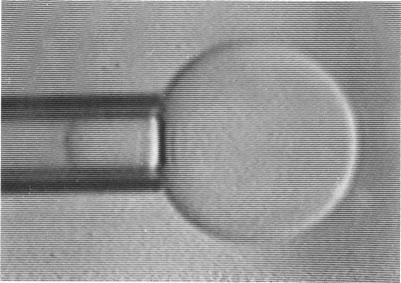
Giant bilayer vesicles were reconstituted from several lipids and lipid/cholesterol (CHOL) mixtures: stearolyloleoylphosphatidylcholine (SOPC), bovine sphingomyelin (BSM), diarachidonylphosphatidylcholine (DAPC), SOPC/CHOL, BSM/CHOL, DAPC/CHOL, and extracted red blood cell (RBC) lipids with native cholesterol. Single-walled vesicles were manipulated by micropipette suction and several membrane material properties were determined. The properties measured were the elastic area compressibility modulus K, the critical areal strain alpha c, and the tensile strength tau lys, from which the failure energy or membrane toughness Tf was calculated. The elastic area expansion moduli for these lipid and lipid/cholesterol bilayers ranged from 57 dyn/cm for DAPC to 1,734 dyn/cm for BSM/CHOL. The SOPC/CHOL series and RBC lipids had intermediate values. The results indicated that the presence of cholesterol is the single most influential factor in increasing bilayer cohesion, but only for lipids where both chains are saturated, or mono- or diunsaturated. Multiple unsaturation in both lipid chains inhibits the condensing effect of cholesterol in bilayers. The SOPC/CHOL system was studied in more detail. The area expansion modulus showed a nonlinear increase with increasing cholesterol concentration up to a constant plateau, indicating a saturation limit for cholesterol in the bilayer phase of approximately 55 mol% CHOL. The membrane compressibility was modeled by a property-averaging composite theory involving two bilayer components, namely, uncomplexed lipid and a lipid/cholesterol complex of stoichiometry 1/1.22. The area expansion modulus of this molecular composite membrane was evaluated by a combination of the expansion moduli of each component scaled by their area fractions in the bilayer. Bilayer toughness, which is the energy stored in the bilayer at failure, showed a maximum value at approximately 40 mol% CHOL. This breakdown energy was found to be only a fraction of the available thermal energy, implying that many molecules (approximately 50-100) may be involved in forming the defect structure that leads to failure. The area expansion modulus of extracted RBC lipids with native cholesterol was compared with recent measurements of intact RBC membrane compressibility. The natural membrane was also modeled as a simple composite made up to a compressible lipid/cholesterol matrix containing relatively incompressible transmembrane proteins. It appears that the interaction of incompressible proteins with surrounding lipid confers enhanced compressibility on the composite structure.
巨型双层囊泡由几种脂质以及脂质/胆固醇(CHOL)混合物重构而成:硬脂酰油酰磷脂酰胆碱(SOPC)、牛神经鞘磷脂(BSM)、二花生四烯酰磷脂酰胆碱(DAPC)、SOPC/CHOL、BSM/CHOL、DAPC/CHOL,以及含有天然胆固醇的提取红细胞(RBC)脂质。通过微量移液器抽吸操作单壁囊泡,并测定了几种膜材料特性。所测量的特性包括弹性面积压缩模量K、临界面积应变αc和拉伸强度τlys,由此计算出破坏能或膜韧性Tf。这些脂质和脂质/胆固醇双层膜的弹性面积膨胀模量范围从DAPC的57达因/厘米到BSM/CHOL的1734达因/厘米。SOPC/CHOL系列和RBC脂质具有中间值。结果表明,胆固醇的存在是增加双层膜凝聚力的唯一最具影响力的因素,但仅适用于两条链均为饱和、单不饱和或双不饱和的脂质。两条脂质链中的多个不饱和键会抑制胆固醇在双层膜中的凝聚作用。对SOPC/CHOL系统进行了更详细的研究。面积膨胀模量随着胆固醇浓度的增加呈现非线性增加,直至达到一个恒定的平台期,这表明在双层膜相中胆固醇的饱和极限约为55摩尔% CHOL。通过一种涉及两个双层膜成分的特性平均复合理论对膜压缩性进行建模,这两个成分分别是未复合的脂质和化学计量比为1/1.22的脂质/胆固醇复合物。通过将每个成分的膨胀模量按其在双层膜中的面积分数进行缩放,来评估这种分子复合膜的面积膨胀模量。双层膜韧性是指双层膜在破坏时储存的能量,在约40摩尔% CHOL时显示出最大值。发现这种断裂能仅为可用热能的一小部分,这意味着可能有许多分子(约50 - 100个)参与形成导致破坏的缺陷结构。将含有天然胆固醇的提取RBC脂质的面积膨胀模量与最近对完整RBC膜压缩性的测量结果进行了比较。天然膜也被建模为一种简单的复合材料,由一个可压缩的脂质/胆固醇基质组成,其中含有相对不可压缩的跨膜蛋白。不可压缩的蛋白质与周围脂质的相互作用似乎赋予了复合结构增强的压缩性。