Department of Surgery, Yeungnam University College of Medicine, Daegu, Korea.
J Breast Cancer. 2012 Mar;15(1):91-7. doi: 10.4048/jbc.2012.15.1.91. Epub 2012 Mar 28.
The axillary reverse mapping (ARM) technique to identify and preserve arm nodes during sentinel lymph node biopsy (SLNB) or axillary lymph node dissection (ALND) was developed to prevent lymphedema. The purpose of this study was to investigate the location and metastatic rate of the arm node, and to evaluate the short term incidence of lymphedema after arm node preserving surgery.
From January 2009 to October 2010, 97 breast cancer patients who underwent ARM were included. Blue-dye (2.5 mL) was injected into the ipsilateral upper-inner arm. At least 20 minutes after injection, SLNB or ALND was performed and blue-stained arm nodes and/or lymphatics were identified. Patients were divided into two groups, an arm node preserved group (70 patients had ALND, 10 patients had SLNB) and an unpreserved group (13 patients had ALND, 4 patients had SLNB). The difference in arm circumference between preoperative and postoperative time points was checked in both groups.
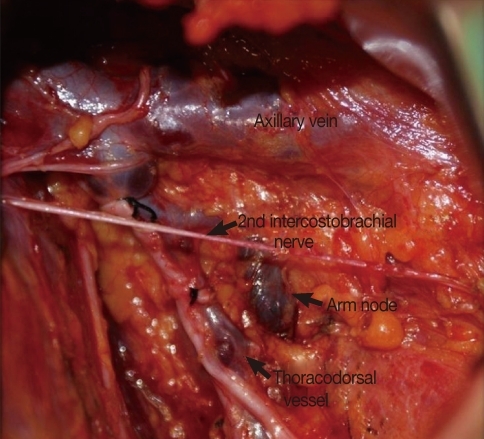
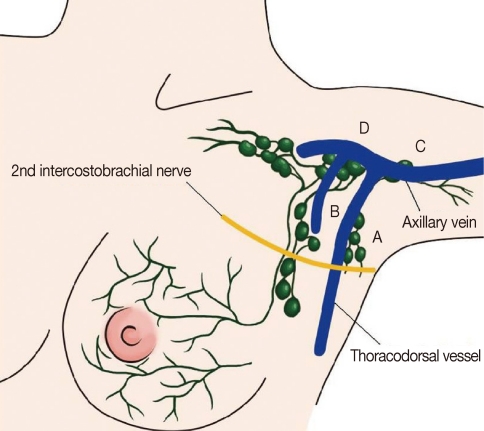
The mean number of identified blue stained arm nodes was 1.4±0.6. In the majority of patients (92%), arm nodes were located between the lower level of the axillary vein and just below the second intercostobrachial nerve. In the arm node unpreserved group, 2 patients had metastasis in their arm node. Among ALND patients, in the arm node preserved group, the difference in arm circumference between preoperative and postoperative time points in ipsilateral and contralateral arms was 0.27 cm and 0.07 cm, respectively, whereas it was 0.47 cm and -0.03 cm in the unpreserved group; one case of lymphedema was found after 6 months. No difference was found between arm node preserved and unpreserved group among SLNB patients.
Arm node preserving was possible in all breast cancer patients with identifiable arm nodes, during ALND or SLNB, except for those with high surgical N stage, and lymphedema did not develop in patients with arm node preserving surgery.
腋窝反向映射(ARM)技术旨在识别和保留腋窝淋巴结清扫术(SLNB 或 ALND)过程中的臂节点,以预防淋巴水肿。本研究旨在调查臂节点的位置和转移率,并评估臂节点保留手术后短期淋巴水肿的发生率。
2009 年 1 月至 2010 年 10 月,共纳入 97 例接受 ARM 的乳腺癌患者。将 2.5mL 蓝染料注入同侧上臂内侧。注射后至少 20 分钟后进行 SLNB 或 ALND,并识别蓝色染色的臂节点和/或淋巴管。患者分为两组,臂节点保留组(70 例患者行 ALND,10 例患者行 SLNB)和非保留组(13 例患者行 ALND,4 例患者行 SLNB)。两组均检查术前和术后臂围的差异。
平均识别到 1.4±0.6 个蓝色染色的臂节点。在大多数患者(92%)中,臂节点位于腋静脉下方水平和第二肋间臂神经下方。在非保留臂节点组中,2 例患者的臂节点有转移。在 ALND 患者中,臂节点保留组同侧和对侧臂围的术前和术后差值分别为 0.27cm 和 0.07cm,而非保留组为 0.47cm 和-0.03cm;术后 6 个月发现 1 例淋巴水肿。在 SLNB 患者中,臂节点保留组与非保留组之间无差异。
除了高手术 N 分期的患者外,所有可识别臂节点的乳腺癌患者在 SLNB 或 ALND 期间均可行臂节点保留,且臂节点保留手术的患者未发生淋巴水肿。