College of Oriental Medicine, Kyung Hee University, Seoul, South Korea.
PLoS One. 2012;7(4):e28706. doi: 10.1371/journal.pone.0028706. Epub 2012 Apr 6.
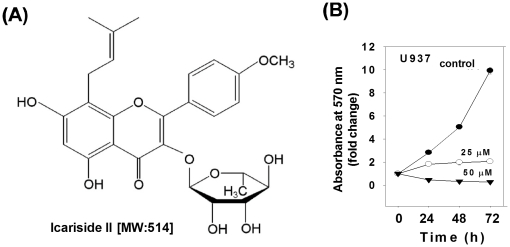
The aim of this study is to determine anti-cancer effect of Icariside II purified from the root of Epimedium koreanum Nakai on human acute myeloid leukemia (AML) cell line U937.
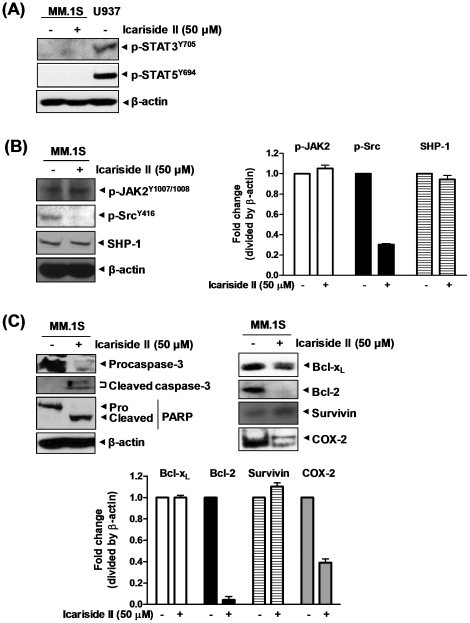
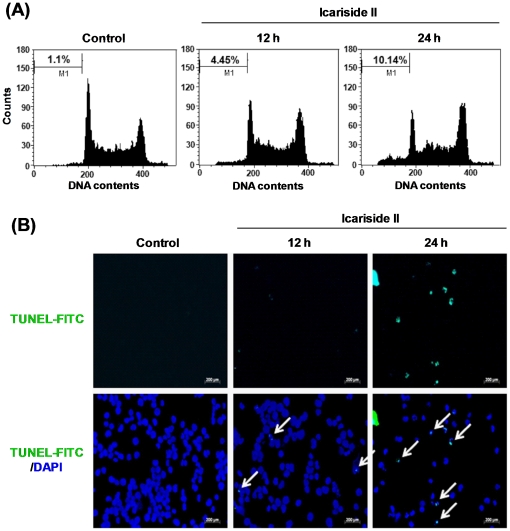
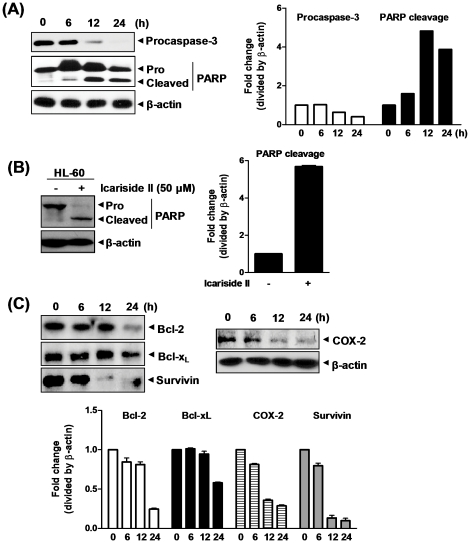
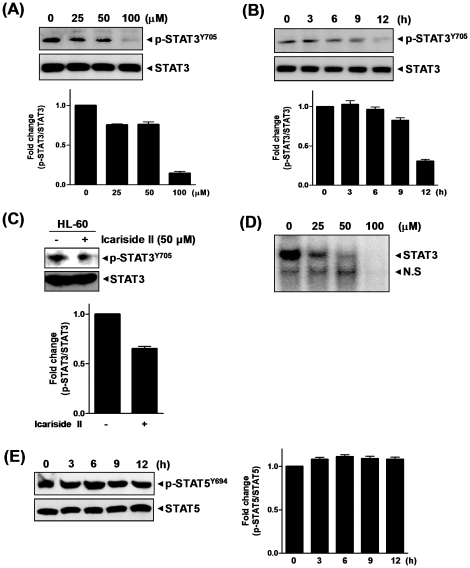
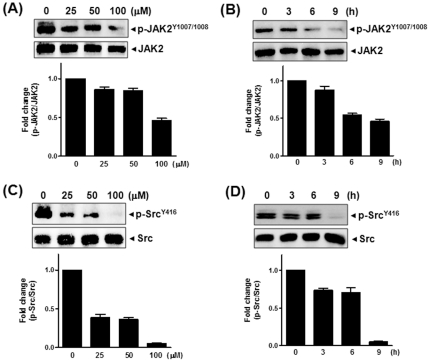
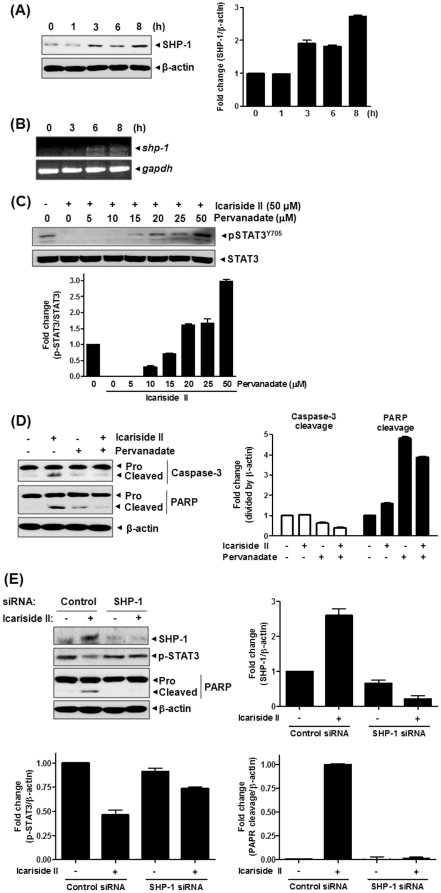
METHODOLOGY/PRINCIPAL FINDINGS: Icariside II blocked the growth U937 cells in a dose- and time-dependent manner. In this anti-proliferation process, this herb compound rendered the cells susceptible to apoptosis, manifested by enhanced accumulation of sub-G1 cell population and increased the terminal deoxynucleotidyl transferase dUTP nick end labeling (TUNEL)-positive cells. Icariside II was able to activate caspase-3 and cleaved poly (ADP-ribose) polymerase (PARP) in a time-dependent manner. Concurrently, the anti-apoptotic proteins, such as bcl-x(L) and survivin in U937 cells, were downregulated by Icariside II. In addition, Icariside II could inhibit STAT3 phosphorylation and function and subsequently suppress the activation of Janus activated kinase 2 (JAK2), the upstream activators of STAT3, in a dose- and time-dependent manner. Icariside II also enhanced the expression of protein tyrosine phosphatase (PTP) SH2 domain-containing phosphatase (SHP)-1, and the addition of sodium pervanadate (a PTP inhibitor) prevented Icariside II-induced apoptosis as well as STAT3 inactivation in STAT3 positive U937 cells. Furthermore, silencing SHP-1 using its specific siRNA significantly blocked STAT3 inactivation and apoptosis induced by Icariside II in U937 cells.
CONCLUSIONS/SIGNIFICANCE: Our results demonstrated that via targeting STAT3-related signaling, Icariside II sensitizes U937 cells to apoptosis and perhaps serves as a potent chemotherapeutic agent for AML.
本研究旨在确定从朝鲜淫羊藿根部纯化的淫羊藿次苷 II 对人急性髓系白血病 (AML) 细胞系 U937 的抗癌作用。
方法/主要发现:淫羊藿次苷 II 以剂量和时间依赖的方式阻断 U937 细胞的生长。在这个抗增殖过程中,这种草药化合物使细胞易发生凋亡,表现为亚 G1 细胞群的积累增加和末端脱氧核苷酸转移酶 dUTP 缺口末端标记 (TUNEL) 阳性细胞增多。淫羊藿次苷 II 能够在时间依赖性方式下激活 caspase-3 并切割聚 (ADP-核糖) 聚合酶 (PARP)。同时,抗凋亡蛋白,如 bcl-x(L) 和 survivin 在 U937 细胞中被淫羊藿次苷 II 下调。此外,淫羊藿次苷 II 可以在剂量和时间依赖性方式下抑制 STAT3 磷酸化和功能,从而抑制 STAT3 的上游激活剂 Janus 激活激酶 2 (JAK2) 的激活。淫羊藿次苷 II 还增强了蛋白酪氨酸磷酸酶 (PTP) SH2 结构域结合磷酸酶 (SHP)-1 的表达,而添加过钒酸钠 (一种 PTP 抑制剂) 可防止淫羊藿次苷 II 诱导的 STAT3 阳性 U937 细胞凋亡和 STAT3 失活。此外,使用其特异性 siRNA 沉默 SHP-1 可显著阻断淫羊藿次苷 II 诱导的 U937 细胞中 STAT3 失活和凋亡。
结论/意义:我们的结果表明,淫羊藿次苷 II 通过靶向 STAT3 相关信号通路,使 U937 细胞对凋亡敏感,可能成为 AML 的有效化疗药物。