Department of Pathology and Laboratory Medicine, Emory University School of Medicine, Atlanta, GA, USA.
BMC Cancer. 2012 Apr 11;12:145. doi: 10.1186/1471-2407-12-145.
Among American men, prostate cancer is the most common, non-cutaneous malignancy that accounted for an estimated 241,000 new cases and 34,000 deaths in 2011. Previous studies have suggested that Wnt pathway inhibitory genes are silenced by CpG hypermethylation, and other studies have suggested that genistein can demethylate hypermethylated DNA. Genistein is a soy isoflavone with diverse effects on cellular proliferation, survival, and gene expression that suggest it could be a potential therapeutic agent for prostate cancer. We undertook the present study to investigate the effects of genistein on the epigenome of prostate cancer cells and to discover novel combination approaches of other compounds with genistein that might be of translational utility. Here, we have investigated the effects of genistein on several prostate cancer cell lines, including the ARCaP-E/ARCaP-M model of the epithelial to mesenchymal transition (EMT), to analyze effects on their epigenetic state. In addition, we investigated the effects of combined treatment of genistein with the histone deacetylase inhibitor vorinostat on survival in prostate cancer cells.
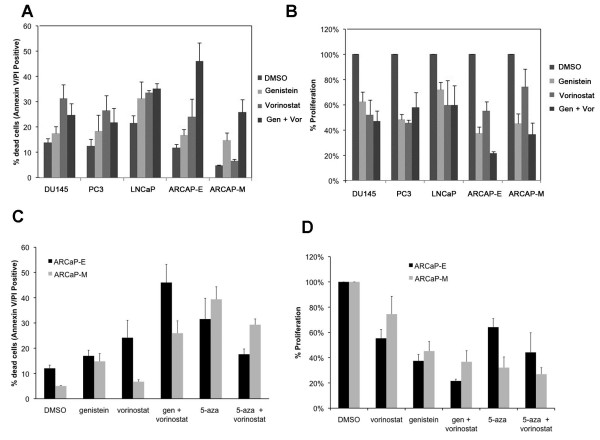
Using whole genome expression profiling and whole genome methylation profiling, we have determined the genome-wide differences in genetic and epigenetic responses to genistein in prostate cancer cells before and after undergoing the EMT. Also, cells were treated with genistein, vorinostat, and combination treatment, where cell death and cell proliferation was determined.
Contrary to earlier reports, genistein did not have an effect on CpG methylation at 20 μM, but it did affect histone H3K9 acetylation and induced increased expression of histone acetyltransferase 1 (HAT1). In addition, genistein also had differential effects on survival and cooperated with the histone deacteylase inhibitor vorinostat to induce cell death and inhibit proliferation.
Our results suggest that there are a number of pathways that are affected with genistein and vorinostat treatment such as Wnt, TNF, G2/M DNA damage checkpoint, and androgen signaling pathways. In addition, genistein cooperates with vorinostat to induce cell death in prostate cancer cell lines with a greater effect on early stage prostate cancer.
在美国男性中,前列腺癌是最常见的非皮肤恶性肿瘤,估计 2011 年有 241000 例新发病例和 34000 例死亡病例。先前的研究表明 Wnt 通路抑制基因被 CpG 过度甲基化沉默,其他研究表明染料木黄酮可以去甲基化过度甲基化的 DNA。染料木黄酮是一种具有多种细胞增殖、存活和基因表达作用的大豆异黄酮,这表明它可能是一种治疗前列腺癌的潜在治疗剂。我们进行了这项研究,以调查染料木黄酮对前列腺癌细胞表观基因组的影响,并发现与染料木黄酮联合使用的其他化合物的新组合方法可能具有转化用途。在这里,我们研究了染料木黄酮对几种前列腺癌细胞系的影响,包括上皮间质转化(EMT)的 ARCaP-E/ARCaP-M 模型,以分析对其表观遗传状态的影响。此外,我们还研究了染料木黄酮与组蛋白去乙酰化酶抑制剂伏立诺他联合治疗对前列腺癌细胞存活的影响。
使用全基因组表达谱和全基因组甲基化谱,我们确定了前列腺癌细胞在经历 EMT 前后对染料木黄酮的遗传和表观遗传反应的全基因组差异。此外,还对细胞进行了染料木黄酮、伏立诺他和联合治疗的处理,测定细胞死亡和细胞增殖情况。
与早期报道相反,20 μM 时染料木黄酮对 CpG 甲基化没有影响,但它确实影响组蛋白 H3K9 乙酰化,并诱导组蛋白乙酰转移酶 1(HAT1)的表达增加。此外,染料木黄酮对存活也有不同的影响,并与组蛋白去乙酰化酶抑制剂伏立诺他合作,诱导细胞死亡并抑制增殖。
我们的结果表明,有许多途径受到染料木黄酮和伏立诺他治疗的影响,如 Wnt、TNF、G2/M DNA 损伤检查点和雄激素信号通路。此外,染料木黄酮与伏立诺他合作,在早期前列腺癌中对前列腺癌细胞系诱导细胞死亡的效果更大。