Radiology and Diagnostic Imaging Department, Regina Elena Cancer Institute, Via Elio Chianesi 53, 00144, Rome, Italy.
J Exp Clin Cancer Res. 2012 Apr 11;31(1):33. doi: 10.1186/1756-9966-31-33.
To determine whether early monitoring of the effects of bevacizumab in patients with recurrent high-grade gliomas, by a Perfusion Computed Tomography (PCT), may be a predictor of the response to treatment assessed through conventional MRI follow-up.
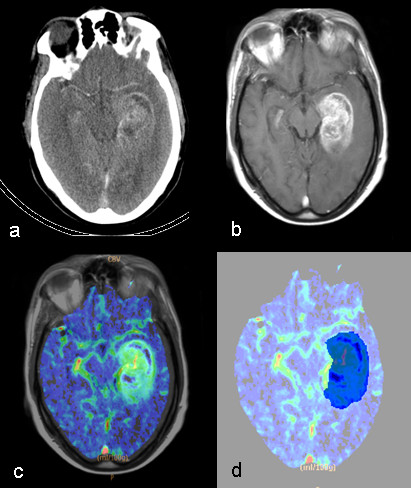
Sixteen patients were enrolled in the present study. For each patient, two PCT examinations, before and after the first dose of bevacizumab, were acquired. Areas of abnormal Cerebral Blood Volume (CBV) were manually defined on the CBV maps, using co-registered T1- weighted images, acquired before treatment, as a guide to the tumor location. Different perfusion metrics were derived from the histogram analysis of the normalized CBV (nCBV) maps; both hyper and hypo-perfused sub-volumes were quantified in the lesion, including tumor necrosis. A two-tailed Wilcoxon test was used to establish the significance of changes in the different perfusion metrics, observed at baseline and during treatment. The relationships between changes in perfusion and morphological MRI modifications at first follow-up were investigated.
Significant reductions in mean and median nCBV were detected throughout the entire patient population, after only a single dose of bevacizumab. The nCBV histogram modifications indicated the normalization effect of bevacizumab on the tumor abnormal vasculature. An improvement in hypoxia after a single dose of bevacizumab was predictive of a greater reduction in T1-weighted contrast-enhanced volumes at first follow-up.
These preliminary results show that a quantification of changes in necrotic intra-tumoral regions could be proposed as a potential imaging biomarker of tumor response to anti-VEGF therapies.
通过灌注计算机断层扫描(PCT)来早期监测复发性高级别胶质瘤患者贝伐单抗的疗效,这种方法是否可以作为通过常规 MRI 随访评估治疗反应的预测因子。
本研究纳入了 16 名患者。每位患者在接受贝伐单抗首剂量之前和之后分别进行了两次 PCT 检查。使用经治疗前 T1 加权图像配准的 CBV 图,手动定义异常脑血容量(CBV)区域,以作为肿瘤位置的指导。从归一化 CBV(nCBV)图的直方图分析中得出了不同的灌注指标;在病变中量化了高灌注和低灌注的亚体积,包括肿瘤坏死。采用双尾 Wilcoxon 检验来确定在基线和治疗期间观察到的不同灌注指标的变化的显著性。研究了灌注变化与首次随访时的形态学 MRI 改变之间的关系。
在整个患者群体中,仅接受单次贝伐单抗治疗后,平均和中位数 nCBV 均显著降低。nCBV 直方图的改变表明贝伐单抗对肿瘤异常血管的正常化作用。单次贝伐单抗治疗后缺氧的改善可预测首次随访时 T1 加权对比增强体积的更大减少。
这些初步结果表明,对坏死性肿瘤内区域变化的定量可以作为肿瘤对抗血管生成治疗反应的潜在影像学生物标志物。