Department of Evolutionary and Environmental Biology, University of Haifa, Haifa, Israel.
PLoS One. 2012;7(4):e32706. doi: 10.1371/journal.pone.0032706. Epub 2012 Apr 9.
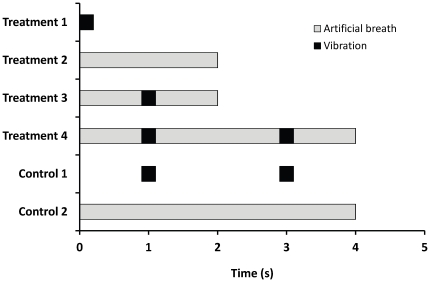
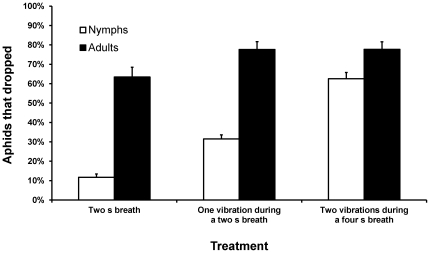
Mammalian herbivores may incidentally ingest plant-dwelling insects while foraging. Adult pea aphids (Acyrthosiphon pisum) avoid this danger by dropping off their host plant after sensing the herbivore's warm and humid breath and the vibrations it causes while feeding. Aphid nymphs may also drop (to escape insect enemies), but because of their slow movement, have a lower chance of finding a new plant. We compared dropping rates of first-instar nymphs with those of adults, after exposing pea aphids to different combinations of simulated mammalian breath and vibrations. We hypothesized that nymphs would compensate for the greater risk they face on the ground by interpreting more conservatively the mammalian herbivore cues they perceive. Most adults dropped in response to breath alone, but nymphs rarely did so. Breath stimulus accompanied by one concurrent vibrational stimulus, caused a minor rise in adult dropping rates. Adding a second vibration during breath had no additional effect on adults. The nymphs, however, relied on a combination of the two types of stimuli, with a threefold increase in dropping rates when the breath was accompanied by one vibration, and a further doubling of dropping rates when the second vibration was added. The age-specificity of the aphids' herbivore detection mechanism is probably an adaptation to the different cost of dropping for the different age groups. Relying on a combination of stimuli from two sensory modalities enables the vulnerable nymphs to avoid costly mistakes. Our findings emphasize the importance of the direct trophic effect of mammalian herbivory for plant-dwelling insects.
哺乳动物草食动物在觅食时可能会偶然摄入栖息在植物上的昆虫。成年豌豆蚜(Acyrthosiphon pisum)在感知到草食动物温暖潮湿的气息以及它在进食时引起的振动时,会从宿主植物上掉落下来,从而避免这种危险。蚜虫若虫也可能掉落(为了逃避昆虫敌人),但由于它们移动缓慢,找到新植物的机会较低。我们比较了暴露于模拟哺乳动物气息和振动的不同组合后,第一代若虫与成虫的掉落率。我们假设,若虫会通过更保守地解释它们感知到的哺乳动物食草动物线索,来弥补它们在地面上所面临的更大风险。大多数成虫仅对气息做出反应而掉落,但若虫很少这样做。气息刺激伴随着一个同时的振动刺激,会导致成虫掉落率略有上升。在气息中添加第二个振动对成虫没有额外影响。然而,若虫依赖于这两种类型的刺激的组合,当气息伴随着一个振动时,掉落率增加了三倍,当添加第二个振动时,掉落率进一步增加了一倍。蚜虫的这种特定于年龄的食草动物检测机制可能是对不同年龄组掉落成本的一种适应。依赖于来自两种感觉模态的刺激的组合,使脆弱的若虫能够避免代价高昂的错误。我们的发现强调了哺乳动物食草动物的直接营养效应对栖息在植物上的昆虫的重要性。