Molecular Plant Pathology Laboratory, Agricultural Research Service, United States Department of Agriculture, Beltsville, Maryland, United States of America.
PLoS One. 2012;7(4):e34673. doi: 10.1371/journal.pone.0034673. Epub 2012 Apr 4.
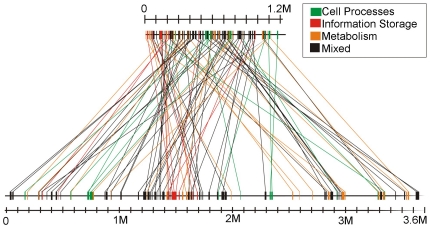
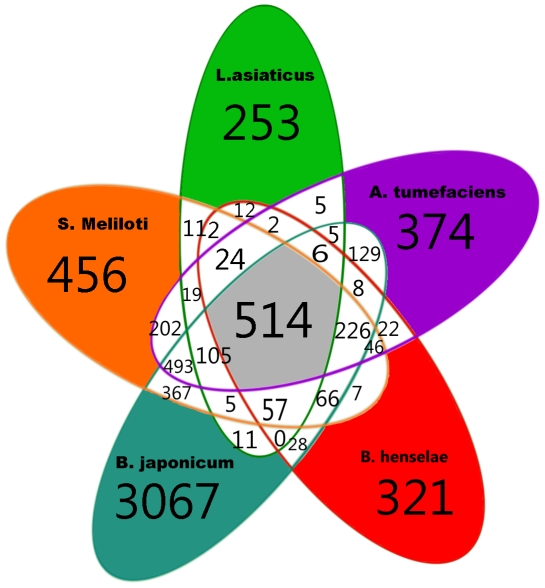
'Ca. Liberibacter asiaticus,' an insect-vectored, obligate intracellular bacterium associated with citrus-greening disease, also called "HLB," is a member of the Rhizobiales along with nitrogen-fixing microsymbionts Sinorhizobium meliloti and Bradyrhizobium japonicum, plant pathogen Agrobacterium tumefaciens and facultative intracellular mammalian pathogen Bartonella henselae. Comparative analyses of their circular chromosomes identified 514 orthologous genes shared among all five species. Shared among all five species are 50 identical blocks of microsyntenous orthologous genes (MOGs), containing a total of 283 genes. While retaining highly conserved genomic blocks of microsynteny, divergent evolution, horizontal gene transfer and niche specialization have disrupted macrosynteny among the five circular chromosomes compared. Highly conserved microsyntenous gene clusters help define the Rhizobiales, an order previously defined by 16S RNA gene similarity and herein represented by the three families: Bartonellaceae, Bradyrhizobiaceae and Rhizobiaceae. Genes without orthologs in the other four species help define individual species. The circular chromosomes of each of the five Rhizobiales species examined had genes lacking orthologs in the other four species. For example, 63 proteins are encoded by genes of 'Ca. Liberibacter asiaticus' not shared with other members of the Rhizobiales. Of these 63 proteins, 17 have predicted functions related to DNA replication or RNA transcription, and some of these may have roles related to low genomic GC content. An additional 17 proteins have predicted functions relevant to cellular processes, particularly modifications of the cell surface. Seventeen unshared proteins have specific metabolic functions including a pathway to synthesize cholesterol encoded by a seven-gene operon. The remaining 12 proteins encoded by 'Ca. Liberibacter asiaticus' genes not shared with other Rhizobiales are of bacteriophage origin. 'Ca. Liberibacter asiaticus' shares 11 genes with only Sinorhizobium meliloti and 12 genes are shared with only Bartonella henselae.
“亚洲韧皮杆菌”,一种由昆虫传播、专性细胞内的细菌,与柑橘黄龙病有关,也被称为“HLB”,是根瘤菌目(Rhizobiales)的成员之一,与固氮共生体苜蓿中华根瘤菌(Sinorhizobium meliloti)和慢生根瘤菌(Bradyrhizobium japonicum)、植物病原体根癌农杆菌(Agrobacterium tumefaciens)和兼性细胞内哺乳动物病原体汉赛巴尔通体(Bartonella henselae)有关。对它们的圆形染色体进行比较分析,确定了这五个物种共有的 514 个直系同源基因。这五个物种共有的 50 个相同的微同源基因块(MOGs),包含总共 283 个基因。虽然保留了高度保守的基因组微同源性,但与其他四个物种相比,五个圆形染色体之间的宏观同源性已经被分歧进化、水平基因转移和生态位特化所破坏。高度保守的微同源基因簇有助于定义根瘤菌目(Rhizobiales),该目以前是根据 16S RNA 基因相似性定义的,现在由三个科代表:巴尔通体科(Bartonellaceae)、慢生根瘤菌科(Bradyrhizobiaceae)和根瘤菌科(Rhizobiaceae)。在其他四个物种中没有直系同源基因的基因有助于定义各个物种。在所检查的五个根瘤菌目物种的圆形染色体中,都有基因在其他四个物种中没有直系同源基因。例如,63 种蛋白质由亚洲韧皮杆菌的基因编码,这些基因与根瘤菌目中的其他成员没有同源性。在这 63 种蛋白质中,有 17 种具有与 DNA 复制或 RNA 转录相关的预测功能,其中一些可能与低基因组 GC 含量有关。另外 17 种具有与细胞过程相关的预测功能,特别是与细胞表面修饰相关的功能。17 种具有特定代谢功能的未共享蛋白质包括一个由七个基因组成的操纵子编码的胆固醇合成途径。由亚洲韧皮杆菌基因编码但与其他根瘤菌目没有共享的其余 12 种蛋白质来源于噬菌体。亚洲韧皮杆菌只与苜蓿中华根瘤菌共享 11 个基因,只与汉赛巴尔通体共享 12 个基因。