Department of Genetics, North Carolina State University, Raleigh, North Carolina, United States of America.
PLoS One. 2012;7(4):e34745. doi: 10.1371/journal.pone.0034745. Epub 2012 Apr 4.
Aerobic organisms are susceptible to damage by reactive oxygen species. Oxidative stress resistance is a quantitative trait with population variation attributable to the interplay between genetic and environmental factors. Drosophila melanogaster provides an ideal system to study the genetics of variation for resistance to oxidative stress.
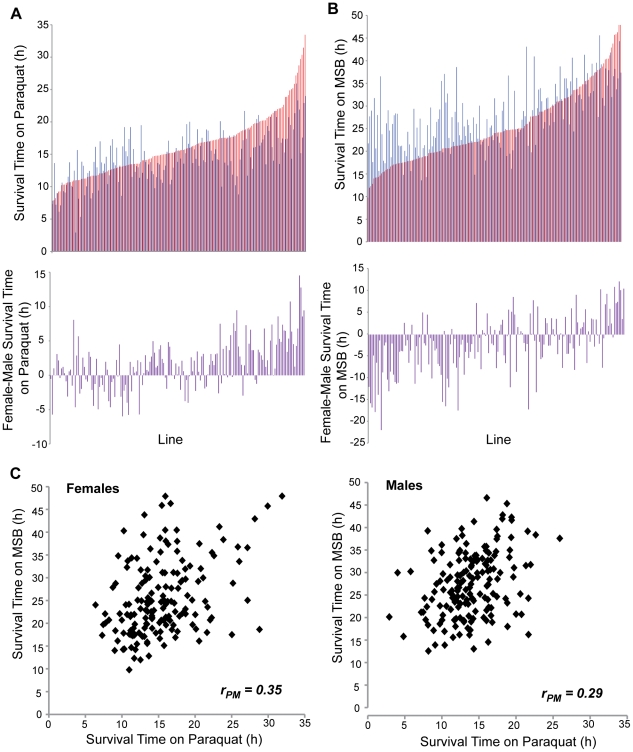
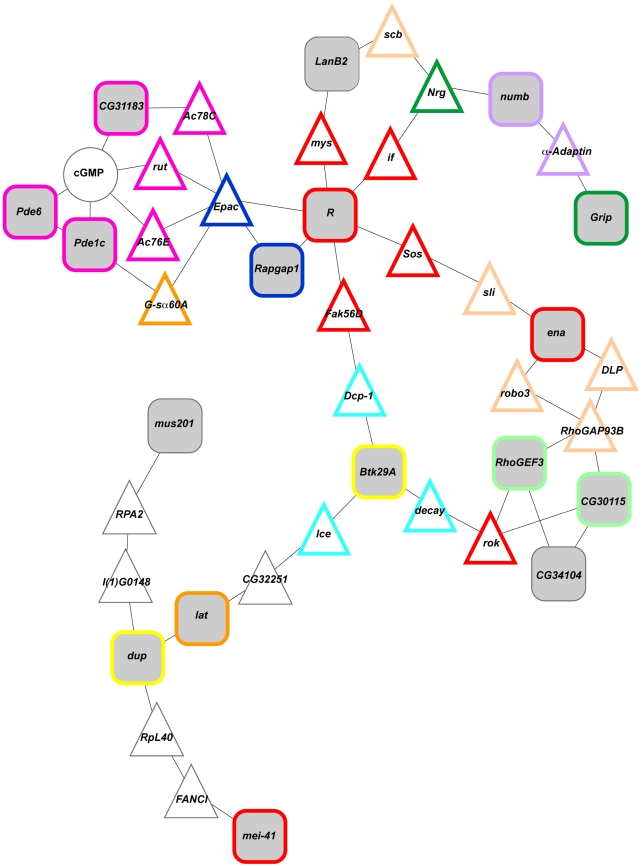
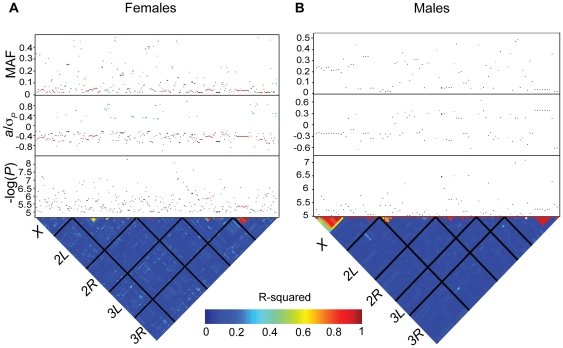
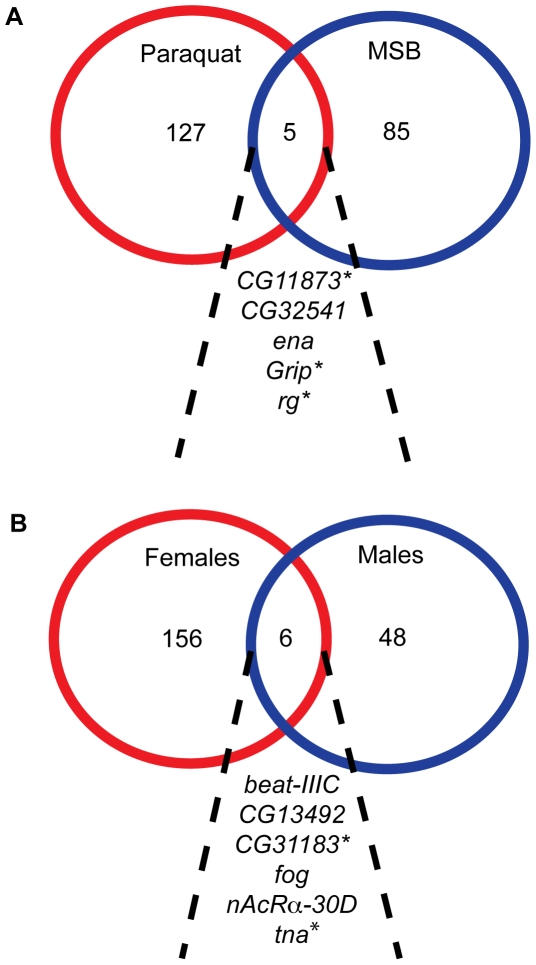
We used 167 wild-derived inbred lines of the Drosophila Genetic Reference Panel for a genome-wide association study of acute oxidative stress resistance to two oxidizing agents, paraquat and menadione sodium bisulfite. We found significant genetic variation for both stressors. Single nucleotide polymorphisms (SNPs) associated with variation in oxidative stress resistance were often sex-specific and agent-dependent, with a small subset common for both sexes or treatments. Associated SNPs had moderately large effects, with an inverse relationship between effect size and allele frequency. Linear models with up to 12 SNPs explained 67-79% and 56-66% of the phenotypic variance for resistance to paraquat and menadione sodium bisulfite, respectively. Many genes implicated were novel with no known role in oxidative stress resistance. Bioinformatics analyses revealed a cellular network comprising DNA metabolism and neuronal development, consistent with targets of oxidative stress-inducing agents. We confirmed associations of seven candidate genes associated with natural variation in oxidative stress resistance through mutational analysis.
We identified novel candidate genes associated with variation in resistance to oxidative stress that have context-dependent effects. These results form the basis for future translational studies to identify oxidative stress susceptibility/resistance genes that are evolutionary conserved and might play a role in human disease.
需氧生物易受到活性氧的损伤。氧化应激抗性是一种具有群体变异的数量性状,归因于遗传和环境因素的相互作用。黑腹果蝇为研究对氧化应激的抗性的遗传变异提供了一个理想的系统。
我们使用了 167 个源自黑腹果蝇遗传参考面板的野生近交系,对两种氧化剂(百草枯和亚硫酸氢钠甲萘醌)的急性氧化应激抗性进行了全基因组关联研究。我们发现两种应激源都存在显著的遗传变异。与氧化应激抗性变异相关的单核苷酸多态性(SNP)通常是性别特异性和试剂依赖性的,有一小部分 SNP 对两性或两种处理都通用。相关的 SNP 具有中等大小的效应,效应大小与等位基因频率呈反比。具有多达 12 个 SNP 的线性模型分别解释了百草枯和亚硫酸氢钠甲萘醌抗性的 67-79%和 56-66%的表型方差。许多涉及的基因是新颖的,与氧化应激抗性无关。生物信息学分析揭示了一个包含 DNA 代谢和神经元发育的细胞网络,这与氧化应激诱导剂的靶标一致。我们通过突变分析证实了与氧化应激抗性自然变异相关的七个候选基因的关联。
我们鉴定了与氧化应激抗性变异相关的新候选基因,这些基因具有上下文相关的效应。这些结果为未来的转化研究奠定了基础,以确定进化保守且可能在人类疾病中发挥作用的氧化应激易感性/抗性基因。