Department of Nutrition Sciences, University of Alabama at Birmingham, Birmingham, AL 35294-3360, USA.
BMC Genomics. 2010 May 11;11:297. doi: 10.1186/1471-2164-11-297.
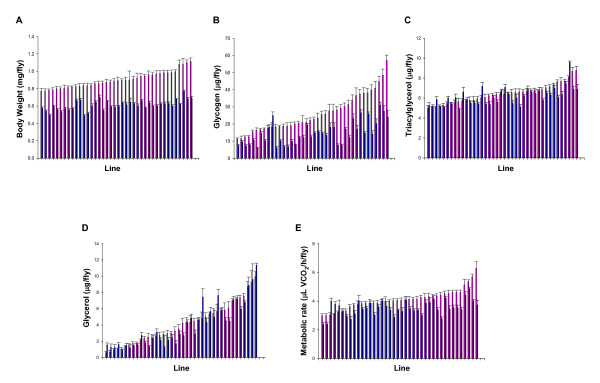
Obesity and phenotypic traits associated with this condition exhibit significant heritability in natural populations of most organisms. While a number of genes and genetic pathways have been implicated to play a role in obesity associated traits, the genetic architecture that underlies the natural variation in these traits is largely unknown. Here, we used 40 wild-derived inbred lines of Drosophila melanogaster to quantify genetic variation in body weight, the content of three major metabolites (glycogen, triacylglycerol, and glycerol) associated with obesity, and metabolic rate in young flies. We chose these lines because they were previously screened for variation in whole-genome transcript abundance and in several adult life-history traits, including longevity, resistance to starvation stress, chill-coma recovery, mating behavior, and competitive fitness. This enabled us not only to identify candidate genes and transcriptional networks that might explain variation for energy metabolism traits, but also to investigate the genetic interrelationships among energy metabolism, behavioral, and life-history traits that have evolved in natural populations.
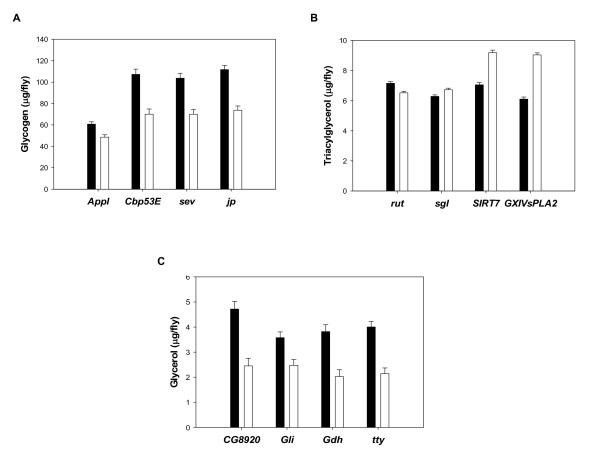
We found significant genetically based variation in all traits. Using a genome-wide association screen for single feature polymorphisms and quantitative trait transcripts, we identified 337, 211, 237, 553, and 152 novel candidate genes associated with body weight, glycogen content, triacylglycerol storage, glycerol levels, and metabolic rate, respectively. Weighted gene co-expression analyses grouped transcripts associated with each trait in significant modules of co-expressed genes and we interpreted these modules in terms of their gene enrichment based on Gene Ontology analysis. Comparison of gene co-expression modules for traits in this study with previously determined modules for life-history traits identified significant modular pleiotropy between glycogen content, body weight, competitive fitness, and starvation resistance.
Combining a large phenotypic dataset with information on variation in genome wide transcriptional profiles has provided insight into the complex genetic architecture underlying natural variation in traits that have been associated with obesity. Our findings suggest that understanding the maintenance of genetic variation in metabolic traits in natural populations may require that we understand more fully the degree to which these traits are genetically correlated with other traits, especially those directly affecting fitness.
在大多数生物的自然种群中,肥胖和与之相关的表型特征表现出显著的遗传性。虽然已经有许多基因和遗传途径被认为在肥胖相关特征中发挥作用,但这些特征的自然变异所基于的遗传结构在很大程度上是未知的。在这里,我们使用 40 条野生衍生的黑腹果蝇近交系来量化体重、与肥胖相关的三种主要代谢物(糖原、三酰甘油和甘油)含量以及年轻果蝇代谢率的遗传变异。我们选择这些系是因为它们之前曾被筛选过全基因组转录丰度和几种成年生活史特征的变异,包括寿命、抗饥饿应激能力、冷昏迷恢复能力、交配行为和竞争适应能力。这使我们不仅能够识别可能解释能量代谢特征变异的候选基因和转录网络,还能够研究在自然种群中进化的能量代谢、行为和生活史特征之间的遗传相互关系。
我们发现所有特征都存在显著的遗传基础变异。通过对单一特征多态性和数量性状转录本进行全基因组关联筛选,我们分别鉴定出与体重、糖原含量、三酰甘油储存、甘油水平和代谢率相关的 337、211、237、553 和 152 个新的候选基因。加权基因共表达分析将与每个特征相关的转录本分组到共表达基因的显著模块中,我们根据基因本体论分析来解释这些模块。将本研究中与生活史特征相关的性状的基因共表达模块与以前确定的生活史特征模块进行比较,发现了糖原含量、体重、竞争适应能力和抗饥饿能力之间显著的模块多效性。
将大型表型数据集与全基因组转录谱变异信息相结合,深入了解了与肥胖相关的特征的自然变异所基于的复杂遗传结构。我们的研究结果表明,要了解自然种群中代谢特征遗传变异的维持情况,可能需要我们更全面地了解这些特征与其他特征(特别是直接影响适应性的特征)在遗传上的相关性。