Swiss National Center for Retroviruses, Institute of Medical Virology, University of Zurich, Switzerland.
BMC Infect Dis. 2012 Apr 12;12:88. doi: 10.1186/1471-2334-12-88.
Serologic testing algorithms for recent HIV seroconversion (STARHS) provide important information for HIV surveillance. We have previously demonstrated that a patient's antibody reaction pattern in a confirmatory line immunoassay (INNO-LIA™ HIV I/II Score) provides information on the duration of infection, which is unaffected by clinical, immunological and viral variables. In this report we have set out to determine the diagnostic performance of Inno-Lia algorithms for identifying incident infections in patients with known duration of infection and evaluated the algorithms in annual cohorts of HIV notifications.
Diagnostic sensitivity was determined in 527 treatment-naive patients infected for up to 12 months. Specificity was determined in 740 patients infected for longer than 12 months. Plasma was tested by Inno-Lia and classified as either incident (< = 12 m) or older infection by 26 different algorithms. Incident infection rates (IIR) were calculated based on diagnostic sensitivity and specificity of each algorithm and the rule that the total of incident results is the sum of true-incident and false-incident results, which can be calculated by means of the pre-determined sensitivity and specificity.
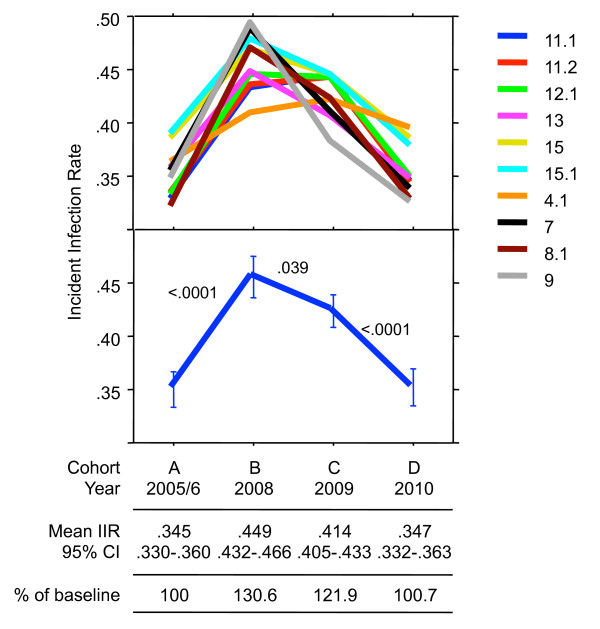
The 10 best algorithms had a mean raw sensitivity of 59.4% and a mean specificity of 95.1%. Adjustment for overrepresentation of patients in the first quarter year of infection further reduced the sensitivity. In the preferred model, the mean adjusted sensitivity was 37.4%. Application of the 10 best algorithms to four annual cohorts of HIV-1 notifications totalling 2'595 patients yielded a mean IIR of 0.35 in 2005/6 (baseline) and of 0.45, 0.42 and 0.35 in 2008, 2009 and 2010, respectively. The increase between baseline and 2008 and the ensuing decreases were highly significant. Other adjustment models yielded different absolute IIR, although the relative changes between the cohorts were identical for all models.
The method can be used for comparing IIR in annual cohorts of HIV notifications. The use of several different algorithms in combination, each with its own sensitivity and specificity to detect incident infection, is advisable as this reduces the impact of individual imperfections stemming primarily from relatively low sensitivities and sampling bias.
近期 HIV 血清转换的血清学检测算法(STARHS)为 HIV 监测提供了重要信息。我们之前已经证明,患者在确认性线免疫分析(INNO-LIA™ HIV I/II Score)中的抗体反应模式提供了有关感染持续时间的信息,而感染持续时间不受临床、免疫和病毒变量的影响。在本报告中,我们旨在确定用于识别具有已知感染持续时间的患者中新发感染的 Inno-Lia 算法的诊断性能,并评估年度 HIV 通知队列中的算法。
在感染时间最长达 12 个月的 527 名未经治疗的初治患者中确定诊断敏感性。在感染时间超过 12 个月的 740 名患者中确定特异性。通过 Inno-Lia 检测血浆,并根据 26 种不同算法将其分类为新发感染(< = 12 个月)或旧感染。根据每种算法的诊断敏感性和特异性以及总新发结果是真新发和假新发结果之和的规则,计算新发感染率(IIR),这可以通过预定的敏感性和特异性来计算。
10 种最佳算法的平均原始敏感性为 59.4%,平均特异性为 95.1%。对感染第一年的患者人数过多进行调整进一步降低了敏感性。在首选模型中,平均调整后的敏感性为 37.4%。将 10 种最佳算法应用于四个年度 HIV-1 通知队列,共 2595 名患者,2005/6 年(基线)的平均 IIR 为 0.35,2008、2009 和 2010 年分别为 0.45、0.42 和 0.35。基线与 2008 年之间的增加以及随后的减少具有高度显著性。其他调整模型产生了不同的绝对 IIR,尽管所有模型的队列之间的相对变化是相同的。
该方法可用于比较年度 HIV 通知队列中的 IIR。使用几种不同的算法结合使用,每种算法都具有检测新发感染的敏感性和特异性,可以减少主要源于相对低敏感性和抽样偏差的个别缺陷的影响。