Kong Wen-Hua, Liu Pan, Tang Li, Zhu Ze-Rong, Xiao Peng, Zhan Jian-Bo, Wang Xia, Zhou Wang, Liu Man-Qing
Department of Pathogen, Wuhan Centers for Disease Prevention and Control, Wuhan, China.
Hubei Provincial Center for Disease Control and Prevention, Wuhan, China.
Front Microbiol. 2019 Jun 12;10:1322. doi: 10.3389/fmicb.2019.01322. eCollection 2019.
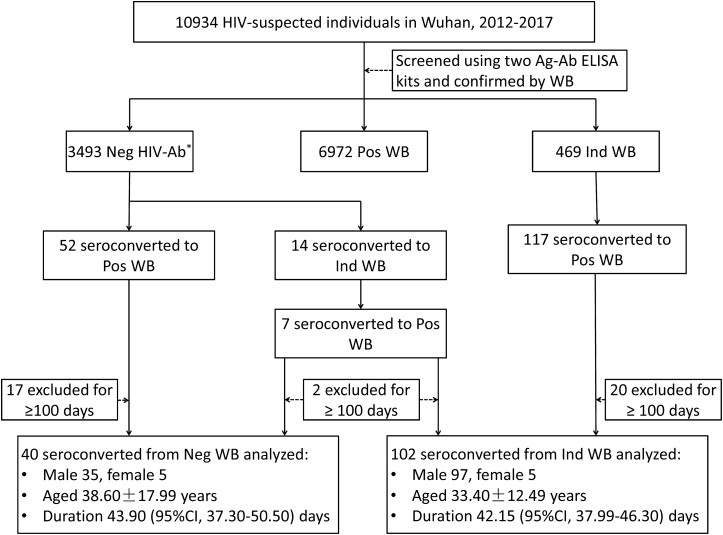
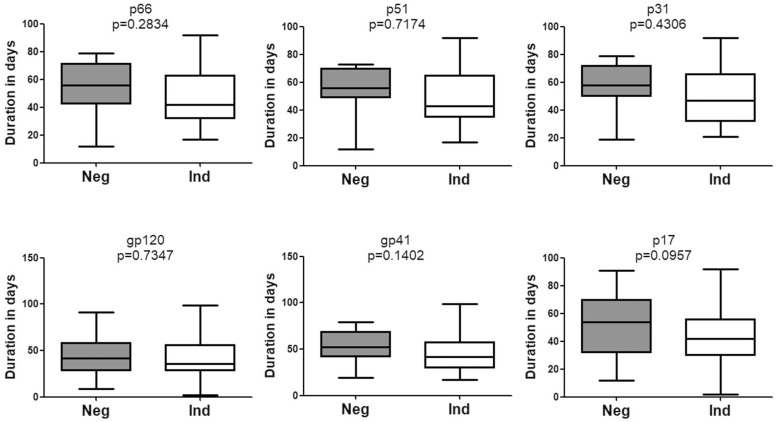
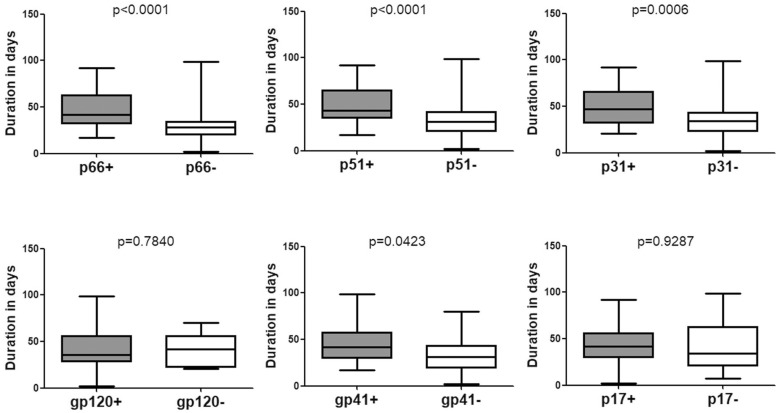
The identification of recent HIV-1 infection is clinically important for the effective treatment and prevention of transmission. However, the window period for seroconversion with respect to various HIV-1 antibodies is not well characterized. In addition, the routine HIV testing algorithms are not particularly appropriate for the identification of recent HIV-1 infection. In this study, we enrolled individuals who showed seroconversion from negative Western blot (WB) or indeterminate WB results and analyzed the window periods for appearance of HIV-1 antibodies. A total of 10,934 individuals with suspected HIV infection were tested by Wuhan CDC between 2012 and 2017; of these, 40 individuals with initial negative WB and 102 individuals with initial indeterminate WB who showed positive WB results within 100 days were included in the analysis. The mean time for seroconversion was 43.90 (95% confidence interval [CI]: 37.30-50.50) days and 42.15 (95% CI: 37.99-46.30) days, respectively. The time duration for p31 seroconversion among people with negative WB and indeterminate WB was 58.11 (95% CI, 44.30-71.92) days and 51.91 (95% CI, 44.55-59.28) days, respectively, both of which were significantly longer ( = 0.0169) than those in people without p31 seroconversion. A similar difference was observed with respect to p66 seroconversion, with a window time of 53.53 (95% CI, 43.54-63.52) days and 47.87 (95% CI, 43.16-52.57) days among people with negative WB and indeterminate WB, respectively. These data suggest that HIV-1 antibody p66, like p31, may serve as a potential serological marker for distinguishing Fiebig stage V and stage VI at day 70 post-infection.
识别近期HIV-1感染对于有效治疗和预防传播具有临床重要性。然而,各种HIV-1抗体血清转化的窗口期尚未得到很好的界定。此外,常规的HIV检测算法对于识别近期HIV-1感染并不特别适用。在本研究中,我们纳入了那些从阴性免疫印迹(WB)或不确定WB结果转为阳性的个体,并分析了HIV-1抗体出现的窗口期。2012年至2017年期间,武汉市疾病预防控制中心对总共10934名疑似HIV感染的个体进行了检测;其中,40名初始WB为阴性且102名初始WB不确定但在100天内WB结果转为阳性的个体被纳入分析。血清转化的平均时间分别为43.90(95%置信区间[CI]:37.30 - 50.50)天和42.15(95%CI:37.99 - 46.30)天。WB阴性和不确定个体中p31血清转化的持续时间分别为58.11(95%CI,44.30 - 71.92)天和51.91(95%CI,44.55 - 59.28)天,两者均显著长于(P = 0.0169)无p31血清转化的个体。在p66血清转化方面也观察到类似差异,WB阴性和不确定个体的窗口期分别为53.53(95%CI,43.54 - 63.52)天和47.87(95%CI,43.16 - 52.57)天。这些数据表明,HIV-1抗体p66与p31一样,可能作为一种潜在的血清学标志物,用于在感染后第70天区分Fiebig V期和VI期。