Department of Molecular and Cellular Biology, Harvard University, Cambridge, MA 02138, USA.
Science. 2012 May 11;336(6082):721-4. doi: 10.1126/science.1221920. Epub 2012 Apr 12.
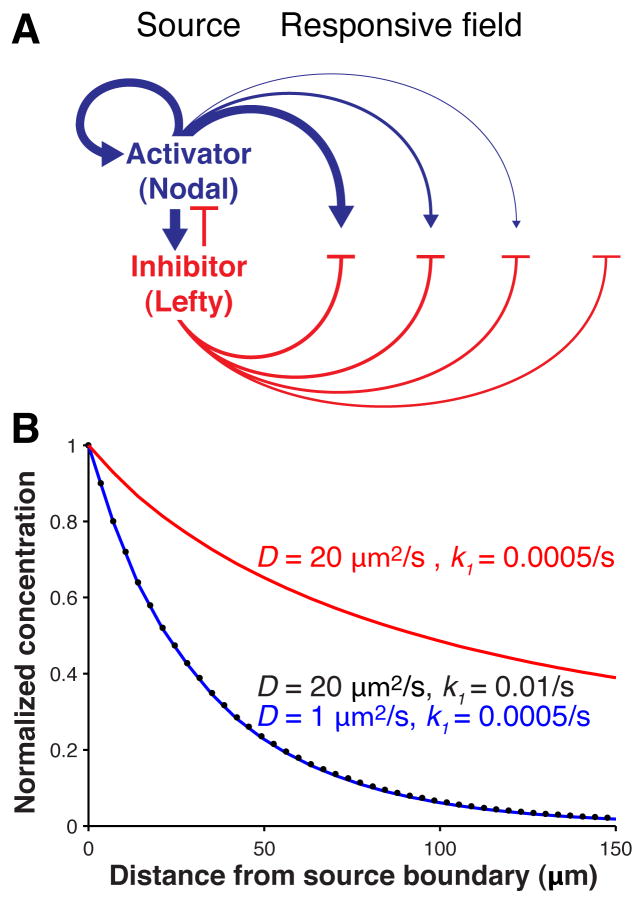
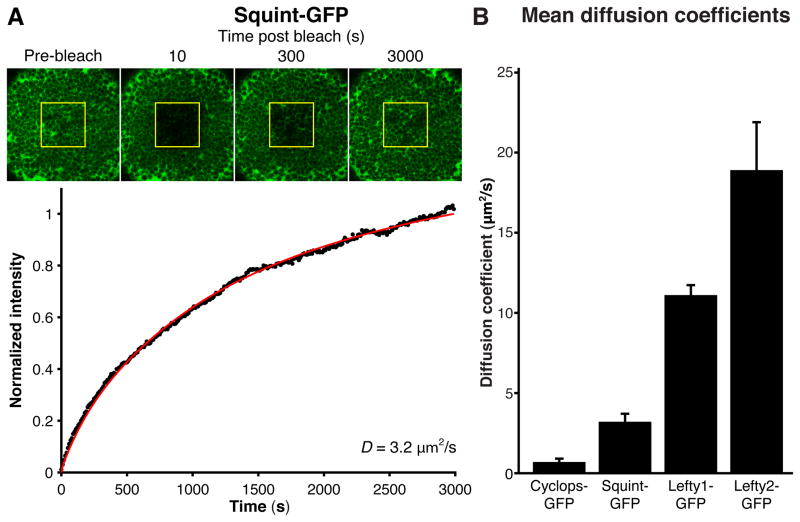
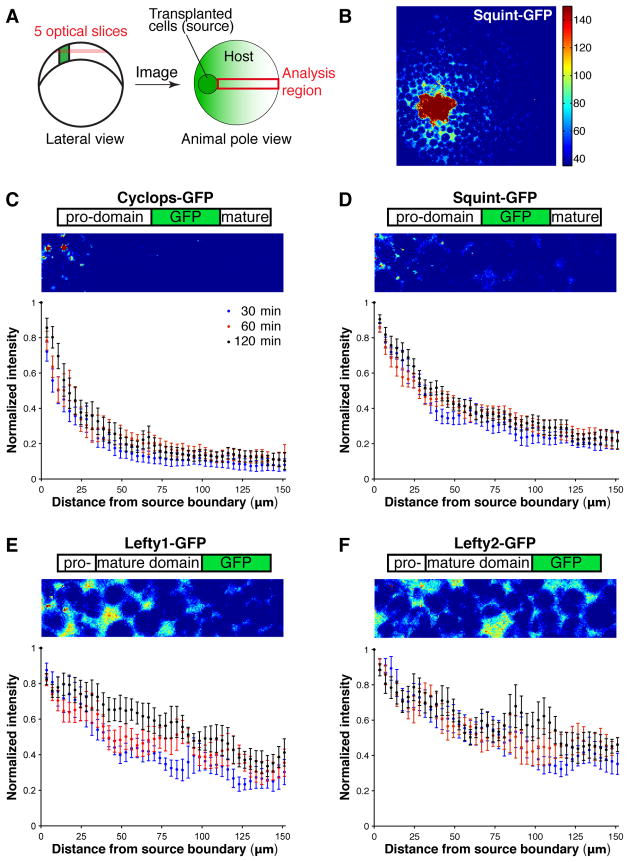
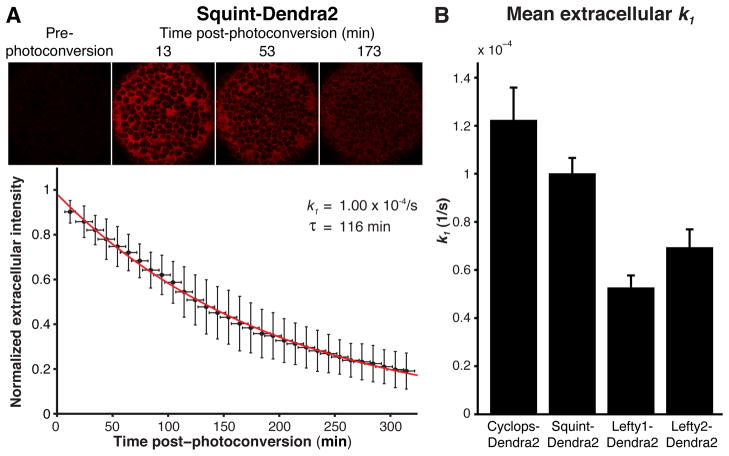
Biological systems involving short-range activators and long-range inhibitors can generate complex patterns. Reaction-diffusion models postulate that differences in signaling range are caused by differential diffusivity of inhibitor and activator. Other models suggest that differential clearance underlies different signaling ranges. To test these models, we measured the biophysical properties of the Nodal/Lefty activator/inhibitor system during zebrafish embryogenesis. Analysis of Nodal and Lefty gradients revealed that Nodals have a shorter range than Lefty proteins. Pulse-labeling analysis indicated that Nodals and Leftys have similar clearance kinetics, whereas fluorescence recovery assays revealed that Leftys have a higher effective diffusion coefficient than Nodals. These results indicate that differential diffusivity is the major determinant of the differences in Nodal/Lefty range and provide biophysical support for reaction-diffusion models of activator/inhibitor-mediated patterning.
涉及短程激活剂和远程抑制剂的生物系统可以产生复杂的模式。反应扩散模型假设信号范围的差异是由抑制剂和激活剂的扩散率差异引起的。其他模型则表明,不同的清除率是导致不同信号范围的原因。为了验证这些模型,我们在斑马鱼胚胎发生过程中测量了 Nodal/Lefty 激活剂/抑制剂系统的生物物理特性。对 Nodal 和 Lefty 梯度的分析表明,Nodals 的范围比 Lefty 蛋白短。脉冲标记分析表明,Nodals 和 Leftys 具有相似的清除动力学,而荧光恢复实验表明,Leftys 的有效扩散系数高于 Nodals。这些结果表明,扩散率差异是 Nodal/Lefty 范围差异的主要决定因素,并为激活剂/抑制剂介导的模式形成的反应扩散模型提供了生物物理支持。