Department of Oncology, University Hospital of Northern Norway, 9038 Tromsø, Norway.
Radiat Oncol. 2012 Apr 13;7:59. doi: 10.1186/1748-717X-7-59.
Cancer-Associated Fibroblasts (CAFs) are significant components of solid malignancies and play central roles in cancer sustainability, invasion and metastasis. In this study we have investigated the invasive capacity and matrix remodelling properties of human lung CAFs after exposure to ablative doses of ionizing radiation (AIR), equivalent to single fractions delivered by stereotactic ablative radiotherapy (SART) for medically inoperable stage-I/II non-small-cell lung cancers.
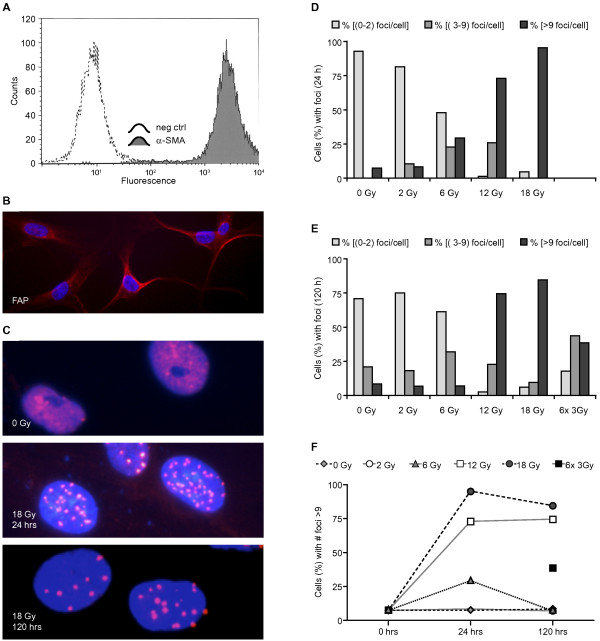
CAFs were isolated from lung tumour specimens from 16 donors. Initially, intrinsic radiosensitivity was evaluated by checking viability and extent of DNA-damage response (DDR) at different radiation doses. The migrative and invasive capacities of CAFs were thereafter determined after a sub-lethal single radiation dose of 18 Gy. To ascertain the mechanisms behind the altered invasive capacity of cells, expression of matrix metalloproteinases (MMPs) and their endogenous inhibitors (TIMPs) were measured in the conditioned media several days post-irradiation, along with expression of cell surface integrins and dynamics of focal contacts by vinculin-staining.
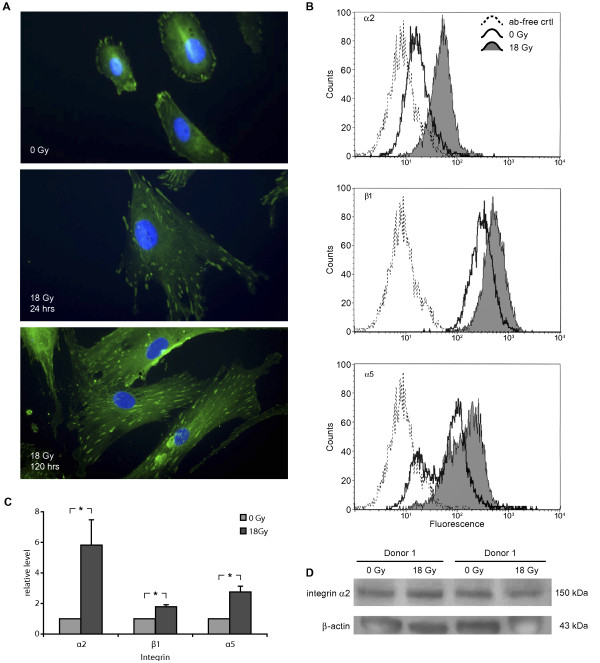
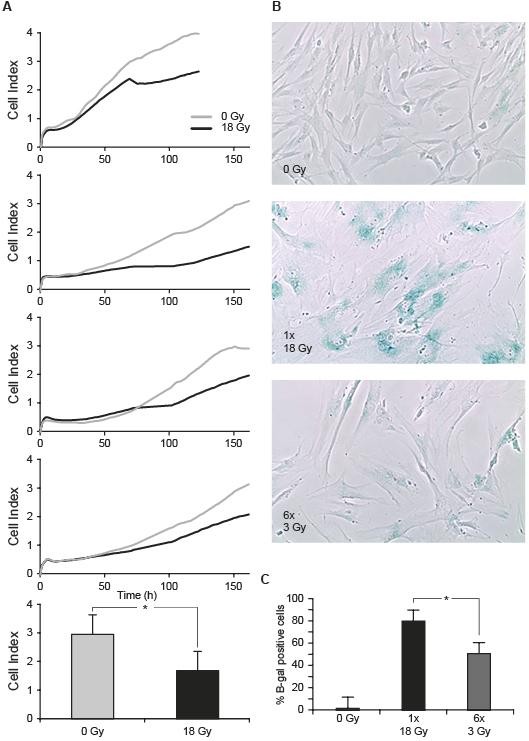
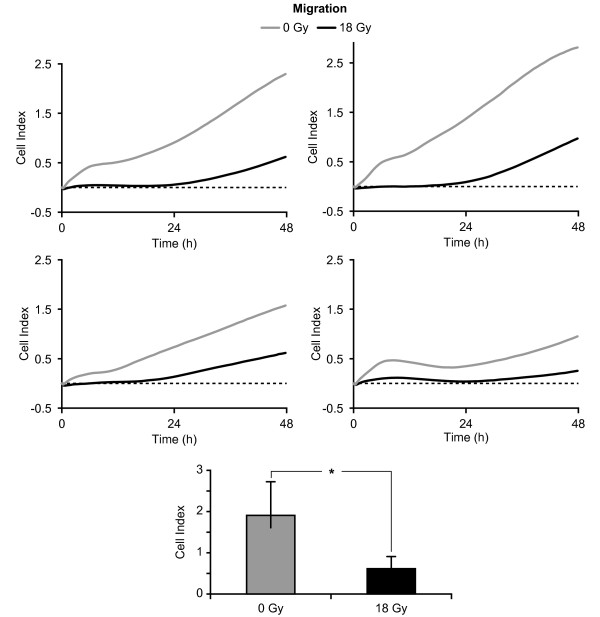
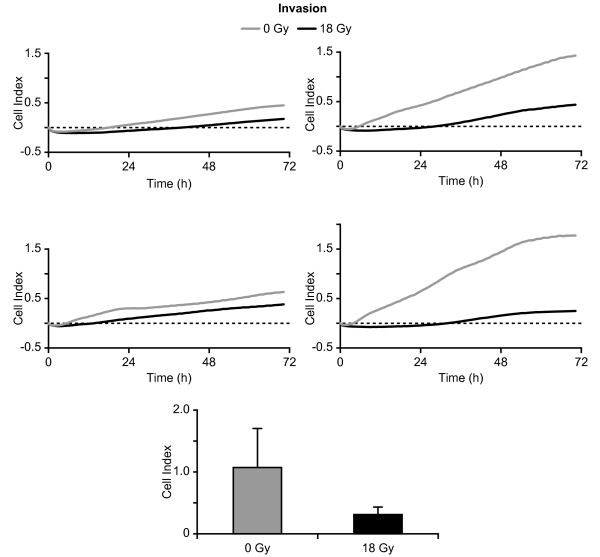
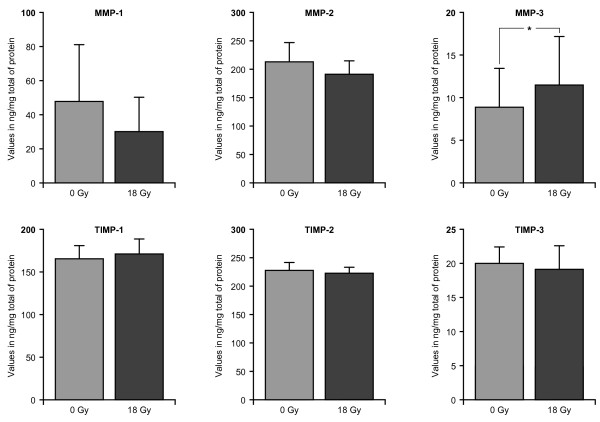
Exposing CAFs to 1 × 18 Gy resulted in a potent induction of multiple nuclear DDR foci (> 9/cell) with little resolution after 120 h, induced premature cellular senescence and inhibition of the proliferative, migrative and invasive capacity. AIR promoted MMP-3 and inhibited MMP-1 appearance to some extent, but did not affect expression of other major MMPs. Furthermore, surface expression of integrins α2, β1 and α5 was consistently enhanced, and a dramatic augmentation and redistribution of focal contacts was observed.
Our data indicate that ablative doses of radiation exert advantageous inhibitory effects on the proliferative, migratory and invasive capacity of lung CAFs. The reduced motility of irradiated CAFs might be a consequence of stabilized focal contacts via integrins.
癌症相关成纤维细胞(CAFs)是实体恶性肿瘤的重要组成部分,在癌症的持续性、侵袭和转移中发挥核心作用。在这项研究中,我们研究了人肺 CAFs 在暴露于消融剂量的电离辐射(AIR)后,对其侵袭能力和基质重塑特性的影响,这种辐射剂量相当于立体定向消融放疗(SART)为无法手术的 I/II 期非小细胞肺癌患者提供的单次分割剂量。
从 16 位供体的肺肿瘤标本中分离出 CAFs。最初,通过检查不同辐射剂量下的细胞活力和 DNA 损伤反应(DDR)的程度来评估固有放射敏感性。然后,在亚致死性单次 18 Gy 辐射剂量后,确定 CAFs 的迁移和侵袭能力。为了确定细胞侵袭能力改变的机制,在照射后几天,通过测定条件培养基中的基质金属蛋白酶(MMPs)及其内源性抑制剂(TIMPs)的表达,以及通过 vinculin 染色测定细胞表面整合素的表达和焦点接触的动力学,来确定细胞侵袭能力改变的机制。
将 CAFs 暴露于 1×18 Gy 会导致多个核 DDR 焦点(>9/细胞)的强烈诱导,120 小时后很少有缓解,导致过早的细胞衰老和增殖、迁移和侵袭能力的抑制。AIR 在一定程度上促进了 MMP-3 的出现并抑制了 MMP-1 的出现,但不影响其他主要 MMP 的表达。此外,整合素α2、β1 和α5 的表面表达持续增强,焦点接触的急剧增加和重新分布。
我们的数据表明,消融剂量的辐射对肺 CAFs 的增殖、迁移和侵袭能力具有有利的抑制作用。照射后的 CAFs 运动能力降低可能是由于整合素稳定了焦点接触。