Department of Neurology, Miller School of Medicine, University of Miami, FL, USA.
Atherosclerosis. 2012 Jul;223(1):177-83. doi: 10.1016/j.atherosclerosis.2012.03.025. Epub 2012 Mar 27.
Carotid plaque is a marker of subclinical atherosclerosis with a genetic component. The aim of this follow-up fine mapping study was to identify candidate genes for carotid plaque within four linkage regions.
We successfully genotyped 3712 single nucleotide polymorphisms (SNPs) under the four linkage regions that were previously identified in 100 extended Dominican families. Family-based association tests were performed to investigate their associations with carotid plaque. Promising SNPs were evaluated in an independent population-based subcohort (N=941, 384 Dominicans) from the Northern Manhattan Study (NOMAS).
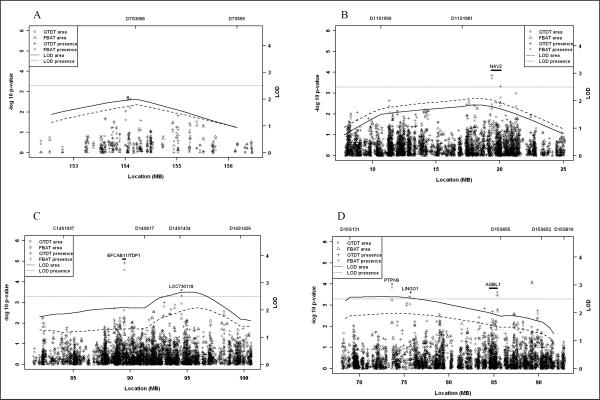
In the family study, evidence for association (p<0.0005) was found regarding several genes (NAV2, EFCAB11/TDP1, AGBL1, PTPN9, LINGO1 and LOC730118), with the strongest association at rs4143999 near EFCAB11/TDP1 (p=0.00001 for carotid presence and 0.00003 for plaque area, multiple testing corrected p≤0.02). The association in AGBL1 and PTPN9 was mainly driven by the families with linkage evidence (p=0.00008-0.00001 and 0.76-0.32, respectively, in the families with and without linkage evidence). However, these associations explained only a small portion of the observed linkage. In NOMAS, replication (p<0.05 in the whole NOMAS subcohort and p<0.10 in the smaller Dominican subcohort) was found for SNPs within/near EFCAB11, NAV2, AGBL1 and other genes.
This follow-up study has identified multiple candidate genes for carotid plaque in the Dominican population. Many of these genes have been implicated in neurodegenerative and cardiovascular diseases. Further studies with in-depth re-sequencing are needed to uncover both rare and common functional variants that contribute to the susceptibility to atherosclerosis.
颈动脉斑块是亚临床动脉粥样硬化的标志物,具有遗传成分。本随访精细定位研究的目的是在四个连锁区域内鉴定颈动脉斑块的候选基因。
我们成功地对先前在 100 个扩展多米尼加家庭中确定的四个连锁区域下的 3712 个单核苷酸多态性(SNP)进行了基因分型。采用基于家庭的关联测试来研究它们与颈动脉斑块的相关性。在来自北曼哈顿研究(NOMAS)的一个独立的基于人群的亚队列(N=941,384 名多米尼加人)中评估了有希望的 SNP。
在家族研究中,发现了一些基因(NAV2、EFCAB11/TDP1、AGBL1、PTPN9、LINGO1 和 LOC730118)与颈动脉斑块存在显著关联(p<0.0005),其中 EFCAB11/TDP1 附近的 rs4143999 最强(颈动脉斑块存在的 p=0.00001,斑块面积的 p=0.00003,多重检验校正后 p≤0.02)。AGBL1 和 PTPN9 的关联主要由具有连锁证据的家庭驱动(具有和不具有连锁证据的家庭中分别为 p=0.00008-0.00001 和 0.76-0.32)。然而,这些关联仅解释了观察到的连锁的一小部分。在 NOMAS 中,发现了 EFCAB11、NAV2、AGBL1 和其他基因内/附近的 SNP 存在复制(整个 NOMAS 亚队列中 p<0.05,较小的多米尼加亚队列中 p<0.10)。
本随访研究在多米尼加人群中鉴定了多个颈动脉斑块的候选基因。其中许多基因与神经退行性和心血管疾病有关。需要进行深入的重测序研究,以揭示导致动脉粥样硬化易感性的罕见和常见功能变体。