Santema Peter, Clutton-Brock Tim
Department of Zoology, University of Cambridge, Cambridge, U.K.
Anim Behav. 2012 Mar;83(3-2):827-832. doi: 10.1016/j.anbehav.2011.12.032.
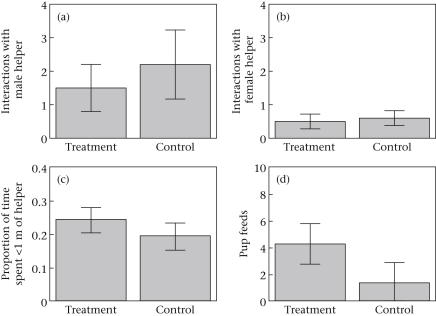
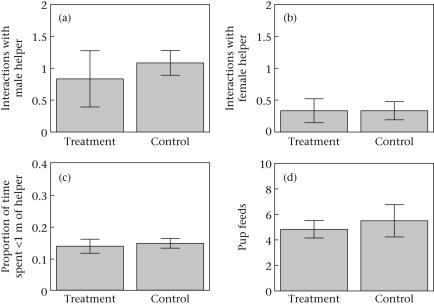
In cooperatively breeding animals, in which nonbreeding subordinates assist in rearing offspring born to dominants, breeders and helpers may be in conflict over their respective contributions to offspring care and selection may favour breeders that use aggression to elevate the work rates of helpers. We tested the prediction that dominant female meerkats, Suricata suricatta, should increase aggression towards subordinates when the need for help is higher, by playing back recordings of pup begging calls to simulate increased need for help. Second, we tested the prediction that dominants should reduce aggression when subordinates help more, by playing back recordings of feeding calls to simulate elevated pup provisioning rates by subordinates. Neither of the two playback experiments affected rates of aggressive interactions between breeding females and helpers. Instead, breeding females increased their own level of pup provisioning in response to increased pup begging. Hence, our results do not support a role of aggression in regulating helping behaviour in meerkats, but suggest that pup provisioning can be explained by direct and/or indirect benefits derived from helping. As yet, firm evidence that breeders use aggression to promote helping by subordinates in cooperative animal societies remains elusive.
在合作繁殖的动物中,非繁殖的从属个体协助抚养优势个体所生育的后代,繁殖者和助手可能在对后代照料的各自贡献方面存在冲突,并且选择可能有利于那些使用攻击性手段来提高助手工作效率的繁殖者。我们通过播放幼崽乞食叫声的录音来模拟对帮助的更高需求,从而检验了这样的预测:当对帮助的需求更高时,优势雌性狐獴(Suricata suricatta)应该会增加对从属个体的攻击性。其次,我们通过播放进食叫声的录音来模拟从属个体提高幼崽供给率,从而检验了这样的预测:当从属个体提供更多帮助时,优势个体应该会减少攻击性。这两个回放实验均未影响繁殖雌性和助手之间攻击性互动的频率。相反,繁殖雌性会响应幼崽乞食增加的情况而提高自身的幼崽供给水平。因此,我们的结果不支持攻击性在调节狐獴帮助行为中所起的作用,而是表明幼崽供给可以通过帮助所带来的直接和/或间接益处来解释。迄今为止,在合作动物社会中,繁殖者利用攻击性来促使从属个体提供帮助的确凿证据仍然难以获得。