Research Divisions of Biochemistry and Molecular Biology, The Unit of Regulatory and Molecular Biology, Salus University, Elkins Park PA, USA.
Front Mol Neurosci. 2012 Apr 9;5:44. doi: 10.3389/fnmol.2012.00044. eCollection 2012.
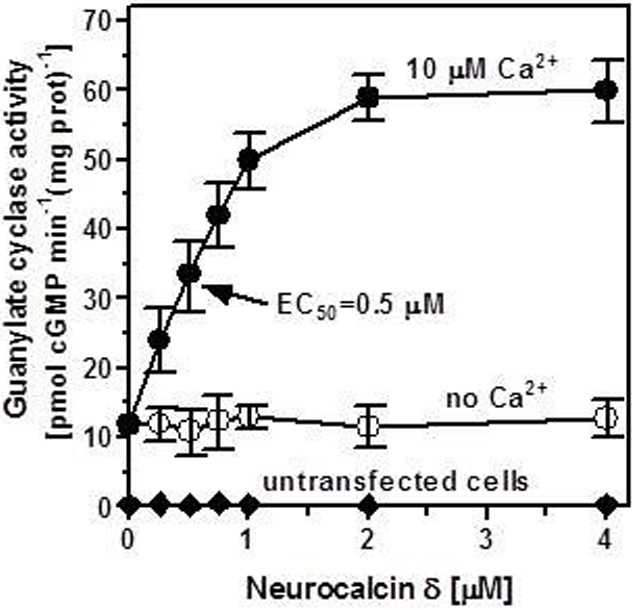
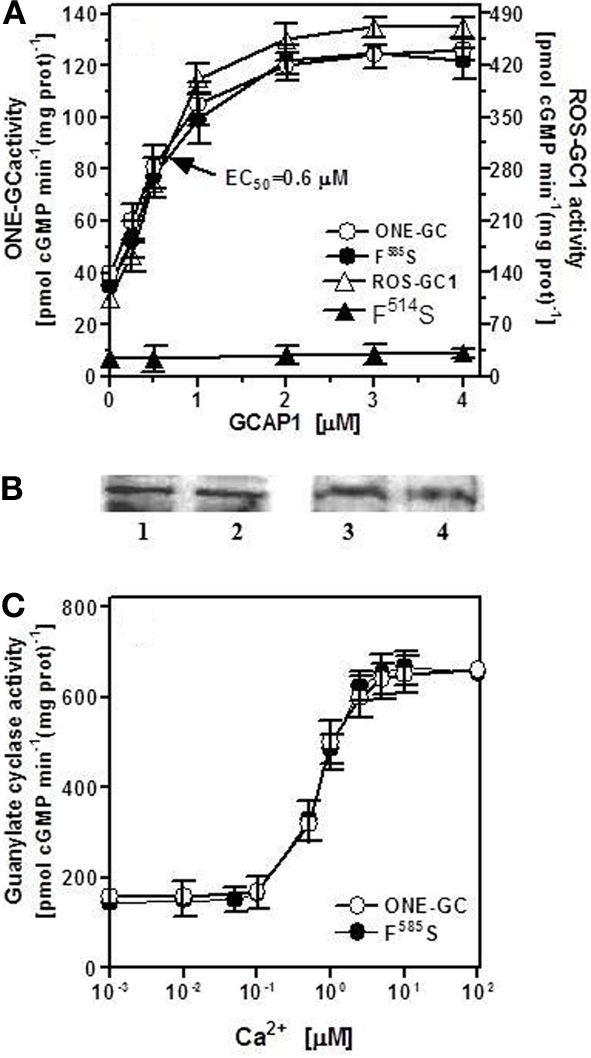
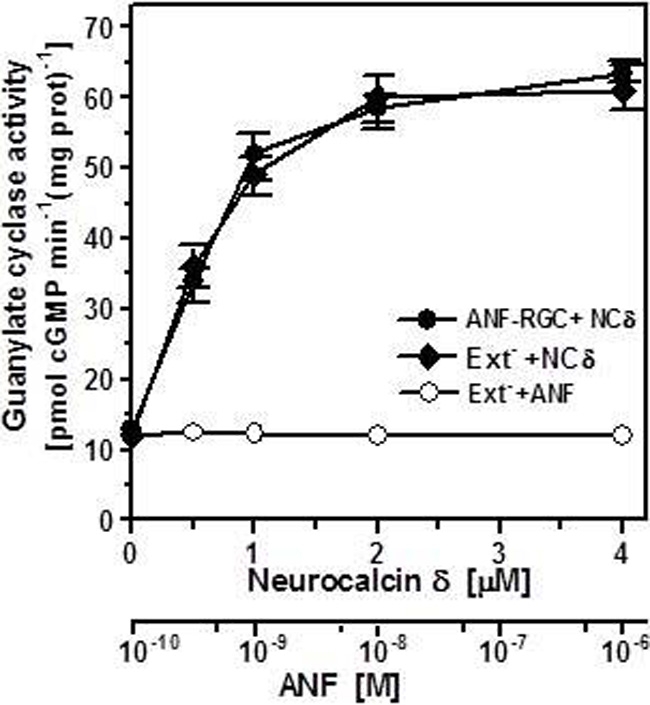
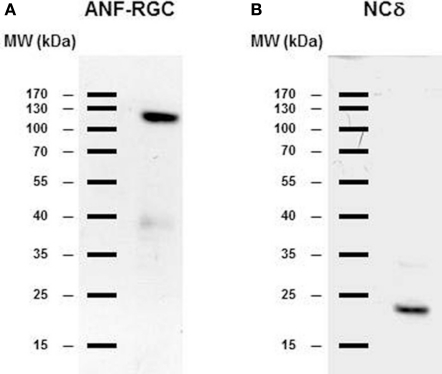
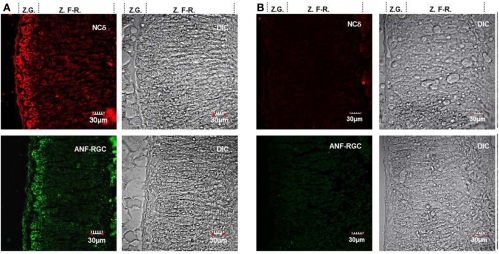
natriuretic peptide hormone surface receptors, Ca(2+)-modulated neuronal ROS-GC, and Ca(2+)-modulated odorant surface receptor ONE-GC. The first subfamily is solely modulated by the extracellularly generated hormonal signals; the second, by the intracellularly generated sensory and sensory-linked signals; and the third, by combination of these two. The present study defines a new paradigm and a new mechanism of Ca(2+) signaling. (1) It demonstrates for the first time that ANF-RGC, the prototype member of the surface receptor subfamily, is stimulated by free Ca(2+). The stimulation occurs via myristoylated form of neurocalcin δ, and both the guanylate cyclase and the calcium sensor neurocalcin δ are present in the glomerulosa region of the adrenal gland. (2) The EF-2, EF-3 and EF-4 hands of GCAP1 sense the progressive increment of Ca(2+) and with a K(1/2) of 100 nM turn ROS-GC1 "OFF." In total reversal, the same EF hands upon sensing the progressive increment of Ca(2+) with K(1/2) turn ONE-GC "ON." The findings suggest a universal Ca(2+)-modulated signal transduction theme of the membrane guanylate cyclase family; demonstrate that signaling of ANF-RGC occurs by the peptide hormones and also by Ca(2+) signals; that for the Ca(2+) signal transduction, ANF-RGC functions as a two-component transduction system consisting of the Ca(2+) sensor neurocalcin δ and the transducer ANF-RGC; and that the neurocalcin δ in this case expands beyond its NCS family. Furthermore, the study shows a novel mechanism of the Ca(2+) sensor GCAP1 where it acts as an antithetical NCS for the signaling mechanisms of ROS-GC1 and ONE-GC.
利钠肽激素表面受体、Ca(2+)-调节神经元 ROS-GC 和 Ca(2+)-调节气味表面受体 ONE-GC。第一个亚家族仅受细胞外产生的激素信号调节;第二个亚家族受细胞内产生的感觉和感觉相关信号调节;第三个亚家族则受这两种信号的共同调节。本研究定义了一种新的 Ca(2+)信号转导模式和机制。(1) 它首次证明,作为表面受体亚家族原型成员的 ANF-RGC 受细胞内游离 Ca(2+)(i)的刺激。这种刺激通过豆蔻酰化形式的神经钙蛋白 δ 发生,而鸟苷酸环化酶和钙传感器神经钙蛋白 δ 都存在于肾上腺球状带中。(2) GCAP1 的 EF-2、EF-3 和 EF-4 手位感知Ca(2+)的渐进性增加,并以 100 nM 的 K(1/2)使 ROS-GC1“关闭”。在完全逆转中,相同的 EF 手位通过感知Ca(2+)的渐进性增加并以 K(1/2)使 ONE-GC“打开”。这些发现表明了膜鸟苷酸环化酶家族的一种普遍的 Ca(2+)-调节信号转导主题;证明了 ANF-RGC 的信号传递不仅通过肽激素,也通过Ca(2+)信号发生;对于 Ca(2+)信号转导,ANF-RGC 作为由钙传感器神经钙蛋白 δ 和转导器 ANF-RGC 组成的两个组件转导系统发挥作用;在这种情况下,神经钙蛋白 δ 扩展到其 NCS 家族之外。此外,该研究还展示了 GCAP1 作为Ca(2+)传感器的一种新机制,它作为 ROS-GC1 和 ONE-GC 信号机制的拮抗 NCS 发挥作用。