Helen Diller Family Comprehensive Cancer Center, University of California, San Francisco 94158, USA.
Cancer Res. 2012 Jun 15;72(12):3048-59. doi: 10.1158/0008-5472.CAN-11-3649. Epub 2012 Apr 17.
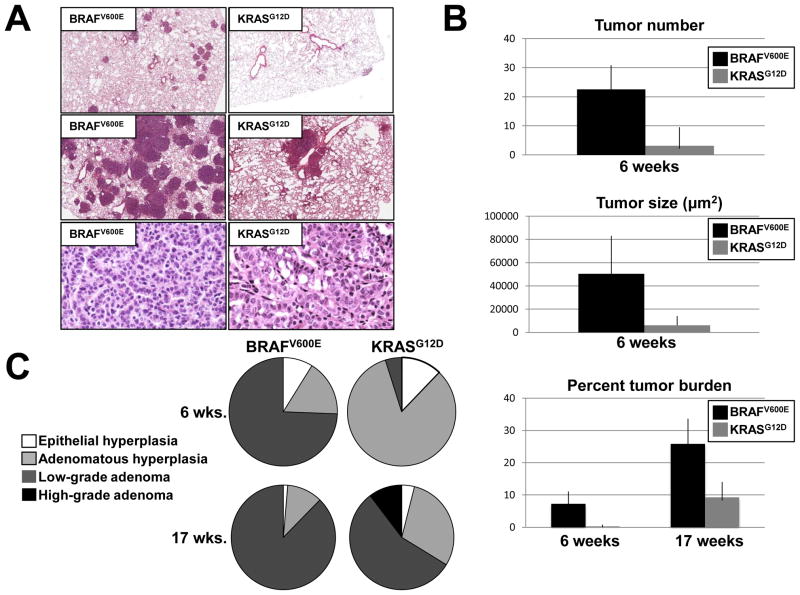
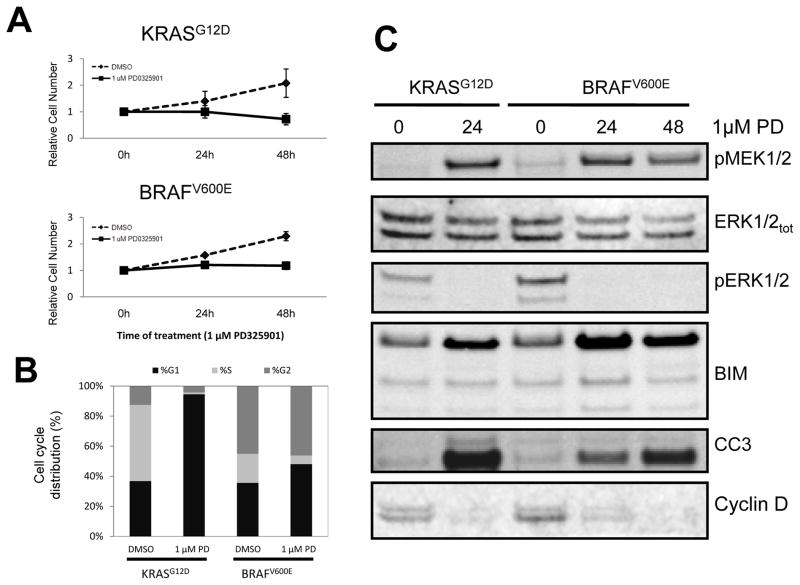
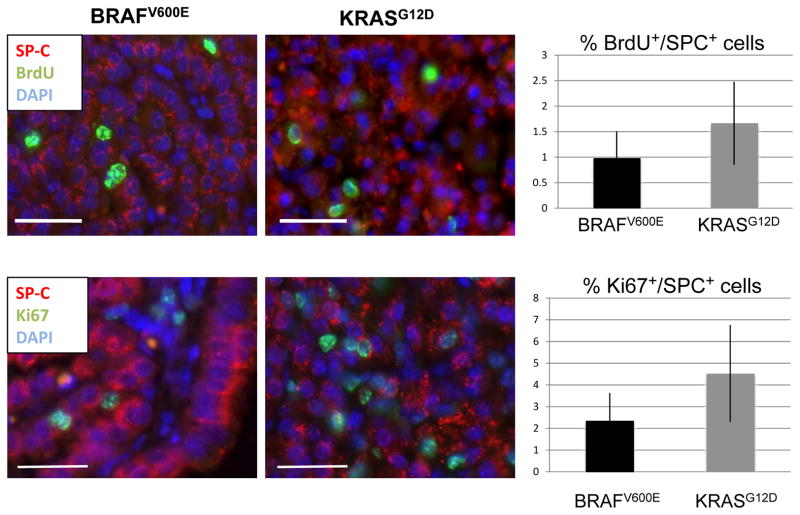
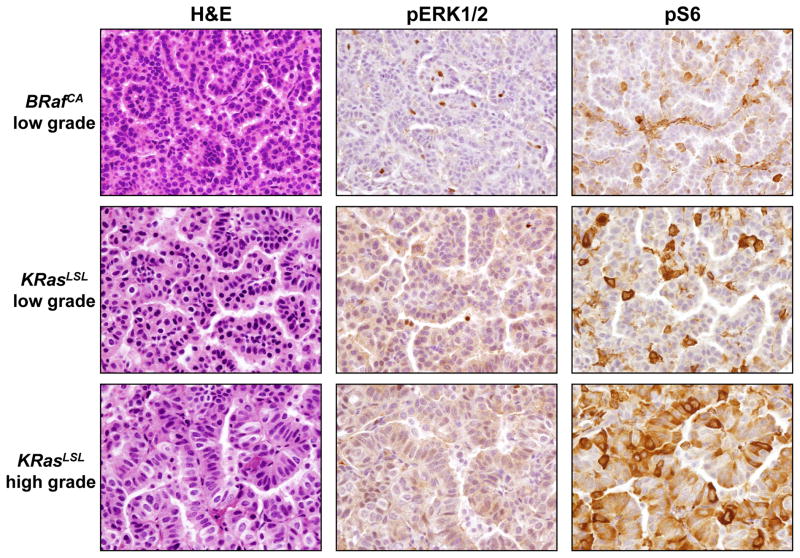
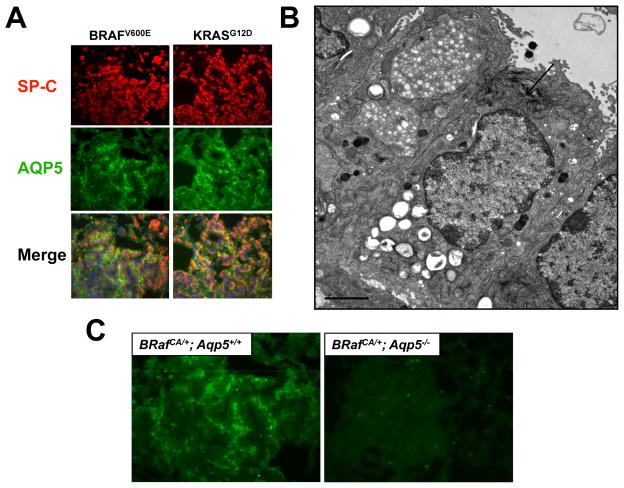
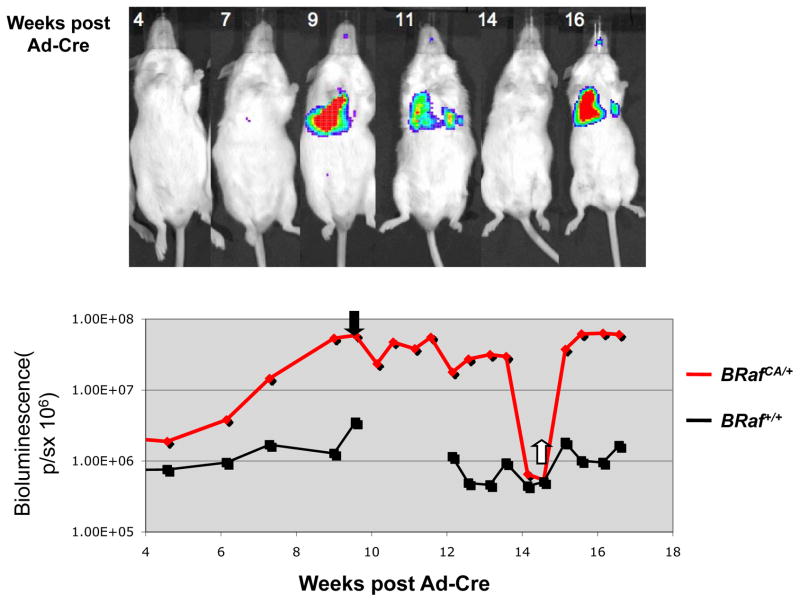
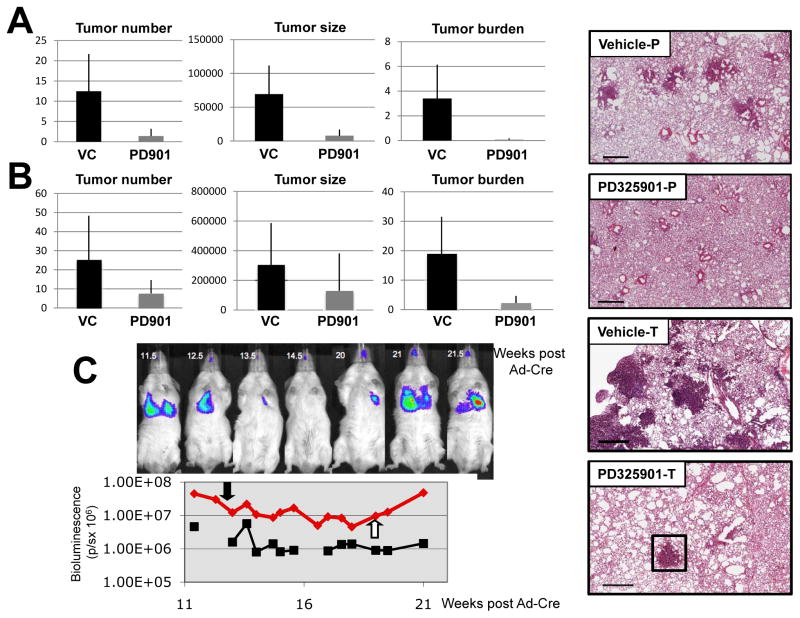
Genetically engineered mouse (GEM) models of lung tumorigenesis allow careful evaluation of lung tumor initiation, progression, and response to therapy. Using GEM models of oncogene-induced lung cancer, we show the striking similarity of the earliest stages of tumorigenesis induced by KRAS(G12D) or BRAF(V600E). Cre-mediated expression of KRAS(G12D) or BRAF(V600E) in the lung epithelium of adult mice initially elicited benign lung tumors comprising cuboidal epithelial cells expressing markers of alveolar pneumocytes. Strikingly, in a head-to-head comparison, oncogenic BRAF(V600E) elicited many more such benign tumors and did so more rapidly than KRAS(G12D). However, despite differences in the efficiency of benign tumor induction, only mice with lung epithelium expression of KRAS(G12D) developed malignant non-small cell lung adenocarcinomas. Pharmacologic inhibition of mitogen-activated protein (MAP)-extracellular signal-regulated kinase (ERK) kinase (MEK)1/2 combined with in vivo imaging showed that initiation and maintenance of both BRAF(V600E)- or KRAS(G12D)-induced lung tumors was dependent on MEK→ERK signaling. Although the tumors dramatically regressed in response to MEK1/2 inhibition, they regrew following cessation of drug treatment. Together, our findings show that RAF→MEK→ERK signaling is both necessary and sufficient for KRAS(G12D)-induced benign lung tumorigenesis in GEM models. The data also emphasize the ability of KRAS(G12D) to promote malignant lung cancer progression compared with oncogenic BRAF(V600E).
基因工程小鼠(GEM)肺癌发生模型可对肺肿瘤的发生、进展和对治疗的反应进行仔细评估。我们利用致癌基因诱导的肺癌 GEM 模型,显示了 KRAS(G12D)或 BRAF(V600E)诱导的肿瘤发生的最早阶段惊人的相似性。在成年小鼠的肺上皮细胞中,通过 Cre 介导表达 KRAS(G12D)或 BRAF(V600E),最初会引发良性肺肿瘤,这些肿瘤由表达肺泡型上皮细胞标志物的立方状上皮细胞组成。引人注目的是,在直接比较中,致癌性 BRAF(V600E)引发了更多这样的良性肿瘤,而且比 KRAS(G12D)更快。然而,尽管良性肿瘤诱导的效率存在差异,但只有肺上皮细胞表达 KRAS(G12D)的小鼠才会发展出恶性非小细胞肺腺癌。丝裂原激活蛋白(MAP)-细胞外信号调节激酶(ERK)激酶(MEK)1/2 的药理学抑制作用与体内成像相结合表明,BRAF(V600E)或 KRAS(G12D)诱导的肺肿瘤的发生和维持都依赖于 MEK→ERK 信号。尽管 MEK1/2 抑制使肿瘤明显消退,但停药后肿瘤又重新生长。总之,我们的研究结果表明,在 GEM 模型中,RAF→MEK→ERK 信号对于 KRAS(G12D)诱导的良性肺肿瘤发生是必要且充分的。这些数据还强调了 KRAS(G12D)与致癌性 BRAF(V600E)相比促进恶性肺癌进展的能力。