Department of Psychiatry, Rudolf Magnus Institute of Neuroscience, University Medical Center Utrecht, Utrecht, The Netherlands.
PLoS One. 2012;7(4):e32316. doi: 10.1371/journal.pone.0032316. Epub 2012 Apr 13.
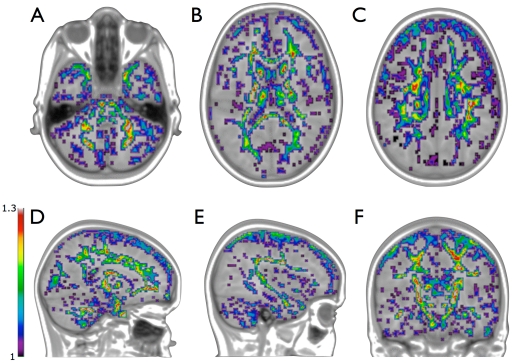
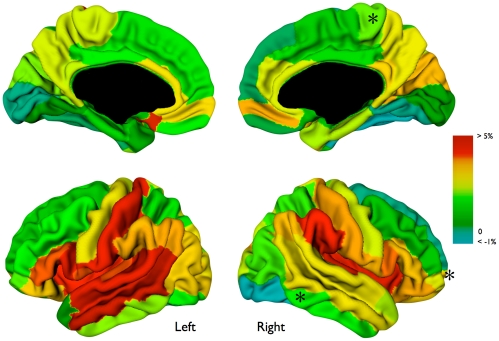
White matter microstructure and volume show synchronous developmental patterns in children. White matter volume increases considerably during development. Fractional anisotropy, a measure for white matter microstructural directionality, also increases with age. Development of white matter volume and development of white matter microstructure seem to go hand in hand. The extent to which the same or different genetic and/or environmental factors drive these two aspects of white matter maturation is currently unknown. We mapped changes in white matter volume, surface area and diffusion parameters in mono- and dizygotic twins who were scanned at age 9 (203 individuals) and again at age 12 (126 individuals). Over the three-year interval, white matter volume (+6.0%) and surface area (+1.7%) increased, fiber bundles expanded (most pronounced in the left arcuate fasciculus and splenium), and fractional anisotropy increased (+3.0%). Genes influenced white matter volume (heritability 85%), surface area (85%), and fractional anisotropy (locally 7% to 50%) at both ages. Finally, volumetric white matter growth was negatively correlated with fractional anisotropy increase (r = -0.62) and this relationship was driven by environmental factors. In children who showed the most pronounced white matter growth, fractional anisotropy increased the least and vice-versa. Thus, white matter development in childhood may reflect a process of both expansion and fiber optimization.
脑白质微观结构和体积在儿童期呈现同步发育模式。脑白质体积在发育过程中会显著增加。各向异性分数(衡量脑白质微观结构方向性的指标)也随年龄增长而增加。脑白质体积和脑白质微观结构的发育似乎是齐头并进的。目前尚不清楚是什么遗传和/或环境因素驱动了这两个方面的脑白质成熟。我们对 9 岁(203 人)和 12 岁(126 人)接受扫描的单卵和双卵双胞胎的脑白质体积、表面积和扩散参数的变化进行了研究。在三年的时间间隔内,脑白质体积(增加 6.0%)和表面积(增加 1.7%)增加,纤维束扩张(在左侧弓状束和胼胝体压部最为明显),各向异性分数(FA)增加(增加 3.0%)。基因在两个年龄段都影响脑白质体积(遗传力85%)、表面积(85%)和各向异性分数(局部 7%至 50%)。最后,脑白质体积的增长与各向异性分数的增加呈负相关(r=-0.62),这种关系是由环境因素驱动的。在脑白质生长最为显著的儿童中,各向异性分数的增加最少,反之亦然。因此,儿童期脑白质的发育可能反映了扩张和纤维优化的双重过程。