Stipancić Gordana, La Grasta Sabolić Lavinia, Pozgaj Sepec Marija, Radica Ana, Skrabić Veselin, Severinski Srećko, Kujundzić Tiljak Mirjana
Gordana Stipancic, Department of Pediatrics, Sestre Milosrdnice University Hospital Center, Vinogradska 29, Zagreb, Croatia.
Croat Med J. 2012 Apr;53(2):141-8. doi: 10.3325/cmj.2012.53.141.
To determine regional differences in the incidence, incidence trends, and clinical presentation of type 1 diabetes in children under the age of 15 years in Croatia in a 9-year period (1995-2003).
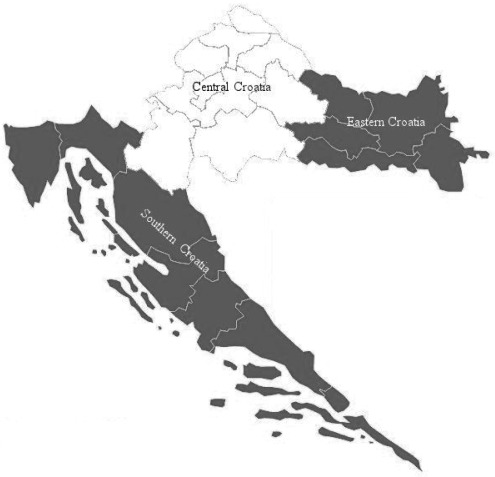
We included the patients who had been diagnosed with the disease and had started the insulin treatment before they were 15 years old. Regional differences between eastern, central, and southern Croatia were observed. The gross incidence was expressed by the number of newly diagnosed type 1 diabetes patients in 100000 children of the same age and sex per year, ie, for the 0-14 age group, and for the 0-4, 5-9, and 10-14 subgroups.
The highest incidence was observed in southern Croatia (10.91 per 100000/y) and the lowest in central Croatia (8.64 per 100000/y), and in eastern Croatia the incidence was 8.93 per 100000/y. All three regions showed a growing incidence trend, which was significant only in eastern and southern Croatia. There was 35.9% of patients with diabetic ketoacidosis in eastern Croatia, 41.7% in central Croatia, and 31.28% in southern Croatia.
Croatian regions show differences in the incidence, incidence trends, and disease presentation of type 1 diabetes. A further follow-up is needed to establish whether the regional differences are a consequence of the population dynamics in the observed period or they will continue to exist, pointing to differences in environmental risk factors.
确定克罗地亚15岁以下儿童1型糖尿病在9年期间(1995 - 2003年)的发病率、发病率趋势及临床表现的地区差异。
纳入15岁前被诊断出患有该疾病并开始胰岛素治疗的患者。观察克罗地亚东部、中部和南部的地区差异。粗发病率用每年每100000名同年龄、同性别的儿童中1型糖尿病新诊断患者的数量来表示,即针对0 - 14岁年龄组,以及0 - 4岁、5 - 9岁和10 - 14岁亚组。
克罗地亚南部的发病率最高(每年每100000人中有10.91例),中部最低(每年每100000人中有8.64例),克罗地亚东部的发病率为每年每100000人中有8.93例。所有三个地区的发病率均呈上升趋势,仅在克罗地亚东部和南部显著。克罗地亚东部35.9%的患者患有糖尿病酮症酸中毒,中部为41.7%,南部为31.28%。
克罗地亚各地区在1型糖尿病的发病率、发病率趋势和疾病表现方面存在差异。需要进一步随访以确定这些地区差异是观察期内人口动态变化的结果,还是会持续存在,这表明环境风险因素存在差异。