Experimental Zoology Group, Department of Animal Sciences, Wageningen University and Research Centre, Wageningen, The Netherlands.
PLoS One. 2012;7(4):e34072. doi: 10.1371/journal.pone.0034072. Epub 2012 Apr 18.
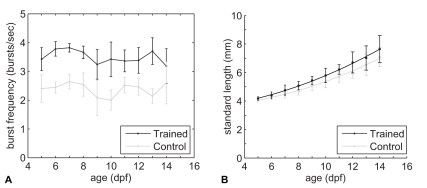
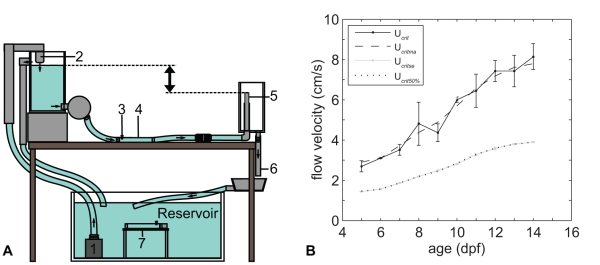
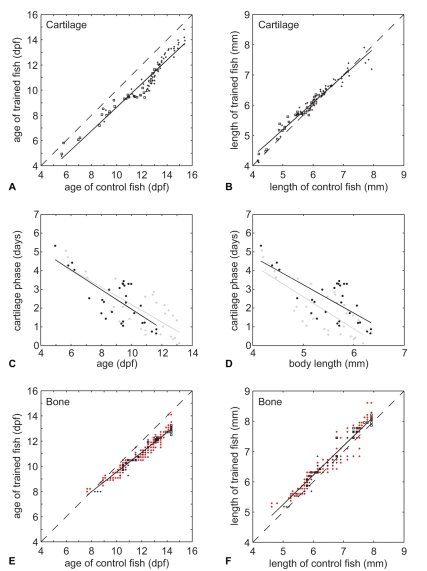
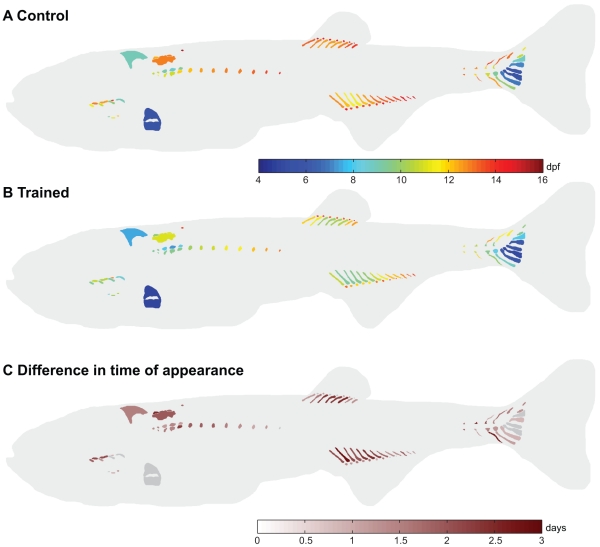
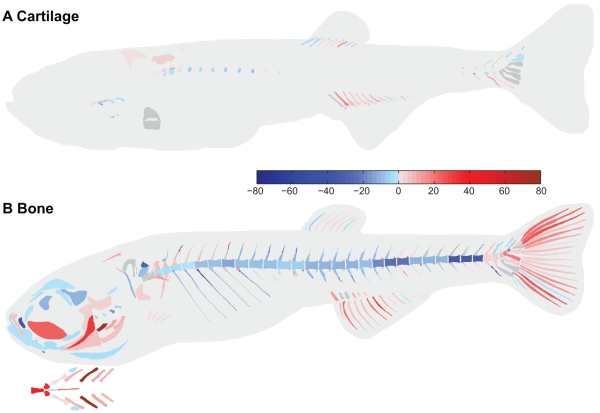
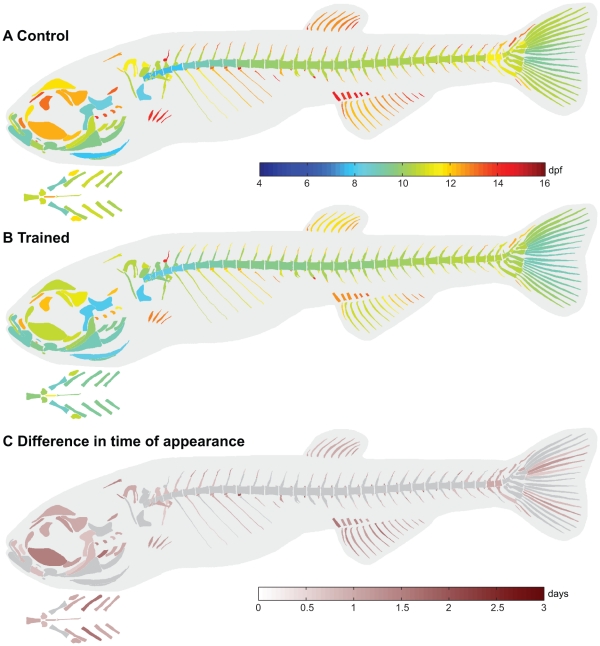
Fish larvae experience many environmental challenges during development such as variation in water velocity, food availability and predation. The rapid development of structures involved in feeding, respiration and swimming increases the chance of survival. It has been hypothesized that mechanical loading induced by muscle forces plays a role in prioritizing the development of these structures. Mechanical loading by muscle forces has been shown to affect larval and embryonic bone development in vertebrates, but these investigations were limited to the appendicular skeleton. To explore the role of mechanical load during chondrogenesis and osteogenesis of the cranial, axial and appendicular skeleton, we subjected zebrafish larvae to swim-training, which increases physical exercise levels and presumably also mechanical loads, from 5 until 14 days post fertilization. Here we show that an increased swimming activity accelerated growth, chondrogenesis and osteogenesis during larval development in zebrafish. Interestingly, swim-training accelerated both perichondral and intramembranous ossification. Furthermore, swim-training prioritized the formation of cartilage and bone structures in the head and tail region as well as the formation of elements in the anal and dorsal fins. This suggests that an increased swimming activity prioritized the development of structures which play an important role in swimming and thereby increasing the chance of survival in an environment where water velocity increases. Our study is the first to show that already during early zebrafish larval development, skeletal tissue in the cranial, axial and appendicular skeleton is competent to respond to swim-training due to increased water velocities. It demonstrates that changes in water flow conditions can result into significant spatio-temporal changes in skeletogenesis.
鱼类幼虫在发育过程中会经历许多环境挑战,例如水流速度、食物供应和捕食的变化。参与进食、呼吸和游泳的结构的快速发育增加了生存的机会。有人假设肌肉力量引起的机械负荷在优先发育这些结构中发挥作用。肌肉力量引起的机械负荷已被证明会影响脊椎动物的幼虫和胚胎骨骼发育,但这些研究仅限于附肢骨骼。为了探索机械负荷在颅、轴和附肢骨骼的软骨形成和骨形成中的作用,我们从受精后 5 天到 14 天对斑马鱼幼虫进行游泳训练,游泳训练增加了身体活动水平,推测也增加了机械负荷。在这里,我们表明,增加的游泳活动加速了斑马鱼幼虫发育过程中的生长、软骨形成和骨形成。有趣的是,游泳训练加速了软骨膜和膜内成骨。此外,游泳训练优先形成头部和尾部的软骨和骨结构,以及肛门和背鳍的元素形成。这表明,增加的游泳活动优先发育在水流增加的环境中对游泳很重要的结构,从而增加了生存的机会。我们的研究首次表明,在早期斑马鱼幼虫发育过程中,颅、轴和附肢骨骼中的骨骼组织由于水流速度的增加而能够对游泳训练做出反应。它表明,水流条件的变化会导致骨骼发生显著的时空变化。