Instituto de Biologia Experimental e Tecnológica/ Instituto de Tecnologia Química e Biológica-Universidade Nova de Lisboa, Oeiras, Portugal.
PLoS One. 2012;7(4):e35113. doi: 10.1371/journal.pone.0035113. Epub 2012 Apr 18.
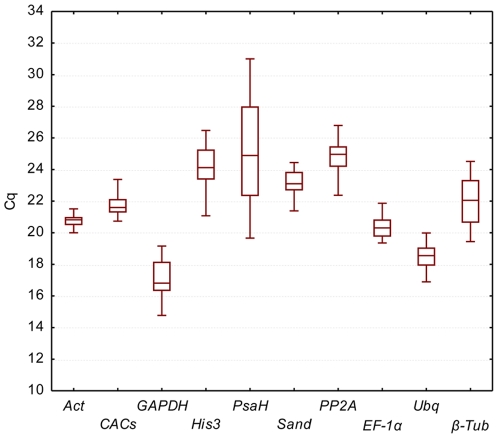
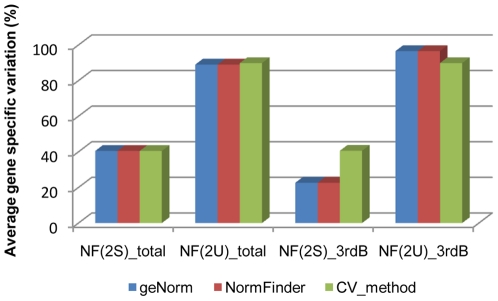
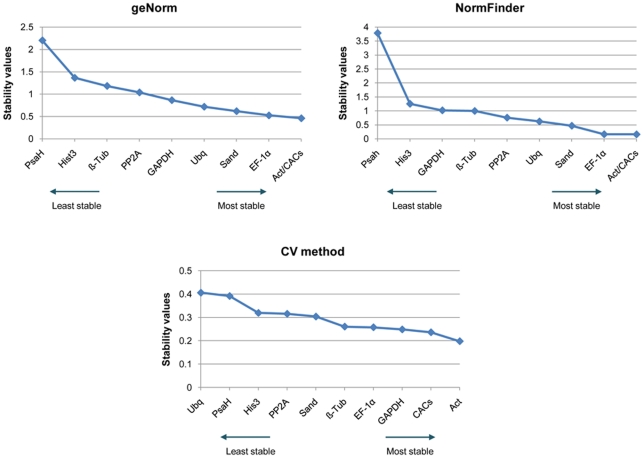
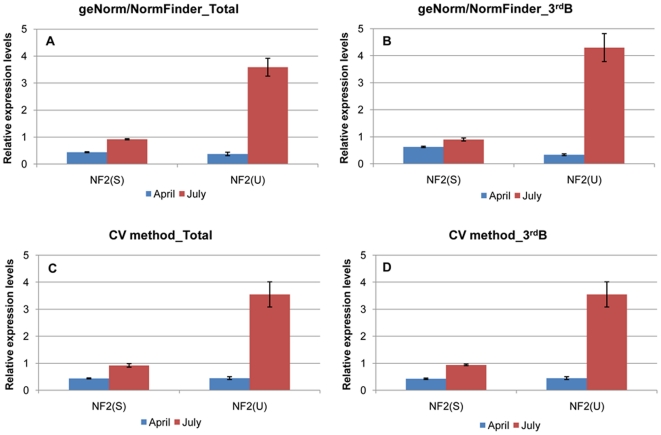
The use of reverse transcription quantitative PCR technology to assess gene expression levels requires an accurate normalization of data in order to avoid misinterpretation of experimental results and erroneous analyses. Despite being the focus of several transcriptomics projects, oaks, and particularly cork oak (Quercus suber), have not been investigated regarding the identification of reference genes suitable for the normalization of real-time quantitative PCR data. In this study, ten candidate reference genes (Act, CACs, EF-1α, GAPDH, His3, PsaH, Sand, PP2A, ß-Tub and Ubq) were evaluated to determine the most stable internal reference for quantitative PCR normalization in cork oak. The transcript abundance of these genes was analysed in several tissues of cork oak, including leaves, reproduction cork, and periderm from branches at different developmental stages (1-, 2-, and 3-year old) or collected in different dates (active growth period versus dormancy). The three statistical methods (geNorm, NormFinder, and CV method) used in the evaluation of the most suitable combination of reference genes identified Act and CACs as the most stable candidates when all the samples were analysed together, while ß-Tub and PsaH showed the lowest expression stability. However, when different tissues, developmental stages, and collection dates were analysed separately, the reference genes exhibited some variation in their expression levels. In this study, and for the first time, we have identified and validated reference genes in cork oak that can be used for quantification of target gene expression in different tissues and experimental conditions and will be useful as a starting point for gene expression studies in other oaks.
使用逆转录定量 PCR 技术评估基因表达水平需要对数据进行准确的归一化,以避免对实验结果的误解和错误分析。尽管橡木,尤其是栓皮栎(Quercus suber),已经成为几个转录组学项目的研究焦点,但尚未针对适合实时定量 PCR 数据归一化的参考基因进行鉴定。在这项研究中,评估了十个候选参考基因(Act、CACs、EF-1α、GAPDH、His3、PsaH、Sand、PP2A、β-Tub 和 Ubq),以确定栓皮栎定量 PCR 归一化最稳定的内参。分析了这些基因在栓皮栎的几种组织中的转录丰度,包括叶子、生殖栓皮和来自不同发育阶段(1 年、2 年和 3 年)或不同日期(活跃生长期与休眠期)的树枝的周皮。用于评估最适合参考基因组合的三种统计方法(geNorm、NormFinder 和 CV 方法)确定 Act 和 CACs 是所有样本一起分析时最稳定的候选基因,而β-Tub 和 PsaH 表现出最低的表达稳定性。然而,当分别分析不同的组织、发育阶段和采集日期时,参考基因的表达水平存在一些变化。在这项研究中,我们首次鉴定并验证了栓皮栎中的参考基因,可用于不同组织和实验条件下靶基因表达的定量,并将作为其他橡木基因表达研究的起点。