Division of Social Communication System for Advanced Clinical Research, the Institute of Medical Science, University of Tokyo, 4-6-1, Shirokanedai, Minato-ku, Tokyo, 108-8639, Japan.
BMC Cancer. 2012 Apr 24;12:152. doi: 10.1186/1471-2407-12-152.
The financial burden of medical expenses has been increasing for cancer patients. We investigated the relationship between household income and financial burden among patients with chronic myelogenous leukaemia (CML) who have been treated with imatinib.
A questionnaire was distributed to 1200 patients between May and August 2009. We retrospectively surveyed their household incomes, out-of-pocket medical expenses, final co-payments after refunds, and the perceived financial burden of their medical expenses in 2000, 2005 and 2008.
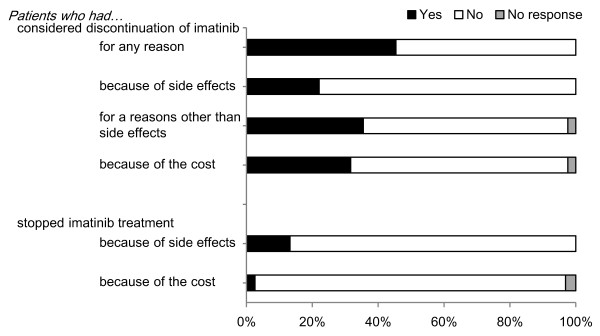
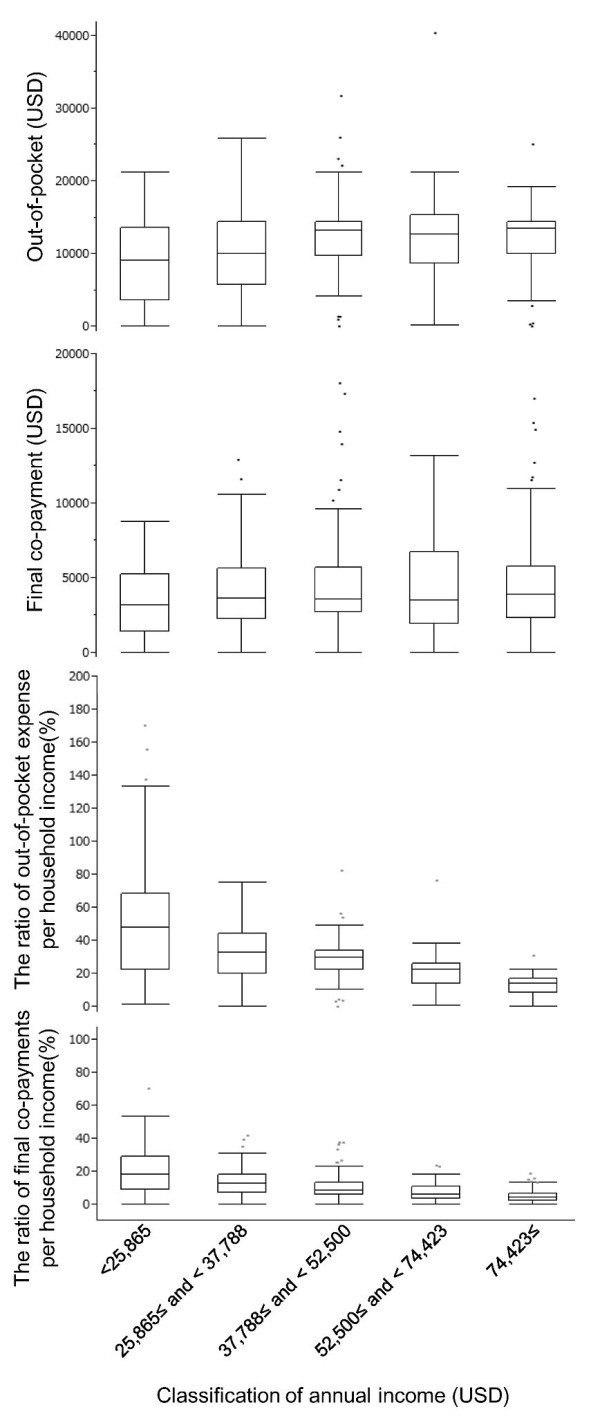
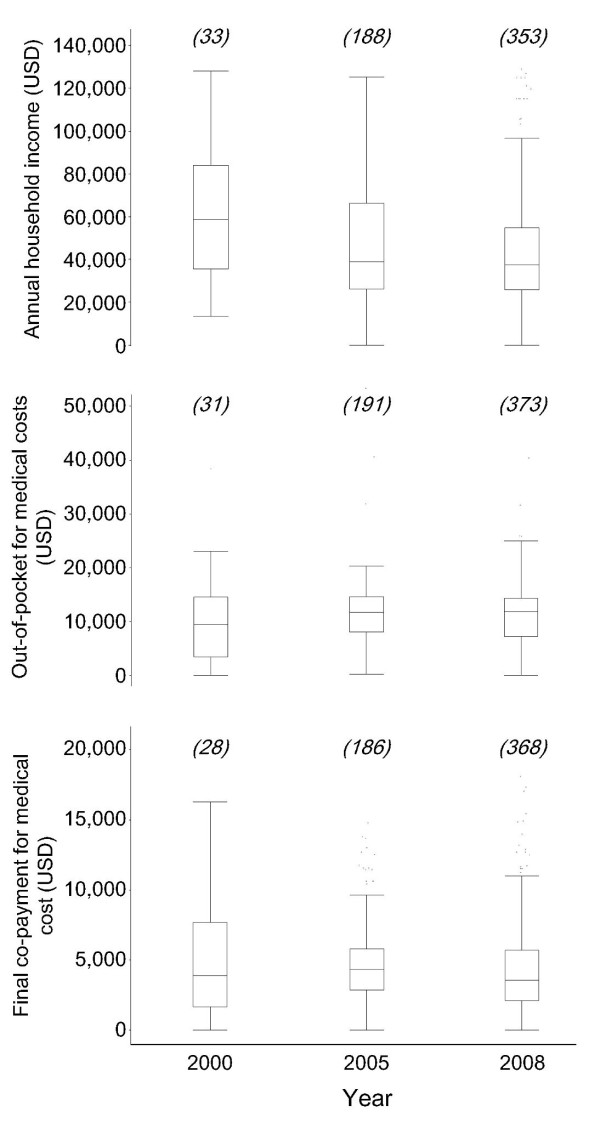
A total of 577 patients completed the questionnaire. Their median age was 61 years (range, 15-94). A financial burden was felt by 41.2 % (28 of 68) of the patients treated with imatinib in 2000, 70.8 % (201 of 284) in 2005, and 75.8 % (400 of 528) in 2008. Overall, 182 patients (31.7 %) considered its discontinuation because of the financial burden and 15 (2.6 %) temporarily stopped their imatinib prescription. In 2000, 2005 and 2008, the patients' median annual household incomes were 49,615 US Dollars (USD), 38,510 USD and 36,731 USD, respectively, with an average currency exchange rate of 104 Yen/USD in 2008. Their median annual out-of-pocket expenses were 11,548, 12,067 and 11,538 USD and their median final annual co-payments were 4,375, 4,327 and 3,558 USD, respectively. Older patients (OR = 0.96, 95 % CI: 0.95-0.98, p ≪ 0.0001 for 1-year increments), and patients with higher household incomes (OR = 0.92, 95 % CI: 0.85-0.99, p = 0.03 for 10,000 USD-increments) were less likely to have considered discontinuing their imatinib treatment. Conversely, patients with higher annual final co-payments (OR = 2.21, 95 % CI: 1.28-4.28, p = 0.004 for 10,000 USD-increments) were more likely to have considered discontinuing their imatinib treatment.
The proportion of CML patients who sensed a financial burden increased between 2000 and 2008. During this period, their annual incomes fell by 13,000 USD, although their medical expenses did not change. Financial support for patients being treated with expensive drugs remains a major problem in Japan.
癌症患者的医疗费用负担一直在增加。我们调查了接受伊马替尼治疗的慢性髓性白血病(CML)患者的家庭收入与经济负担之间的关系。
2009 年 5 月至 8 月期间,我们向 1200 名患者发放了问卷。我们回顾性调查了他们的家庭收入、自付医疗费用、退款后的最终共同支付额,以及他们在 2000 年、2005 年和 2008 年对医疗费用的经济负担的认知。
共有 577 名患者完成了问卷。他们的中位年龄为 61 岁(范围为 15-94 岁)。2000 年接受伊马替尼治疗的 68 名患者中有 41.2%(28 名)感到经济负担,2005 年接受伊马替尼治疗的 284 名患者中有 70.8%(201 名)感到经济负担,2008 年接受伊马替尼治疗的 528 名患者中有 75.8%(400 名)感到经济负担。总体而言,有 182 名患者(31.7%)因经济负担而考虑停止服用该药,有 15 名患者(2.6%)暂时停止了伊马替尼处方。2000 年、2005 年和 2008 年,患者的家庭年收入中位数分别为 49615 美元、38510 美元和 36731 美元,2008 年的平均汇率为 104 日元/美元。他们的年自付医疗费用中位数分别为 11548 美元、12067 美元和 11538 美元,最终年共同支付额中位数分别为 4375 美元、4327 美元和 3558 美元。年龄较大的患者(OR=0.96,95%CI:0.95-0.98,p≪0.0001,每增加 1 年)和家庭收入较高的患者(OR=0.92,95%CI:0.85-0.99,p=0.03,每增加 10000 美元)不太可能考虑停止服用伊马替尼。相反,年最终共同支付额较高的患者(OR=2.21,95%CI:1.28-4.28,p=0.004,每增加 10000 美元)更有可能考虑停止服用伊马替尼。
2000 年至 2008 年间,感到经济负担的 CML 患者比例有所增加。在此期间,尽管医疗费用没有变化,但他们的年收入下降了 13000 美元。为接受昂贵药物治疗的患者提供经济支持仍然是日本的一个主要问题。