Department of Anesthesiology, Leiden University Medical Center, Leiden, The Netherlands.
J Pain Res. 2012;5:51-9. doi: 10.2147/JPR.S30406. Epub 2012 Mar 15.
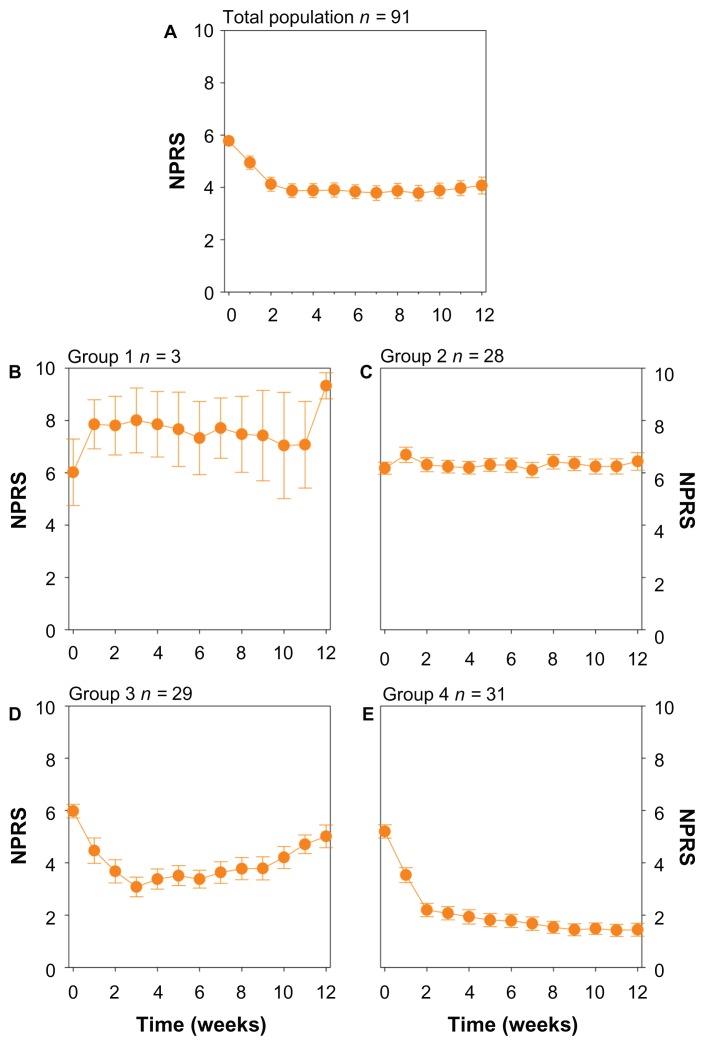
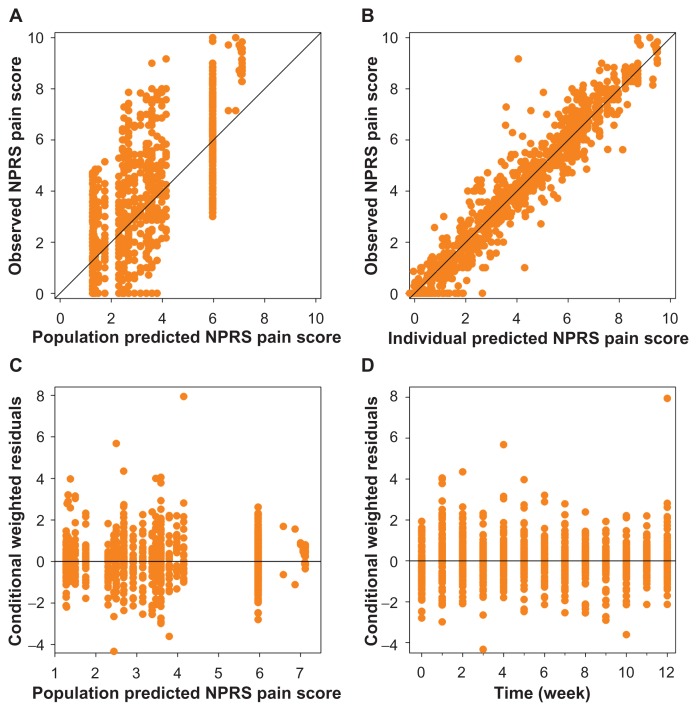
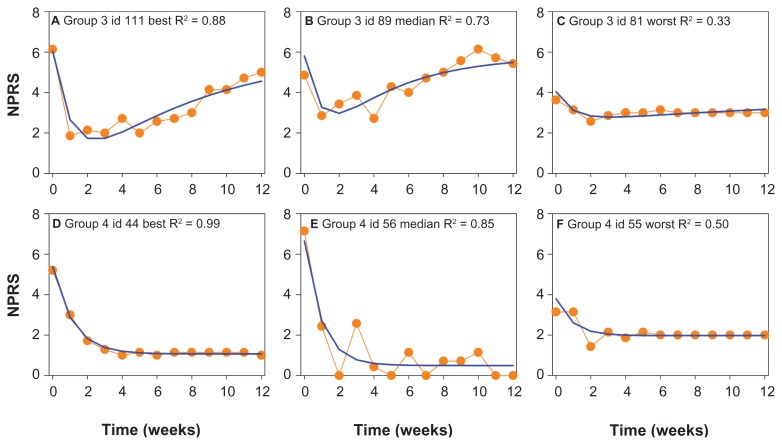
Treatment of chronic pain is associated with high variability in the response to pharmacological interventions. A mathematical pharmacodynamic model was developed to quantify the magnitude and onset/offset times of effect of a single capsaicin 8% patch application in the treatment of painful diabetic peripheral neuropathy in 91 patients. In addition, a mixture model was applied to objectively match patterns in pain-associated behavior. The model identified four distinct subgroups that responded differently to treatment: 3.3% of patients (subgroup 1) showed worsening of pain; 31% (subgroup 2) showed no change; 32% (subgroup 3) showed a quick reduction in pain that reached a nadir in week 3, followed by a slow return towards baseline (16% ± 6% pain reduction in week 12); 34% (subgroup 4) showed a quick reduction in pain that persisted (70% ± 5% reduction in week 12). The estimate of the response-onset rate constant, obtained for subgroups 1, 3, and 4, was 0.76 ± 0.12 week(-1) (median ± SE), indicating that every 0.91 weeks the pain score reduces or increases by 50% relative to the score of the previous week (= t½). The response-offset rate constant could be determined for subgroup 3 only and was 0.09 ± 0.04 week(-1) (t½ 7.8 weeks). The analysis allowed separation of a heterogeneous neuropathic pain population into four homogenous subgroups with distinct behaviors in response to treatment with capsaicin. It is argued that this model-based approach may have added value in analyzing longitudinal chronic pain data and allows optimization of treatment algorithms for patients suffering from chronic pain conditions.
治疗慢性疼痛时,药物干预的反应存在高度变异性。本研究构建了一个药效动力学模型,用于量化 91 例痛性糖尿病周围神经病变患者单次使用 8%辣椒素贴剂治疗的效果(以疼痛减轻程度和起效/失效时间来衡量)。此外,还应用混合模型客观匹配疼痛相关行为模式。模型识别出对治疗反应不同的四个亚组:3.3%的患者(亚组 1)疼痛恶化;31%(亚组 2)无变化;32%(亚组 3)疼痛迅速减轻,第 3 周达最低点,随后缓慢恢复基线(第 12 周疼痛减轻 16%±6%);34%(亚组 4)疼痛迅速减轻且持续(第 12 周减轻 70%±5%)。亚组 1、3 和 4 的反应起始率常数估计值分别为 0.76±0.12 周(-1)(中位数±SE),这表明每 0.91 周,疼痛评分相对于前一周降低或增加 50%(=t½)。仅可确定亚组 3 的反应终止率常数,为 0.09±0.04 周(-1)(t½为 7.8 周)。该分析可将异质性神经病理性疼痛人群分为四个亚组,每个亚组对辣椒素治疗的反应具有不同的行为特征。有人认为,这种基于模型的方法可能会增加分析慢性疼痛纵向数据的价值,并有助于优化患有慢性疼痛疾病的患者的治疗算法。