Centre Pfizer-Universidad de Granada-Junta de Andalucía for Genomics, Oncological Research (GENyO), Granada, Spain.
PLoS One. 2012;7(4):e35824. doi: 10.1371/journal.pone.0035824. Epub 2012 Apr 24.
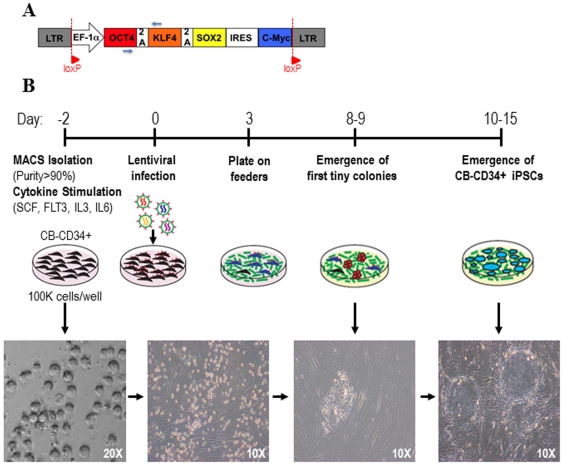
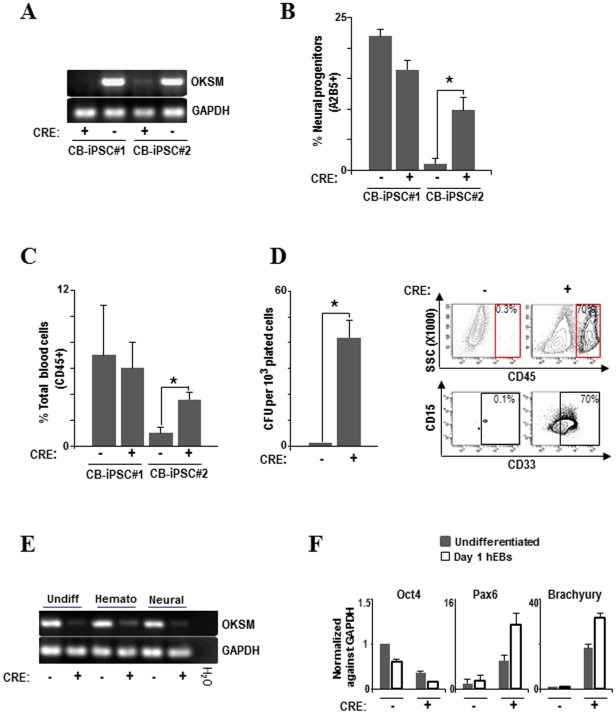
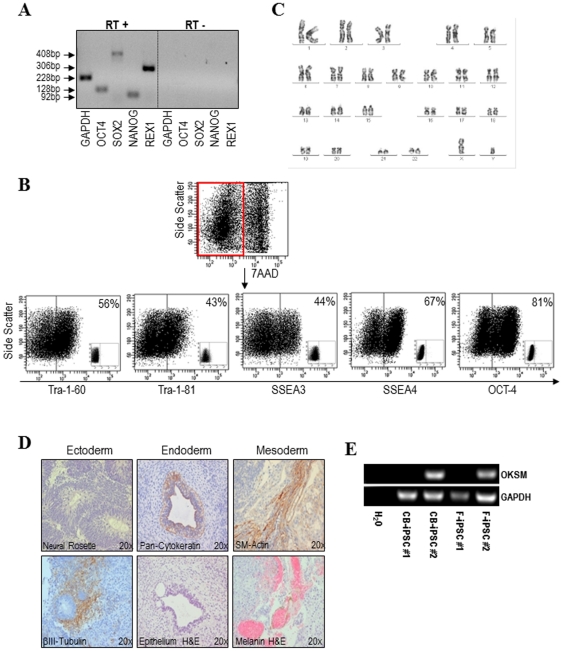
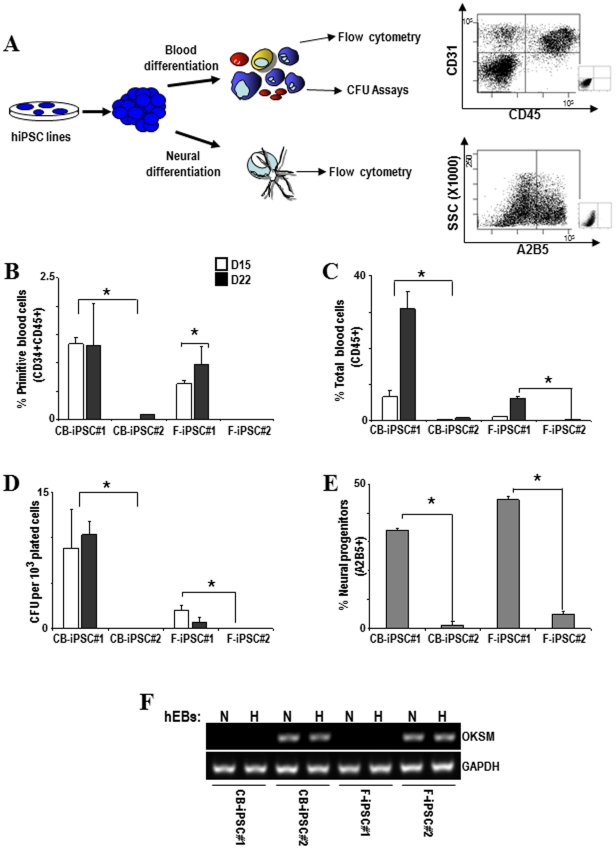
Human induced pluripotent stem cells (hiPSC) have been generated from different tissues, with the age of the donor, tissue source and specific cell type influencing the reprogramming process. Reprogramming hematopoietic progenitors to hiPSC may provide a very useful cellular system for modelling blood diseases. We report the generation and complete characterization of hiPSCs from human neonatal fibroblasts and cord blood (CB)-derived CD34+ hematopoietic progenitors using a single polycistronic lentiviral vector containing an excisable cassette encoding the four reprogramming factors Oct4, Klf4, Sox2 and c-myc (OKSM). The ectopic expression of OKSM was fully silenced upon reprogramming in some hiPSC clones and was not reactivated upon differentiation, whereas other hiPSC clones failed to silence the transgene expression, independently of the cell type/tissue origin. When hiPSC were induced to differentiate towards hematopoietic and neural lineages those hiPSC which had silenced OKSM ectopic expression displayed good hematopoietic and early neuroectoderm differentiation potential. In contrast, those hiPSC which failed to switch off OKSM expression were unable to differentiate towards either lineage, suggesting that the residual expression of the reprogramming factors functions as a developmental brake impairing hiPSC differentiation. Successful adenovirus-based Cre-mediated excision of the provirus OKSM cassette in CB-derived CD34+ hiPSC with residual transgene expression resulted in transgene-free hiPSC clones with significantly improved differentiation capacity. Overall, our findings confirm that residual expression of reprogramming factors impairs hiPSC differentiation.
人类诱导多能干细胞(hiPSC)已从不同组织中产生,供体的年龄、组织来源和特定细胞类型都会影响重编程过程。将造血祖细胞重编程为 hiPSC 可能为模拟血液疾病提供非常有用的细胞系统。我们报告了使用含有可切除盒的单个多顺反子慢病毒载体从人新生儿成纤维细胞和脐带血(CB)衍生的 CD34+造血祖细胞生成和完全表征 hiPSC,该盒编码四个重编程因子 Oct4、Klf4、Sox2 和 c-myc(OKSM)。在一些 hiPSC 克隆中,重编程时 OKSM 的异位表达被完全沉默,并且在分化时不会重新激活,而其他 hiPSC 克隆则无法沉默转基因表达,而与细胞类型/组织来源无关。当 hiPSC 被诱导向造血和神经谱系分化时,那些沉默了 OKSM 异位表达的 hiPSC 显示出良好的造血和早期神经外胚层分化潜力。相比之下,那些未能关闭 OKSM 表达的 hiPSC 无法向任何谱系分化,表明残留的重编程因子表达作为一种发育刹车,损害了 hiPSC 的分化。成功地用残余转基因表达的 CB 衍生的 CD34+ hiPSC 进行基于腺病毒的 Cre 介导的 provirus OKSM 盒切除,导致转基因-free hiPSC 克隆具有显著改善的分化能力。总体而言,我们的研究结果证实了残留的重编程因子表达会损害 hiPSC 的分化。