Almeida-Souza Leonardo, Timmerman Vincent, Janssens Sophie
Bioarchitecture. 2011 Nov 1;1(6):267-270. doi: 10.4161/bioa.1.6.19198.
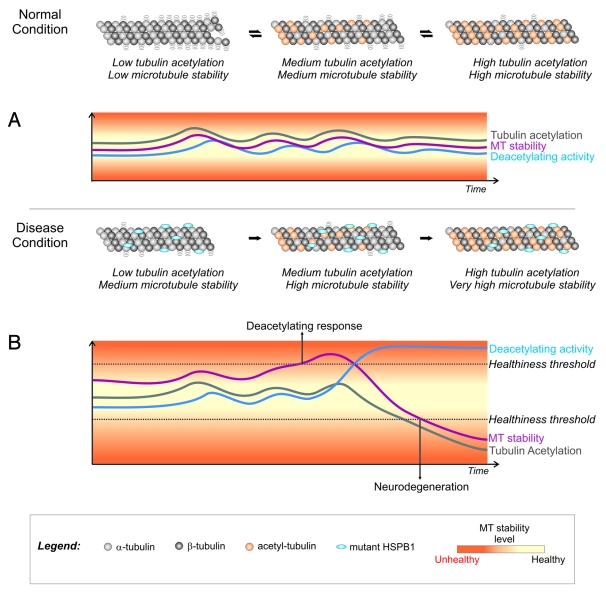
The special architecture of neurons in the peripheral nervous system, with axons extending for long distances, represents a major challenge for the intracellular transport system. Two recent studies show that mutations in the small heat shock protein HSPB1, which cause an axonal type of Charcot-Marie-Tooth (CMT) neuropathy, affect microtubule dynamics and impede axonal transport. Intriguingly, while at presymptomatic age the neurons in the mutant HSPB1 mouse show a hyperstable microtubule network, at postsymptomatic age, the microtubule network completely lost its stability as reflected by a marked decrease in tubulin acetylation levels. We here propose a model explaining the role of microtubule stabilization and tubulin acetylation in the pathogenesis of HSPB1 mutations.
外周神经系统中神经元的特殊结构,其轴突可延伸很长距离,这对细胞内运输系统构成了重大挑战。最近的两项研究表明,小热休克蛋白HSPB1的突变会导致轴索性夏科-马里-图思(CMT)神经病,影响微管动力学并阻碍轴突运输。有趣的是,在症状出现前的年龄,突变型HSPB1小鼠的神经元显示出超稳定的微管网络,而在症状出现后的年龄,微管网络完全失去了稳定性,这表现为微管蛋白乙酰化水平显著降低。我们在此提出一个模型,解释微管稳定和微管蛋白乙酰化在HSPB1突变发病机制中的作用。