Chen Shaotian, Xing Yaowu, Su Tao, Zhou Zhekun, Dilcher Emeritus David L, Soltis Douglas E
Kunming Institute of Botany, Chinese Academy of Sciences, Kunming, Yunnan, China.
BMC Plant Biol. 2012 Apr 30;12:58. doi: 10.1186/1471-2229-12-58.
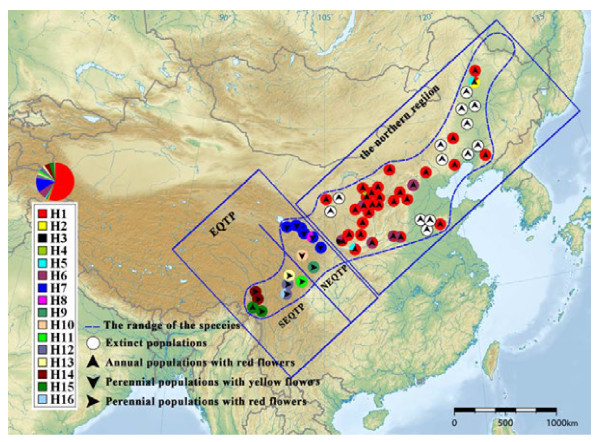
Incarvillea sinensis is widely distributed from Southwest China to Northeast China and in the Russian Far East. The distribution of this species was thought to be influenced by the uplift of the Qinghai-Tibet Plateau and Quaternary glaciation. To reveal the imprints of geological events on the spatial genetic structure of Incarvillea sinensis, we examined two cpDNA segments ( trnH- psbA and trnS- trnfM) in 705 individuals from 47 localities.
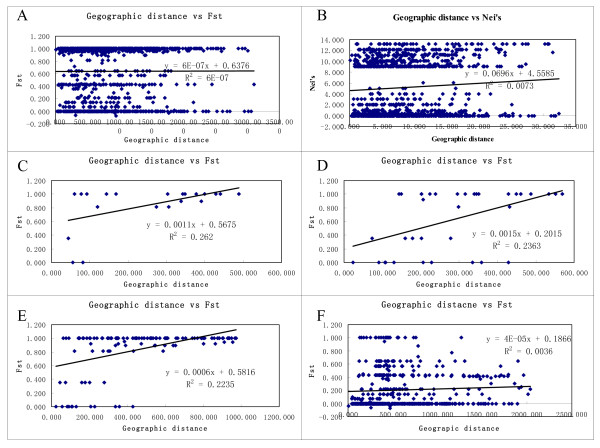
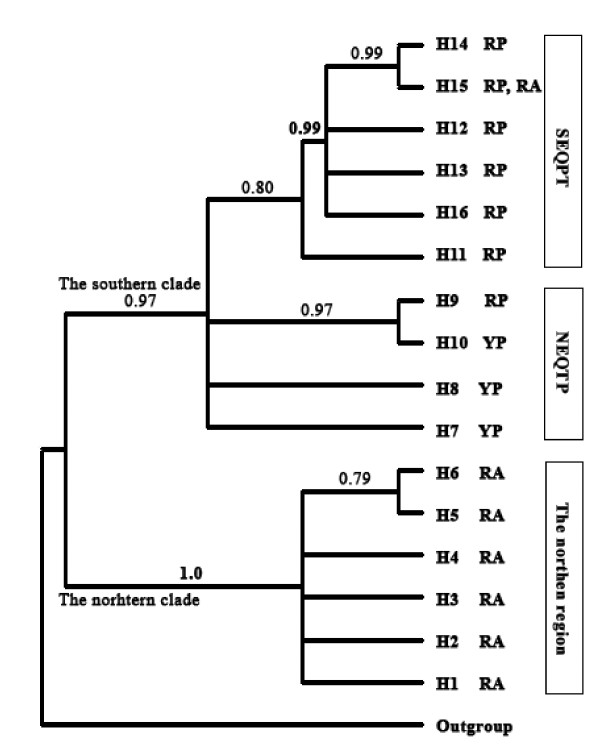
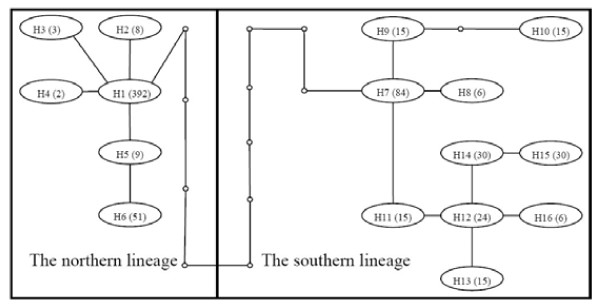
A total of 16 haplotypes was identified, and significant genetic differentiation was revealed (GST =0.843, NST = 0.975, P < 0.05). The survey detected two highly divergent cpDNA lineages connected by a deep gap with allopatric distributions: the southern lineage with higher genetic diversity and differentiation in the eastern Qinghai-Tibet Plateau, and the northern lineage in the region outside the Qinghai-Tibet Plateau. The divergence between these two lineages was estimated at 4.4 MYA. A correlation between the genetic and the geographic distances indicates that genetic drift was more influential than gene flow in the northern clade with lower diversity and divergence. However, a scenario of regional equilibrium between gene flow and drift was shown for the southern clade. The feature of spatial distribution of the genetic diversity of the southern lineage possibly indicated that allopatric fragmentation was dominant in the collections from the eastern Qinghai-Tibet Plateau.
The results revealed that the uplift of the Qinghai-Tibet Plateau likely resulted in the significant divergence between the lineage in the eastern Qinghai-Tibet Plateau and the other one outside this area. The diverse niches in the eastern Qinghai-Tibet Plateau created a wide spectrum of habitats to accumulate and accommodate new mutations. The features of genetic diversity of populations outside the eastern Qinghai-Tibet Plateau seemed to reveal the imprints of extinction during the Glacial and the interglacial and postglacial recolonization. Our study is a typical case of the significance of the uplift of the Qinghai-Tibet Plateau and the Quaternary Glacial in spatial genetic structure of eastern Asian plants, and sheds new light on the evolution of biodiversity in the Qinghai-Tibet Plateau at the intraspecies level.
中国角蒿广泛分布于中国西南至东北以及俄罗斯远东地区。该物种的分布被认为受到青藏高原隆升和第四纪冰川作用的影响。为揭示地质事件对中国角蒿空间遗传结构的印记,我们检测了来自47个地点的705个个体的两个叶绿体DNA片段(trnH-psbA和trnS-trnfM)。
共鉴定出16种单倍型,并揭示出显著的遗传分化(GST = 0.843,NST = 0.975,P < 0.05)。调查发现两个高度分化的叶绿体DNA谱系,它们之间存在明显的间断且异域分布:南部谱系在青藏高原东部具有较高的遗传多样性和分化,而北部谱系分布在青藏高原以外地区。这两个谱系之间的分化估计发生在440万年前。遗传距离与地理距离之间的相关性表明,在多样性和分化较低的北部类群中,遗传漂变比基因流的影响更大。然而,南部类群呈现出基因流与漂变之间的区域平衡情况。南部谱系遗传多样性的空间分布特征可能表明,来自青藏高原东部的样本中异域片段化占主导。
结果表明,青藏高原的隆升可能导致了青藏高原东部谱系与该地区以外谱系之间的显著分化。青藏高原东部多样的生态位创造了广泛的栖息地,以积累和容纳新的突变。青藏高原东部以外地区种群的遗传多样性特征似乎揭示了冰川期、间冰期和冰后期重新定殖过程中的灭绝印记。我们的研究是青藏高原隆升和第四纪冰川对东亚植物空间遗传结构影响的典型案例,并为青藏高原物种内水平的生物多样性进化提供了新的视角。