Institute of Psychiatry, Medical Research Council Social, Genetic & Developmental Psychiatry Centre, King's College London, England.
Psychol Sci. 2012 Jun;23(6):643-50. doi: 10.1177/0956797611431693. Epub 2012 Apr 30.
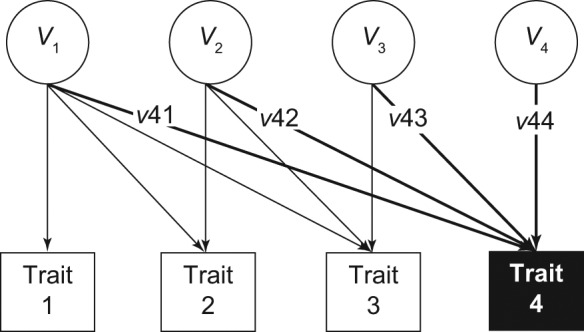
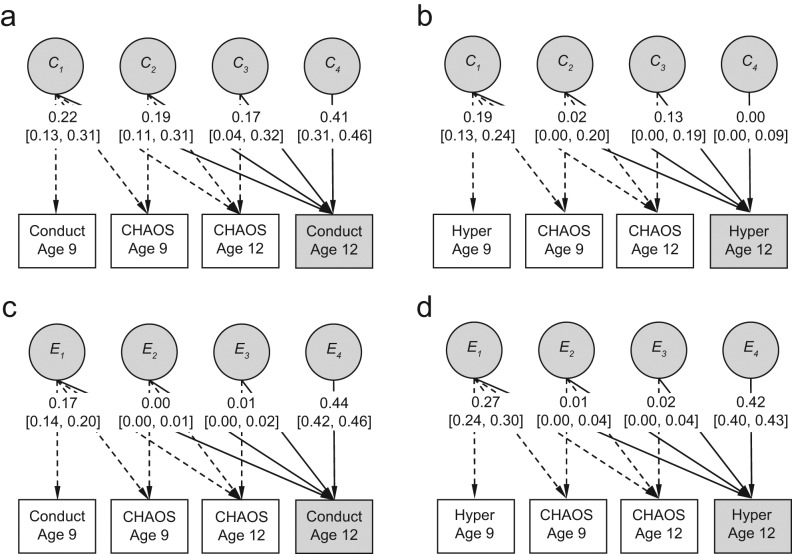
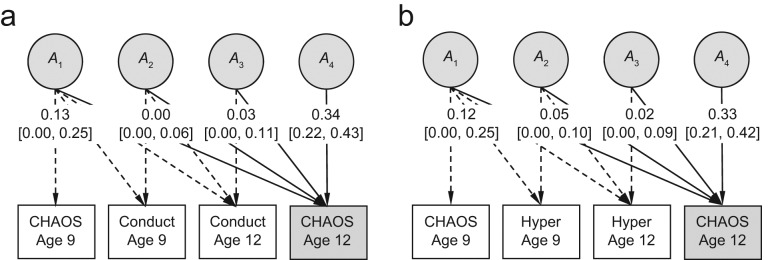
Chaotic home lives are correlated with behavior problems in children. In the study reported here, we tested whether there was a cross-lagged relation between children's experience of chaos and their disruptive behaviors (conduct problems and hyperactivity-inattention). Using genetically informative models, we then tested for the first time whether the influence of household chaos on disruptive behavior was environmentally mediated and whether genetic influences on children's disruptive behaviors accounted for the heritability of household chaos. We measured children's perceptions of household chaos and parents' ratings of children's disruptive behavior at ages 9 and 12 in a sample of 6,286 twin pairs from the Twins Early Development Study (TEDS). There was a phenotypic cross-lagged relation between children's experiences of household chaos and their disruptive behavior. In genetically informative models, we found that the effect of household chaos on subsequent disruptive behavior was environmentally mediated. However, genetic influences on disruptive behavior did not explain why household chaos was heritable.
混乱的家庭生活与儿童的行为问题有关。在本研究中,我们测试了儿童经历的混乱是否与他们的破坏性行为(行为问题和多动-注意力不集中)之间存在交叉滞后关系。然后,我们首次使用具有遗传信息的模型,测试了家庭混乱对破坏性行为的影响是否是由环境因素介导的,以及儿童破坏性行为的遗传影响是否解释了家庭混乱的遗传性。我们在双胞胎早期发展研究(TEDS)的 6286 对双胞胎样本中,分别在儿童 9 岁和 12 岁时测量了他们对家庭混乱的感知以及父母对他们破坏性行为的评价。儿童对家庭混乱的体验与他们的破坏性行为之间存在表型交叉滞后关系。在具有遗传信息的模型中,我们发现家庭混乱对后续破坏性行为的影响是由环境因素介导的。然而,破坏性行为的遗传影响并不能解释为什么家庭混乱是遗传性的。