Institute for Medical Devices Control, National Institutes for Food and Drug Control, Beijing 100050, China.
J Nanobiotechnology. 2012 May 1;10:16. doi: 10.1186/1477-3155-10-16.
Since silver-nanoparticles (NPs) possess an antibacterial activity, they were commonly used in medical products and devices, food storage materials, cosmetics, various health care products, and industrial products. Various silver-NP based medical devices are available for clinical uses, such as silver-NP based dressing and silver-NP based hydrogel (silver-NP-hydrogel) for medical applications. Although the previous data have suggested silver-NPs induced toxicity in vivo and in vitro, there is lack information about the mechanisms of biological response and potential toxicity of silver-NP-hydrogel.
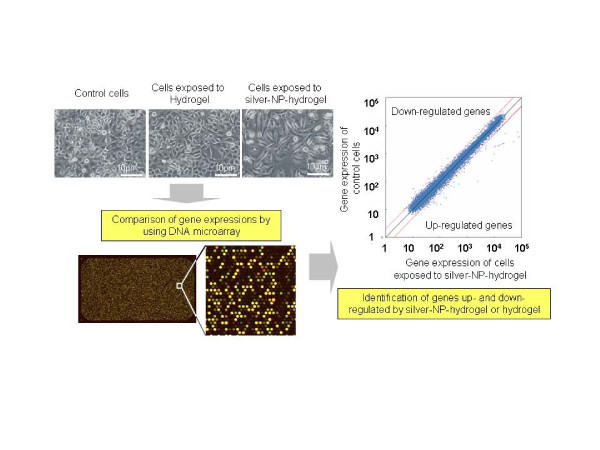
In this study, the genotoxicity of silver-NP-hydrogel was assayed using cytokinesis-block micronucleus (CBMN). The molecular response was studied using DNA microarray and GO pathway analysis.
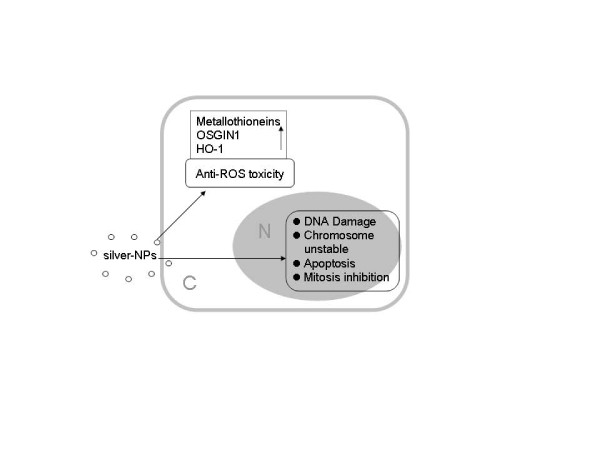
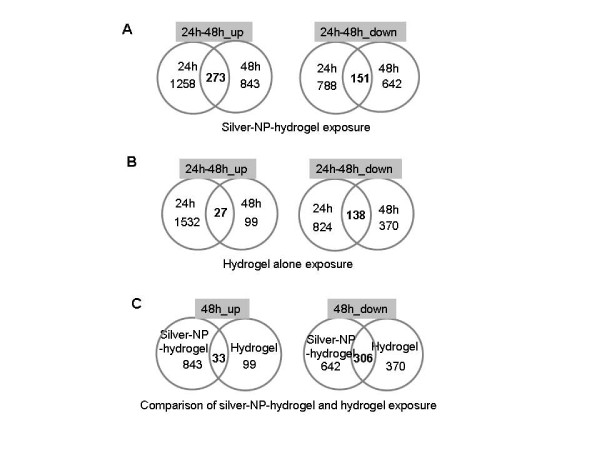
The results of global gene expression analysis in HeLa cells showed that thousands of genes were up- or down-regulated at 48 h of silver-NP-hydrogel exposure. Further GO pathway analysis suggested that fourteen theoretical activating signaling pathways were attributed to up-regulated genes; and three signal pathways were attributed to down-regulated genes. It was discussed that the cells protect themselves against silver NP-mediated toxicity through up-regulating metallothionein genes and anti-oxidative stress genes. The changes in DNA damage, apoptosis and mitosis pathway were closely related to silver-NP-induced cytotoxicity and chromosome damage. The down-regulation of CDC14A via mitosis pathway might play a role in potential genotoxicity induced by silver-NPs.
The silver-NP-hydrogel induced micronuclei formation in cellular level and broad spectrum molecular responses in gene expression level. The results of signal pathway analysis suggested that the balances between anti-ROS response and DNA damage, chromosome instability, mitosis inhibition might play important roles in silver-NP induced toxicity. The inflammatory factors were likely involved in silver-NP-hydrogel complex-induced toxic effects via JAK-STAT signal transduction pathway and immune response pathway. These biological responses eventually decide the future of the cells, survival or apoptosis.
由于纳米银颗粒(NPs)具有抗菌活性,因此它们通常被用于医疗产品和设备、食品储存材料、化妆品、各种保健品和工业产品中。各种基于银纳米颗粒的医疗器械可用于临床,例如基于银纳米颗粒的敷料和基于银纳米颗粒的水凝胶(银纳米颗粒水凝胶)用于医疗应用。尽管之前的数据表明银纳米颗粒在体内和体外具有诱导毒性作用,但关于银纳米颗粒水凝胶的生物反应和潜在毒性的机制信息还很缺乏。
在这项研究中,使用细胞有丝分裂阻断微核(CBMN)测定银纳米颗粒水凝胶的遗传毒性。使用 DNA 微阵列和 GO 途径分析研究了分子反应。
HeLa 细胞中全基因表达分析的结果表明,在银纳米颗粒水凝胶暴露 48 小时后,数千个基因被上调或下调。进一步的 GO 途径分析表明,14 个理论激活信号通路归因于上调基因;三个信号通路归因于下调基因。研究认为,细胞通过上调金属硫蛋白基因和抗氧化应激基因来保护自身免受银 NP 介导的毒性。DNA 损伤、细胞凋亡和有丝分裂途径的变化与银 NP 诱导的细胞毒性和染色体损伤密切相关。CDC14A 通过有丝分裂途径的下调可能在银 NPs 诱导的潜在遗传毒性中发挥作用。
银纳米颗粒水凝胶在细胞水平上诱导微核形成,并在基因表达水平上引起广泛的分子反应。信号通路分析的结果表明,抗 ROS 反应与 DNA 损伤、染色体不稳定性、有丝分裂抑制之间的平衡可能在银 NP 诱导的毒性中发挥重要作用。炎症因子可能通过 JAK-STAT 信号转导通路和免疫反应通路参与银纳米颗粒水凝胶复合物诱导的毒性作用。这些生物学反应最终决定了细胞的未来,是存活还是凋亡。