Laboratory of Environmental Toxicology, Chulabhorn Research Institute, Bangkok, 10210, Thailand.
Environ Health. 2012 May 2;11:31. doi: 10.1186/1476-069X-11-31.
Accumulating evidence indicates that in utero exposure to arsenic is associated with congenital defects and long-term disease consequences including cancers. Recent studies suggest that arsenic carcinogenesis results from epigenetic changes, particularly in DNA methylation. This study aimed to investigate DNA methylation changes as a result of arsenic exposure in utero and in vitro.
For the exposure in utero study, a total of seventy-one newborns (fifty-five arsenic-exposed and sixteen unexposed newborns) were recruited. Arsenic concentrations in the drinking water were measured, and exposure in newborns was assessed by measurement of arsenic concentrations in cord blood, nails and hair by Inductively Coupled Plasma Mass Spectrometry (ICP-MS). In the in vitro study, human lymphoblasts were treated with arsenite at 0-100 μM for two, four and eight hours (short-term) and at 0, 0.5 and 1.0 μM for eight-weeks period (long-term). DNA methylation was analyzed in cord blood lymphocytes and lymphoblasts treated with arsenite in vitro. Global DNA methylation was determined as LINE-1 methylation using combined bisulfite restriction analysis (COBRA) and total 5-methyldeoxycytidine (5MedC) content which was determined by HPLC-MS/MS. Methylation of p53 was determined at the promoter region using methylation-specific restriction endonuclease digestion with MspI and HpaII.
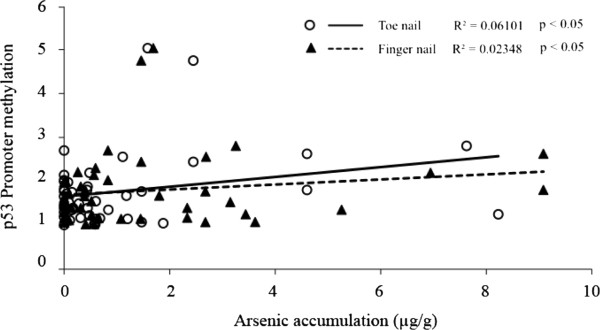
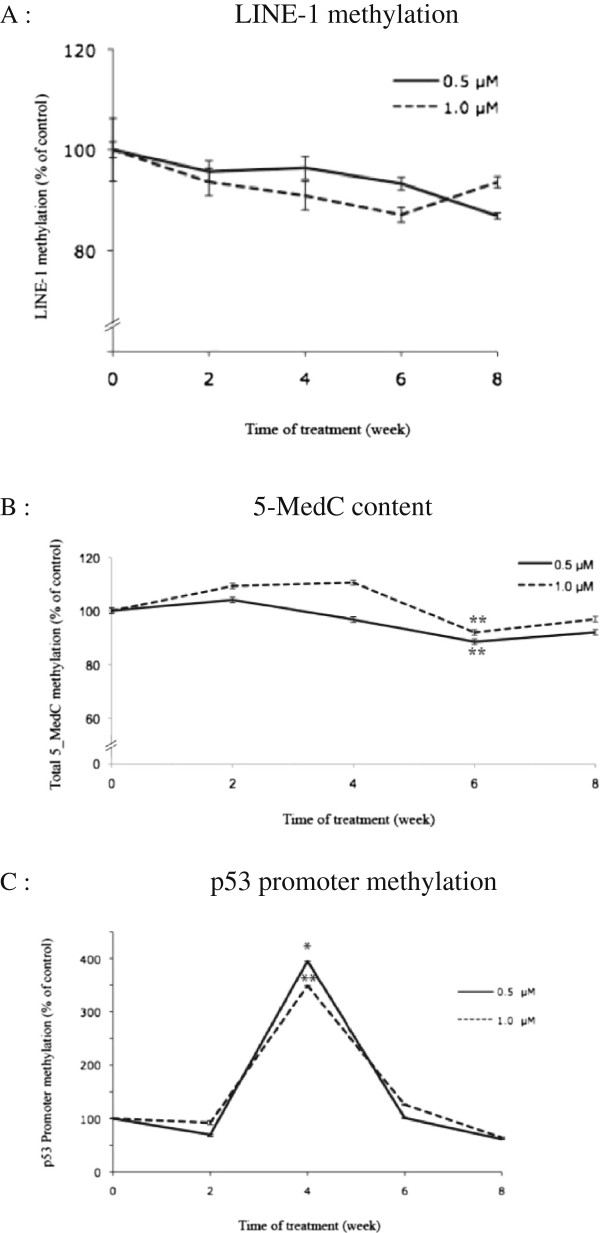
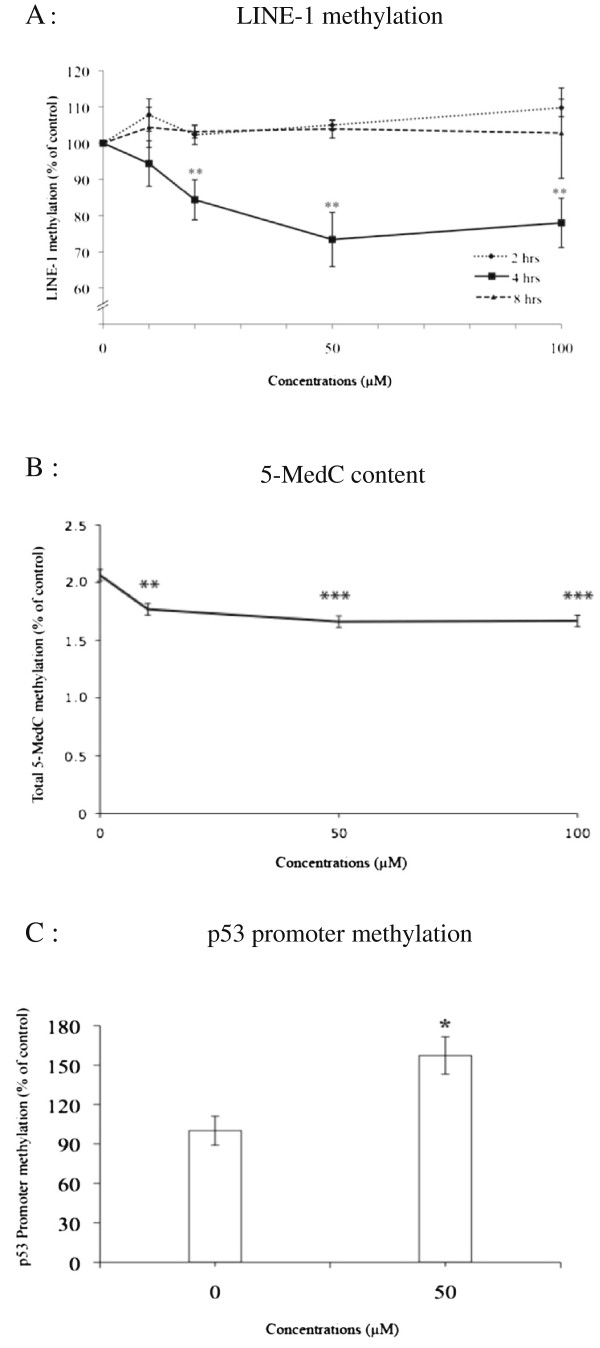
Results showed that arsenic-exposed newborns had significantly higher levels of arsenic in cord blood, fingernails, toenails and hair than those of the unexposed subjects and a slight increase in promoter methylation of p53 in cord blood lymphocytes which significantly correlated with arsenic accumulation in nails (p < 0.05) was observed, while LINE-1 methylation was unchanged. Short-term in vitro arsenite treatment in lymphoblastoid cells clearly demonstrated a significant global hypomethylation, determined as reduction in LINE-1 methylation and total 5-MedC content, and p53 hypermethylation (p < 0.05). However, a slight LINE-1 hypomethylation and transient p53 promoter hypermethylation were observed following long-term in vitro treatment.
This study provides an important finding that in utero arsenic exposure affects DNA methylation, particularly at the p53 promoter region, which may be linked to the mechanism of arsenic carcinogenesis and the observed increased incidence of cancer later in life.
越来越多的证据表明,子宫内暴露于砷与先天缺陷和长期疾病后果(包括癌症)有关。最近的研究表明,砷致癌作用是由表观遗传变化引起的,特别是 DNA 甲基化。本研究旨在探讨子宫内和体外暴露于砷导致的 DNA 甲基化变化。
对于宫内暴露研究,共招募了 71 名新生儿(55 名砷暴露新生儿和 16 名未暴露新生儿)。通过电感耦合等离子体质谱法(ICP-MS)测量饮用水中的砷浓度,并通过测量脐带血、指甲和头发中的砷浓度来评估新生儿的暴露情况。在体外研究中,用人淋巴母细胞用亚砷酸钠在 0-100μM 下处理 2、4 和 8 小时(短期),在 0、0.5 和 1.0μM 下处理 8 周(长期)。用亚砷酸钠处理脐带血淋巴细胞和体外培养的淋巴母细胞,分析 DNA 甲基化。使用联合亚硫酸氢盐限制性分析(COBRA)测定 LINE-1 甲基化作为全基因组 DNA 甲基化,并用 HPLC-MS/MS 测定总 5-甲基脱氧胞嘧啶(5MedC)含量。使用 MspI 和 HpaII 进行甲基化特异性限制性内切酶消化,在启动子区域测定 p53 的甲基化。
结果表明,与未暴露组相比,砷暴露组新生儿脐带血、指甲、脚趾甲和头发中的砷含量明显更高,且脐带血淋巴细胞中 p53 启动子甲基化略有增加,这与指甲中砷的积累明显相关(p<0.05),而 LINE-1 甲基化无变化。体外短期亚砷酸钠处理淋巴母细胞细胞明显导致全基因组低甲基化,表现为 LINE-1 甲基化和总 5-MedC 含量降低,以及 p53 高甲基化(p<0.05)。然而,在长期体外处理后,观察到轻微的 LINE-1 低甲基化和短暂的 p53 启动子高甲基化。
本研究提供了一个重要发现,即子宫内暴露于砷会影响 DNA 甲基化,特别是在 p53 启动子区域,这可能与砷致癌作用的机制以及后来观察到的癌症发病率增加有关。