Kaushal Akhilesh, Zhang Hongmei, Karmaus Wilfried J J, Everson Todd M, Marsit Carmen J, Karagas Margaret R, Tsai Shih-Fen, Wen Hui-Ju, Wang Shu-Li
Division of Epidemiology, Biostatistics, and Environmental Health, University of Memphis, Memphis, TN, 38152, USA.
Department of Environmental Health, Rollins School of Public Health, Emory University, Atlanta, GA, USA.
Environ Health. 2017 May 30;16(1):50. doi: 10.1186/s12940-017-0262-0.
In utero arsenic exposure may alter fetal developmental programming by altering DNA methylation, which may result in a higher risk of disease in later life. We evaluated the association between in utero arsenic exposure and DNA methylation (DNAm) in cord blood and its influence in later life.
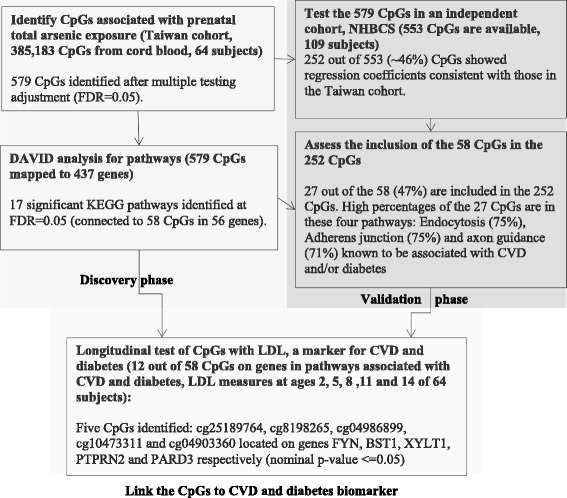
Genome-wide DNA methylation in cord blood from 64 subjects in the Taiwanese maternal infant and birth cohort was analyzed. Robust regressions were applied to assess the association of DNA methylation with in utero arsenic exposure. Multiple testing was adjusted by controlling false discovery rate (FDR) of 0.05. The DAVID bioinformatics tool was implemented for functional annotation analyses on the detected CpGs. The identified CpGs were further tested in an independent cohort. For the CpGs replicated in the independent cohort, linear mixed models were applied to assess the association of DNA methylation with low-density lipoprotein (LDL) at different ages (2, 5, 8, 11 and 14 years).
In total, 579 out of 385,183 CpGs were identified after adjusting for multiple testing (FDR = 0.05), of which ~60% were positively associated with arsenic exposure. Functional annotation analysis on these CpGs detected 17 KEGG pathways (FDR = 0.05) including pathways for cardiovascular diseases (CVD) and diabetes mellitus. In the independent cohort, about 46% (252 out of 553 CpGs) of the identified CpGs showed associations consistent with those in the study cohort. In total, 11 CpGs replicated in the independent cohort were in the pathways related to CVD and diabetes mellitus. Via longitudinal analyses, we found at 5 out of the 11 CpGs methylation was associated with LDL over time and interactions between DNA methylation and time were observed at 4 of the 5 CpGs, cg25189764 (coeff = 0.157, p-value = 0.047), cg04986899 (coeff. For interaction [coeff.int] = 0.030, p-value = 0.024), cg04903360 (coeff.int = 0.026, p-value = 0.032), cg08198265 (coeff.int = -0.063, p-value = 0.0021), cg10473311 (coeff.int = -0.021, p-value = 0.027).
In utero arsenic exposure was associated with cord blood DNA methylation at various CpGs. The identified CpGs may help determine pathological epigenetic mechanisms linked to in utero arsenic exposure. Five CpGs (cg25189764, cg04986899, cg04903360, cg08198265 and cg10473311) may serve as epigenetic markers for changes in LDL later in life.
子宫内砷暴露可能通过改变DNA甲基化来改变胎儿发育编程,这可能导致日后患疾病的风险更高。我们评估了子宫内砷暴露与脐带血中DNA甲基化(DNAm)之间的关联及其对日后生活的影响。
对台湾母婴和出生队列中64名受试者的脐带血进行全基因组DNA甲基化分析。应用稳健回归评估DNA甲基化与子宫内砷暴露的关联。通过控制错误发现率(FDR)为0.05来调整多重检验。使用DAVID生物信息学工具对检测到的CpG进行功能注释分析。在一个独立队列中对鉴定出的CpG进行进一步测试。对于在独立队列中重复出现的CpG,应用线性混合模型评估不同年龄(2、5、8、11和14岁)时DNA甲基化与低密度脂蛋白(LDL)的关联。
在调整多重检验(FDR = 0.05)后,共鉴定出385,183个CpG中的579个,其中约60%与砷暴露呈正相关。对这些CpG的功能注释分析检测到17条KEGG通路(FDR = 0.05),包括心血管疾病(CVD)和糖尿病的通路。在独立队列中,约46%(553个CpG中的252个)鉴定出的CpG显示出与研究队列中一致的关联。在独立队列中重复出现的11个CpG总共位于与CVD和糖尿病相关的通路中。通过纵向分析,我们发现11个CpG中的5个CpG甲基化随时间与LDL相关,并且在5个CpG中的4个观察到DNA甲基化与时间之间的相互作用,即cg25189764(系数 = 0.157,p值 = 0.047)、cg04986899(相互作用系数[coeff.int] = 0.030,p值 = 0.024)、cg04903360(coeff.int = 0.026,p值 = 0.032)、cg08198265(coeff.int = -0.063,p值 = 0.0021)、cg10473311(coeff.int = -0.021,p值 = 0.027)。
子宫内砷暴露与多种CpG处的脐带血DNA甲基化相关。鉴定出的CpG可能有助于确定与子宫内砷暴露相关的病理表观遗传机制。五个CpG(cg25189764、cg04986899、cg04903360、cg08198265和cg10473311)可能作为日后生活中LDL变化的表观遗传标记。