Virology Unit, Department of Biomedical Sciences, Institute of Tropical Medicine of Antwerp, Antwerp, Belgium.
Retrovirology. 2012 May 2;9:36. doi: 10.1186/1742-4690-9-36.
Binding of the viral envelope protein (Env), and particularly of its gp120 subunit, to the cellular CD4 receptor is the first essential step of the HIV-1 entry process. The CD4 binding site (CD4bs) of gp120, and especially a recessed cavity occupied by the CD4 Phe43 residue, are known to be highly conserved among the different circulating subtypes and therefore constitute particularly interesting targets for vaccine and drug design. The miniCD4 proteins are a promising class of CD4bs inhibitors. Studying virus evolution under pressure of CD4bs inhibitors could provide insight on the gp120-CD4 interaction and viral entry.
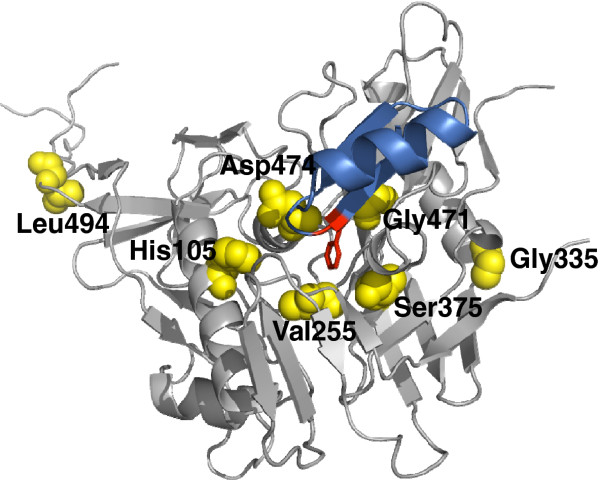
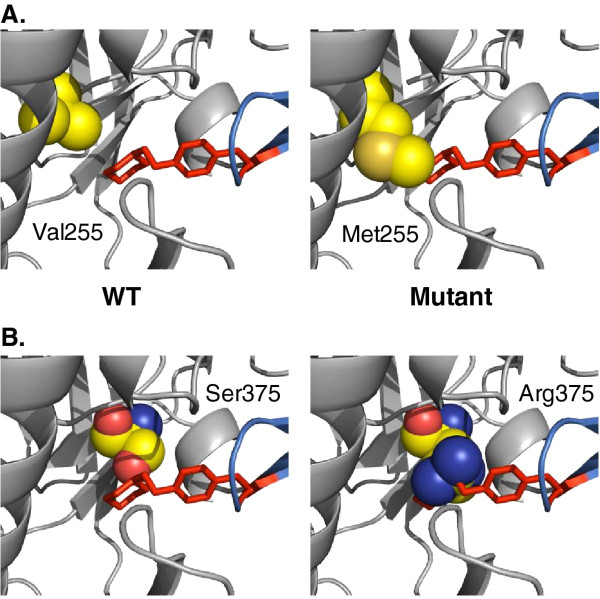
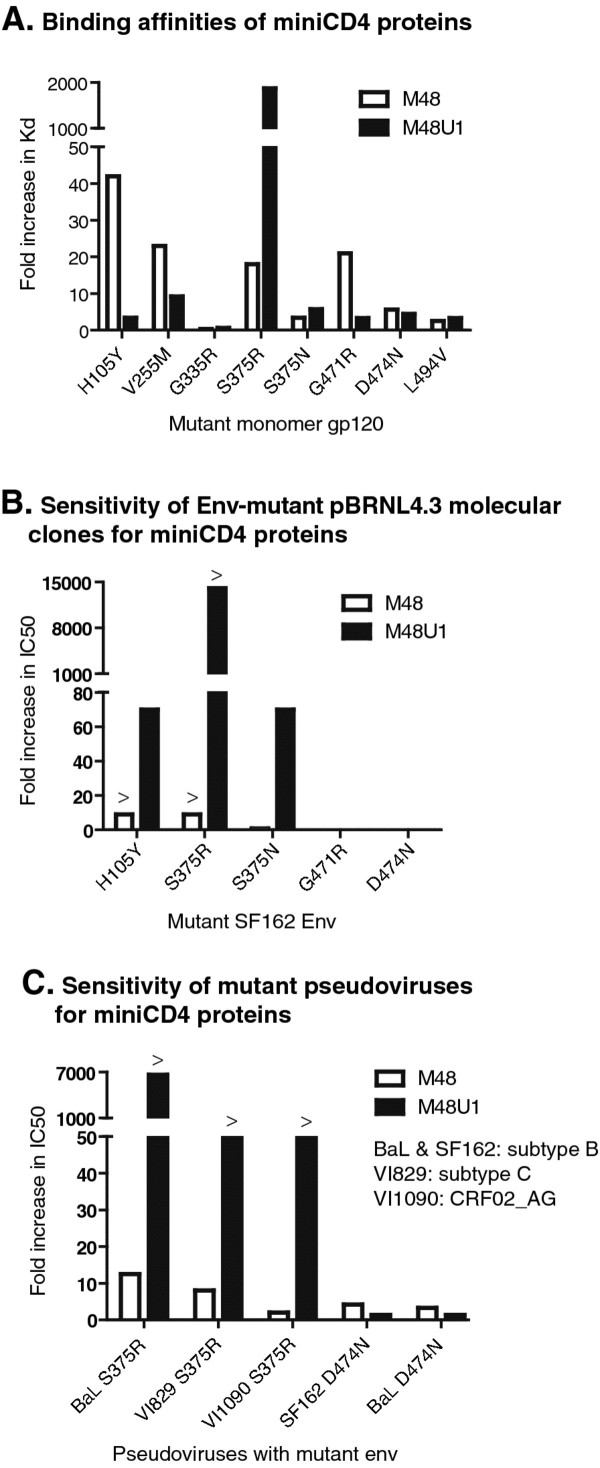
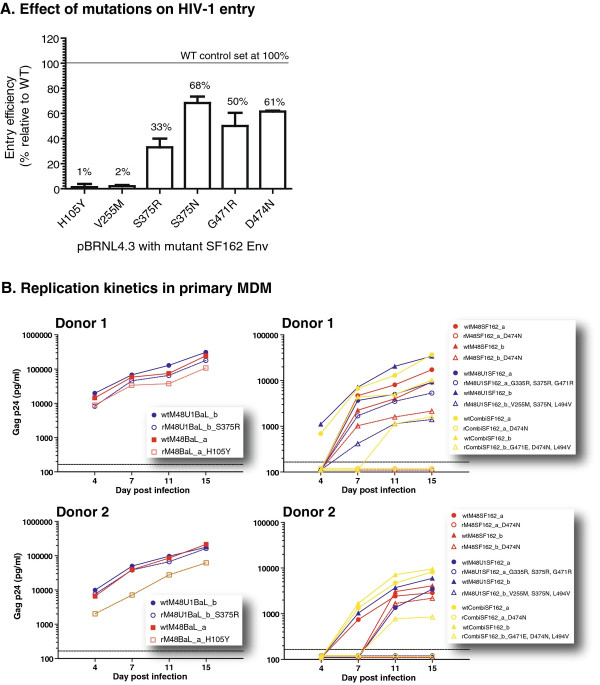
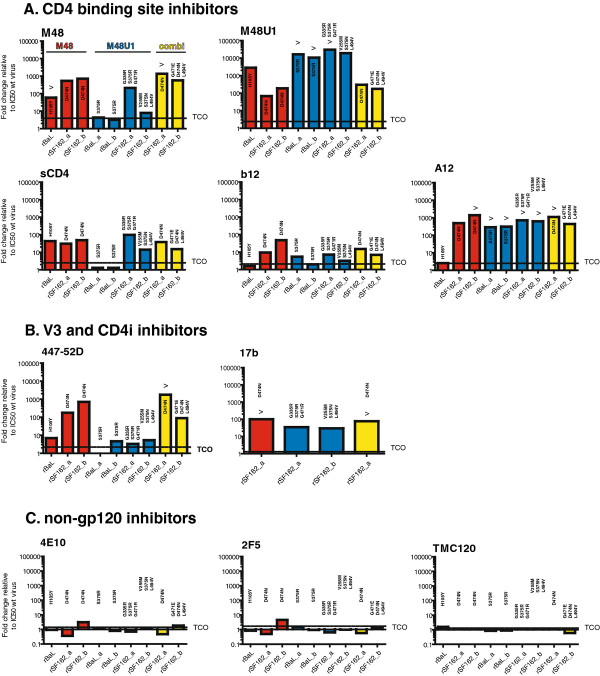
The present study reports on the resistance induction of two subtype B HIV-1 against the most active miniCD4, M48U1, and its ancestor, M48, and how these mutated positions affect CD4bs recognition, entry efficiency, and sensitivity to other CD4bs inhibitors. Resistance against M48U1 was always associated with S375R/N substitution in both BaL and SF162; M48 resistance was associated with D474N substitution in SF162 and with H105Y substitution in BaL. In addition, some other mutations at position V255 and G471 were of importance for SF162 resistant viruses. Except for 474, all of these mutated positions are conserved, and introducing them into an SF162 Env expressing infectious molecular clone (pBRNL4.3 SF162) resulted in decreased entry efficiency. Furthermore, resistant mutants showed at least some cross-resistance towards other CD4bs inhibitors, the V3 monoclonal antibody 447-52D and some even against the monoclonal antibody 17b, of which the epitope overlaps the co-receptor binding site.
The mutations H105Y, V255M, S375R/N, G471R/E, and D474N are found to be involved in resistance towards M48 and M48U1. All mutated positions are part of, or in close proximity to, the CD4bs; most are highly conserved, and all have an impact on the entry efficiency, suggesting their importance for optimal virus infectivity.
病毒包膜蛋白(Env)的结合,特别是其 gp120 亚基与细胞 CD4 受体的结合,是 HIV-1 进入过程的第一步。gp120 的 CD4 结合位点(CD4bs),特别是由 CD4 Phe43 残基占据的凹陷腔,在不同的循环亚型中高度保守,因此是疫苗和药物设计的特别有趣的靶点。迷你 CD4 蛋白是一类有前途的 CD4bs 抑制剂。在 CD4bs 抑制剂的压力下研究病毒进化,可以深入了解 gp120-CD4 相互作用和病毒进入。
本研究报告了两种 B 亚型 HIV-1 对最活跃的迷你 CD4(M48U1)及其前体 M48 的耐药诱导情况,以及这些突变位置如何影响 CD4bs 识别、进入效率和对其他 CD4bs 抑制剂的敏感性。M48U1 的耐药性总是与 BaL 和 SF162 中的 S375R/N 取代有关;M48 的耐药性与 SF162 中的 D474N 取代和 BaL 中的 H105Y 取代有关。此外,V255 和 G471 位置的其他一些突变对 SF162 耐药病毒也很重要。除了 474 之外,所有这些突变位置都是保守的,将它们引入表达传染性分子克隆(pBRNL4.3 SF162)的 SF162 Env 中,会导致进入效率降低。此外,耐药突变体对其他 CD4bs 抑制剂至少表现出一定的交叉耐药性,V3 单克隆抗体 447-52D,甚至对单克隆抗体 17b 也有耐药性,后者的表位与共受体结合位点重叠。
H105Y、V255M、S375R/N、G471R/E 和 D474N 突变被发现与 M48 和 M48U1 的耐药性有关。所有突变位置都在 CD4bs 内或附近;大多数位置高度保守,且都对进入效率有影响,这表明它们对病毒最佳感染性很重要。