USDA Agricultural Research Service, Center for Grain and Animal Health Research, Manhattan, Kansas, United States of America.
PLoS One. 2012;7(4):e34624. doi: 10.1371/journal.pone.0034624. Epub 2012 Apr 25.
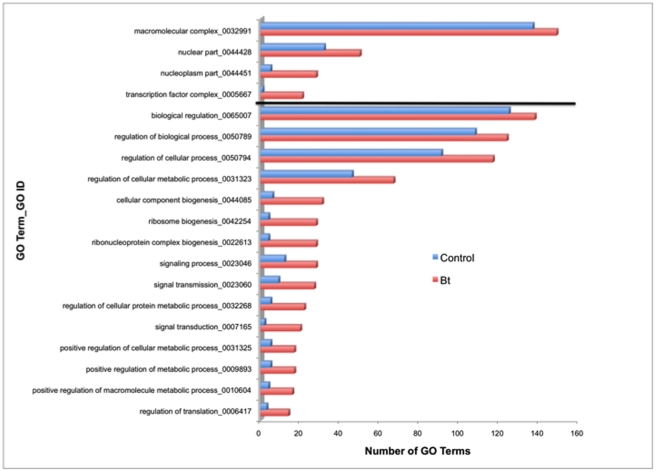
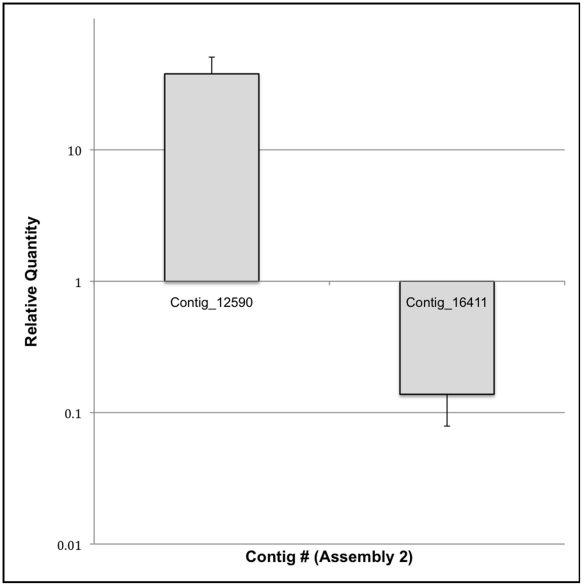
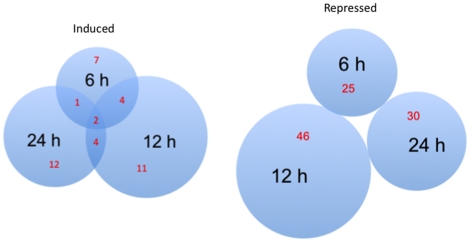
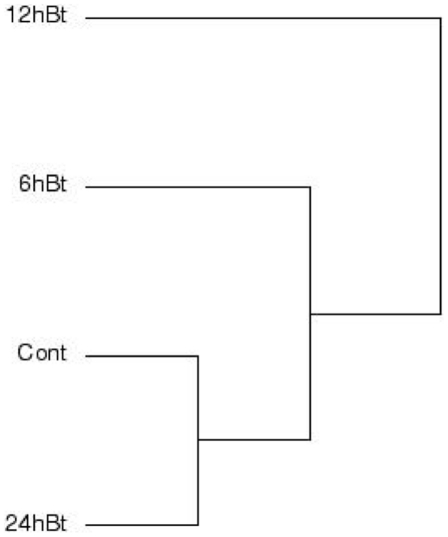
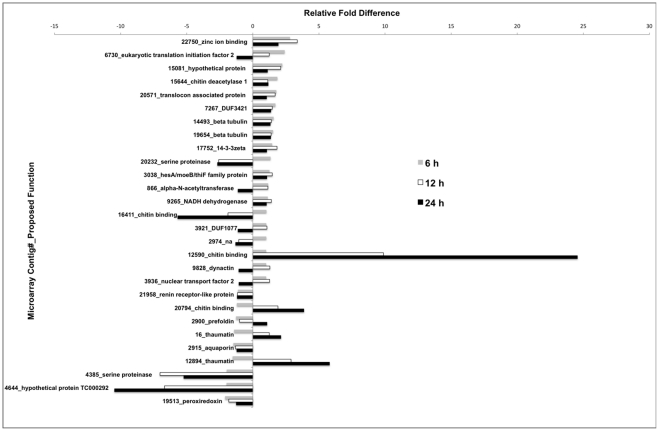
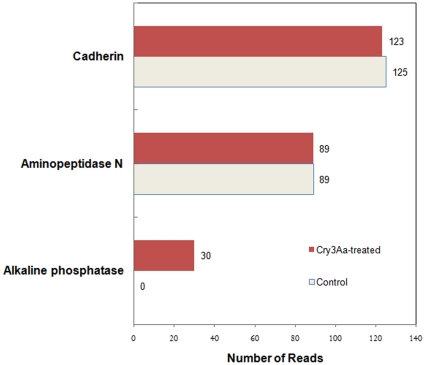
Bacillus thuringiensis (Bt) crystal (Cry) proteins are effective against a select number of insect pests, but improvements are needed to increase efficacy and decrease time to mortality for coleopteran pests. To gain insight into the Bt intoxication process in Coleoptera, we performed RNA-Seq on cDNA generated from the guts of Tenebrio molitor larvae that consumed either a control diet or a diet containing Cry3Aa protoxin. Approximately 134,090 and 124,287 sequence reads from the control and Cry3Aa-treated groups were assembled into 1,318 and 1,140 contigs, respectively. Enrichment analyses indicated that functions associated with mitochondrial respiration, signalling, maintenance of cell structure, membrane integrity, protein recycling/synthesis, and glycosyl hydrolases were significantly increased in Cry3Aa-treated larvae, whereas functions associated with many metabolic processes were reduced, especially glycolysis, tricarboxylic acid cycle, and fatty acid synthesis. Microarray analysis was used to evaluate temporal changes in gene expression after 6, 12 or 24 h of Cry3Aa exposure. Overall, microarray analysis indicated that transcripts related to allergens, chitin-binding proteins, glycosyl hydrolases, and tubulins were induced, and those related to immunity and metabolism were repressed in Cry3Aa-intoxicated larvae. The 24 h microarray data validated most of the RNA-Seq data. Of the three intoxication intervals, larvae demonstrated more differential expression of transcripts after 12 h exposure to Cry3Aa. Gene expression examined by three different methods in control vs. Cry3Aa-treated larvae at the 24 h time point indicated that transcripts encoding proteins with chitin-binding domain 3 were the most differentially expressed in Cry3Aa-intoxicated larvae. Overall, the data suggest that T. molitor larvae mount a complex response to Cry3Aa during the initial 24 h of intoxication. Data from this study represent the largest genetic sequence dataset for T. molitor to date. Furthermore, the methods in this study are useful for comparative analyses in organisms lacking a sequenced genome.
苏云金芽孢杆菌(Bt)晶体(Cry)蛋白对一些特定的昆虫害虫有效,但需要改进以提高效率并缩短鞘翅目害虫的致死时间。为了深入了解鞘翅目昆虫中 Bt 的中毒过程,我们对食用对照饮食或含有 Cry3Aa 原毒素的饮食的黄粉虫幼虫的肠道 cDNA 进行了 RNA-Seq 分析。来自对照和 Cry3Aa 处理组的大约 134090 和 124287 个序列读段分别组装成 1318 和 1140 个连续序列。富集分析表明,Cry3Aa 处理幼虫中与线粒体呼吸、信号转导、细胞结构维持、膜完整性、蛋白质回收/合成以及糖苷水解酶相关的功能显著增加,而与许多代谢过程相关的功能减少,特别是糖酵解、三羧酸循环和脂肪酸合成。微阵列分析用于评估 Cry3Aa 暴露 6、12 或 24 小时后基因表达的时间变化。总体而言,微阵列分析表明,Cry3Aa 中毒幼虫中诱导了与过敏原、几丁质结合蛋白、糖苷水解酶和微管蛋白相关的转录本,而与免疫和代谢相关的转录本则受到抑制。24 小时微阵列数据验证了大多数 RNA-Seq 数据。在三个中毒间隔中,幼虫在 12 小时暴露于 Cry3Aa 后表现出更多的转录本差异表达。在 24 小时时间点,用三种不同方法在对照与 Cry3Aa 处理幼虫中检查的基因表达表明,在 Cry3Aa 中毒幼虫中,编码具有几丁质结合结构域 3 的蛋白的转录本表达差异最大。总体而言,数据表明黄粉虫幼虫在最初 24 小时的中毒过程中对 Cry3Aa 产生了复杂的反应。本研究的数据代表了迄今为止黄粉虫最大的遗传序列数据集。此外,本研究中的方法对于缺乏测序基因组的生物体的比较分析是有用的。